Lawsuits pile up over HUD mixed-status rule as AGs sue to block crackdown on immigrant tenants
Nov 23, 2026 | 4:51 pm ET
Description
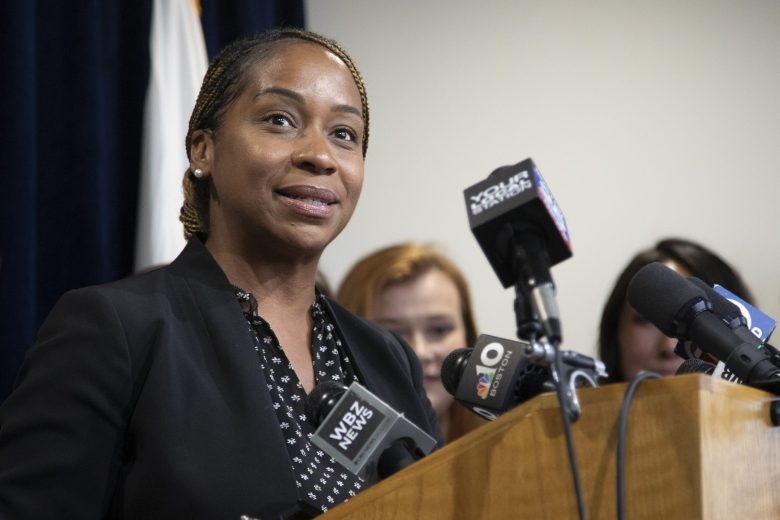
Attorney General Andrea Campbell speaks at a press conference on August 26, 2026 to announce a landmark settlement with social media giant Meta.
THE US DEPARTMENT of Housing and Urban Development is facing yet another legal challenge to a rule that would require households receiving federal housing assistance to prove that every member has citizenship or eligible immigration status.
Days after a coalition of public tenant advocates and residents filed a federal class-action lawsuit on behalf of mixed-status families whose housing is endangered by the new rule, a coalition of 22 state attorneys general dropped their own suit Monday arguing that the change illegally reverses nearly 30 years of federal policy.
The rule “leaves families no real choice because they must either break apart, forcing ineligible members out of the home so that the rest of the family can keep its HUD assistance, or be driven out of assisted housing altogether, at grave risk of homelessness,” wrote the tenant and public housing group in its complaint. “Families forced out of assisted housing will be thrown into a housing market that is already desperately short of affordable units.”
Both suits argue that the “arbitrary and capricious” rule change exceeded the agency’s authority and violated federal law, including the Administrative Procedure Act.
The tenants also claim that the rule and requirement that residents produce substantial documentation violate the equal protection and due process guarantees of the Fifth Amendment to the US Constitution.
Since 1996, Congress has allowed families whose members have different legal immigration statuses to live in federally funded housing so long as the assistance was pro-rated so that only eligible household members received support.
“HUD’s final rule fully implements the 1980 Housing and Community Development Act and ends the exploitation of taxpayer dollars,” HUD Secretary Scott Turner said in a statement Monday evening. “This rule guarantees ONLY AMERICAN citizens and certain eligible noncitizens will reside in HUD-funded housing. This change represents a reallocation of up to $218 million which will now go to eligible Americans that are currently on a waitlist.”
Turner said earlier this month that the rule change reflects that “the federal government is not good at providing housing,” and long-term subsidies are “not the way that it’s intended to be.
The attorneys general argue what HUD wants is irrelevant.
“Federal financial assistance is not a slush fund that executive agencies can redirect at will to the groups they favor,” they assert in the complaint. “HUD is charged with administering a statutory scheme in furtherance of Congress’s goals, which are clear: Congress seeks to ensure a decent home and suitable living environment for all American families, and Congress’s definition includes mixed- status families.”
Tenants and the attorneys general are asking a Massachusetts federal judge to declare the rule unlawful, strike it down, and block HUD from implementing or enforcing it against the states, their local governments, and their public housing authorities.
Around 20,000 mixed-status families, totaling 78,100 people, could lose their housing assistance under the new rule. The state prosecutors note that this estimate includes 55,000 people who are fully eligible for federal housing assistance, many of whom are children and seniors. In Massachusetts, about 910 households would likely be impacted.
One of the class-action plaintiffs is a Massachusetts mother of four. She has lived in the country for 15 years and is currently authorized to live and work in Massachusetts, but her immigration status is not among those deemed eligible. She lives in a Section 8 subsidized apartment with her four children, all of them 12 or younger and three of them US citizens.
“Under the mixed-status rule challenged in this case, the family would lose their housing subsidy entirely,” the suit asserts. Because her “citizen children cannot live independently from her, the family would face eviction and homelessness.”
The City of Boston announced on Monday that the city and the Boston Housing Authority were also suing HUD. More than 500 Boston families could have federal housing assistance stripped away, according to city officials.
“Almost every family we house at the Boston Housing Authority has previously suffered through a period of homelessness,” said Kenzie Bok, administrator of the Boston Housing Authority. “These are Boston kids, they are eligible for federal housing in their own right, and they deserve to stay safely in their homes.”
The lawsuit, also filed in the District Court of Massachusetts, is brought by public housing authorities including Boston, New York, San Francisco, and Chicago.
The rule, the cities argue, is “callous, ill-conceived, and illegal. It radically departs from statutory authority, congressional intent, and prior regulations, all of which permit mixed status families to remain in federally subsidized housing and access prorated assistance.”
Lawyers and advocates cautioned that although the new rule is set to take effect on December 14, that does not mean immediate withdrawal of benefits. Housing authorities would have about a month to begin sending out notifications to impacted families. Those families would then have until March 14 to verify the eligibility of every family member.
Zafiro Patiño, director of organizing for the Massachusetts Union of Public Housing Tenants, one of the groups in the class- action suit, urged families to be prepared but patient.
“We are basically saying to people, ‘Do not sign anything yet.’ The law still is the same, so do not panic,” she said. The group has already heard that some housing authorities are already sending out notices, which Patiño expects will spook many households.
The class-action group emphasized that a severe regulatory burden will land on tenants and housing authorities if the rule takes effect. “We expect that the housing authorities already are feeling terrorized with this because they have a lot of work,” said Patiño, “and now it’s going to be even more.”
HUD’s impact review estimates that sheltering people displaced by the rule could cost state and local governments between $20,000 and $50,000 per person each year.
About 8.8 million tenants across the country will be impacted, because all tenants would have to verify their status, said Annette Duke, a senior housing attorney at the Mass Law Reform Institute.
That burden, she noted, will fall disproportionately on people of color, women, children, and people with disabilities.
“The rule really seeks to divide the communities,” she said, “and what’s great is this lawsuit shows that people are standing together to fight this.”
Updated November 23, 6:35 p.m. — This story has been updated with comment from HUD.
Boston