Landry can court Texas talent but also needs to show some homefield love
Nov 20, 2026 | 2:42 pm ET
Description
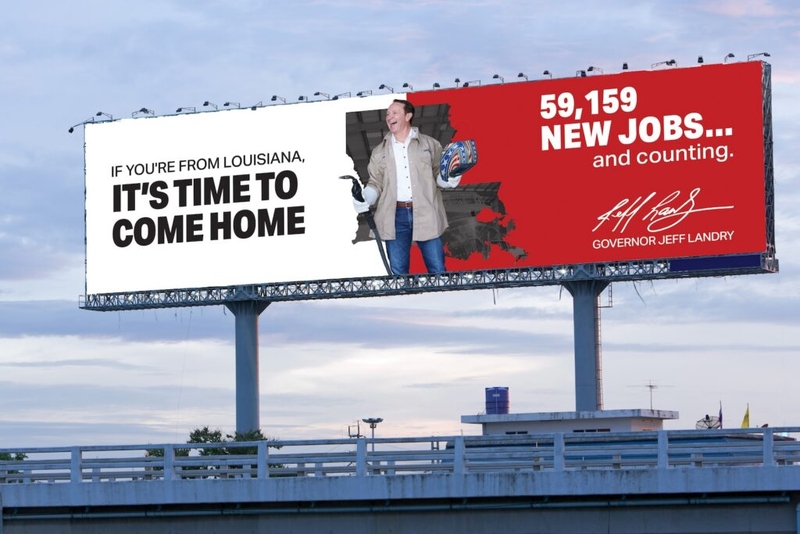
Louisiana officials have placed billboards along Interstate 10 in Houston to lure Texas workers and businesses. (Photo courtesy Louisiana Economic Development.
Like other LSU fans, Gov. Jeff Landry and Louisiana Economic Development Secretary Susan Bourgeois probably suffered heartbreak last Saturday when University of Texas quarterback Arch Manning connected with receiver Raleek Brown for a touchdown in the closing seconds to escape Tiger Stadium with a win.
The governor is clearly invested in LSU football, having orchestrated the exit of coach Brian Kelly to make way for Lane Kiffin. Bourgeois earned her bachelor’s degree from the university.
But with the loss to the Longhorns still sinking in, you have to wonder if either official was having any “just you wait” thoughts in the back of their minds, knowing that Louisiana was about to launch a full frontal recruiting assault on the Lone Star State. Not for football talent but for its businesses and workforce.
The governor’s office announced Wednesday it was “extending an open invitation to Texas companies and talent to take a look next door following recent elections that brought a significant shift in the state’s political leadership.”
The Nov. 3 vote in Texas saw the ouster of Republican Gov. Gregg Abbott in favor of Democrat Gina Hinojosa, and President Donald Trump’s endorsed U.S. Senate candidate, disgraced state Attorney General Ken Paxton, lost decisively to another Democrat, James Talarico.
Louisiana leaders are responding to the new landscape by placing billboards along Interstate 10 East in Houston. They feature a photo of Landry, with a beaming smile as he holds a welding torch and mask, and a frank message: “If you’re from Louisiana, it’s time to come home” on one side of the governor, and “59,159 new jobs … and counting” on the other.
The campaign also includes a full-page ad in the Houston Business Journal “aimed at business leaders and corporate decision-makers.” The entire effort will cost $40,000 to $50,000 and will come from Louisiana Economic Development’s marketing budget, an agency spokesperson said.
Over the past two weeks, the governor has repeatedly referenced Texas’ election results as an economic development opportunity for Louisiana.
“Elections have consequences, and business leaders pay attention to the direction a state is headed,” Landry said in a news release.
His billboards were announced the day after Leaders for a Better Louisiana, a pro-business nonprofit, released a report saying the state will need 42,000 industrial construction workers to handle the peak workload for the 12 major industrial and technology projects planned statewide. The demand will be particularly acute in Lake Charles, Lafayette and Monroe, where the report says they will be roughly 19,000 workers short of what’s needed.
Richard Nelson, leader of the state’s community and technical college system, said in September the demand for trained personnel is so high that its 12 schools would have to double their enrollment for Louisiana residents to fill the available jobs. The system enrolls more than 100,000 students annually and awards 30,000 degrees and certificates each year.
Landry’s latest moves are certainly a shot across the bluebonnet bow of our neighbors to the west, but there are still major gaps that Louisiana isn’t likely to close in the immediate future.
For starters, Texas has no corporate or personal income tax.
Landry was behind efforts to establish flat income tax rates in Louisiana, and he said earlier this year he wants them to go away entirely. But doing so would likely require an increase in other state taxes, including a sales tax that’s already the highest in the country when combined with local levies.
Plus, Louisiana is one of the poorest states in the country. Even if lawmakers are willing to lean more into sales taxes (they aren’t), there’s simply not the ability or appetite to make up for the loss of income taxes with more consumption of taxable goods and services. Each 0.5% drop in the state income taxes eliminates roughly $500 million in government revenue annually, according to legislative calculations.
There are other reasons people move to another state besides work Landry also has to confront.
Louisiana is starting to see improvements in reading and math scores at the elementary level, but most overall public education rankings place Louisiana among the bottom five states. By comparison, Texas lands in the middle of the pack for its K-12 schools.
Healthcare is another area where Louisiana has been a consistent cellar dweller, with its substandard maternal and infant health being singled out again just this week. Texas doesn’t do much better, but it still outperforms Louisiana in a metric that’s important to the working-class families and business owners who Landry wants to pull up stakes and head east.
It’s understandable that the governor is getting creative to address a looming workforce shortage, but there are myriad matters here at home that, if improved, would go a long way toward building and retaining a homegrown talent pool to support an economic boom. Add affordable housing and insurance, clean air and better infrastructure to the concerns already mentioned.
Louisiana can and should lay out its welcome mat, but leaders can’t ignore why so many residents have departed — almost 237,000 over the past 10 years based on U.S. Census data.
Like New Orleans native Arch Manning, these departures have a way of coming back to bite us in the butt.
Baton Rouge, LA