Analyzing Utah’s blue wave: Many Republicans didn’t turn out; others crossed over to vote blue
Nov 20, 2026 | 7:02 am ET
Description
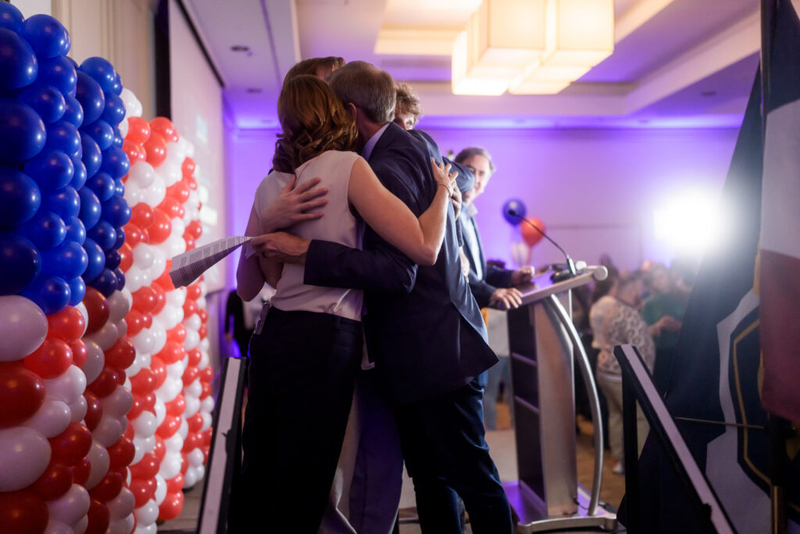
Ben McAdams hugs family members after talking to supporters during an election night party for Democrats at the Hilton in Salt Lake City on Tuesday, Nov. 3, 2026. (Photo by Spenser Heaps for Utah News Dispatch)
A new report is shedding light on how Utahns’ voting patterns contributed to this year’s blue wave election, even in typically ruby red Utah.
The biggest factors are twofold: First, many Republicans — especially MAGA supporters loyal to President Donald Trump — simply didn’t turn out. And second, more Republican leaners and independents crossed over to vote for Democrats.

That’s according to an analysis written by Brigham Young University political science professor Quin Monson for the university’s Center for the Study of Elections and Democracy.
“The biggest cause, as far as I can tell from the data between the results for U.S. House in Utah (from) 2024 to 2026, is a drop off in turnout among the Trump Republicans,” Monson told Utah News Dispatch on Thursday. “The next biggest cause is some crossover voting.”
Monson analyzed Utah’s 2024 and 2026 U.S. House election results and compared surveys of Utah voters conducted by BYU’s Center for the Study of Elections and Democracy in both election years. In 2024, 6,513 Utah voters participated, while 5,230 participated in this year’s survey.
Monson stressed that the data doesn’t show a trend indicating voters switching political parties or identities — but rather they changed who they voted for.
“Somebody voting for a Democrat does not mean that they’ve become a Democrat,” he said. “They’re very different. Crossover voting does not mean Republicans are becoming Democrats. It means that they’re fed up with Republican voting and they voted Democratic for a number of potential reasons.”
‘Blue tsunami’ hits Utah: House Republicans on pace to lose 17 seats, breaking supermajority
But the bigger difference between 2024 and 2026 in Utah, he said, “is some of the most loyal MAGA Republicans just didn’t show up” this year.
Three takeaways stand out from Monson’s analysis:
- The Republican share of the electorate got smaller in 2026: Counting independents who identify as leaning GOP, Republicans fell from 63% of congressional voters in 2024 to 52% in 2026. Meanwhile, Democrats rose from 29% in 2024 to 38% in 2026, and those who identify as pure independents rose from 7% to 10%. And the biggest single drop in participation was among those who identify as “strong” Republicans, from 35% to 28%.
- The middle moved: Independents went from a near tie (43% voting Democratic, and 39% voting Republican) in 2024 to clearly favoring Democrats (57% to 22%) in 2026. The share of those who identify as “lean” and “weak” Republicans voting Democratic roughly doubled, from under 1 in 10 in 2024 to about 1 in 6 in 2026.
- The strongest partisans didn’t move: Those who identify as “strong” Republicans gave their party’s candidates 96% in 2024 and 94% in 2026. “Strong” Democrats stayed at 97% in 2024 and 98% in 2026.
“Most of the Democratic gain came from a different mix of voters, not from Republicans switching sides,” Monson wrote in the report.
While Democrats won 33% of the statewide congressional vote in 2024, that jumped to 47% in 2026. Meanwhile, Republican candidates fell from 62% in 2024 to 47% in 2026, “leaving the two parties essentially tied,” the report says.
Utah Gov. Cox: Republicans ‘suffered a historic defeat.’ Now, he says they have to ‘listen’
Monson concluded that voting behavior changed “mostly in the middle.”
“Independents and Republicans with looser party ties moved toward Democrats in their voting behavior,” he wrote. “Strong Republicans and strong Democrats voted for their own party at almost exactly the same rates as in 2024.”
Republicans who crossed over, he wrote, were “traditional” Republicans, not MAGA supporters, with virtually no Republicans who identified with the MAGA movement voting for a Democrat for Congress.
Notably, Monson also found that voters who identified as active members of Utah’s predominant faith, The Church of Jesus Christ of Latter-day Saints, “moved toward voting for Democrats as much or more than other voters.”
“The religious makeup of the electorate barely changed, but active Latter-day Saints more than doubled their Democratic vote, from 13% to 28%,” Monson wrote. “This shift is likely a result of 2024 Trump voters turning out at a lower rate in 2026, though some Latter-day Saint Republicans also crossed over to vote for Democrats.”
What caused MAGA voters to stay home, and why did some in the middle cross over?
Monson said the “why” behind Utah’s blue wave could have many reasons: maybe middle-ground voters were turned off by Trump politics or they weren’t energized to go to the polls because it was a fairly “boring” election with no statewide races.
Utah, he said, is “just part of the national story,” with a blue tsunami that washed over the entire country.
Utah House Democrats shake up leadership after the blue wave doubled their caucus
“We’re not the only place that saw the tidal wave hit,” he said.
But for the state, it was a “relatively sleepy year,” he said. “And I think the Trump Republicans, some of them at least, are a little discouraged. The president’s got us in a war, the economy’s not great, gas prices are high … I mean there’s a lot of reasons played out nationally that this isn’t the most exciting time.”
“Another reason, potentially, is that these Trump Republicans, the ones that didn’t show up, are probably also the segment of the Trump Republicans that are just kind of less engaged in politics generally,” he said. “So a sleepy midterm election just doesn’t get their attention.”
To Monson, Utah’s blue wave boils down to low turnout for Republicans and “slightly more defection than you would normally see.”
“Then you mix that in with, you know, the Democrats in Utah did a pretty good job of recruiting candidates to run for the state legislature in targeted races,” he said. “I don’t think anyone realized in advance just how big of a deal it would be. But you’ve got to give the Democrats credit for having competent opponents on the ballot, ready to capitalize and take the votes.”
He said an opposing minority party has to have candidates on the ballot poised to strike if “the majority party stumbles.”
“And the Republicans in Utah got caught a little bit complacent and just a little bit in the vortex of a Trump meltdown, basically,” he said.
Why did some Latter-day Saints cross over?
Monson said it appears active Latter-day Saints that were willing to vote for Democrats are “for whatever reason, the ones that haven’t been captured by the Trump identity.”
“So I think that makes them more open to crossing over,” he said. “They’re more easily able to see the problems with the Trump administration and the problems with candidates that are too closely aligned with Trump, and maybe also just have sort of reached the end of their patience with the politics that comes out of that wing of the Republican party.”
In a closed-door vote, Republicans pick Sen. Evan Vickers to be next Senate president
But Monson said the data shouldn’t be interpreted to assume that most “Latter-day Saints are ready to vote Democratic.”
“Maybe over the next 20 to 30 years we’ll see an incremental shift, because that’s how it would happen,” he said.
But it’s too soon to say whether this year’s election is part of a larger trend.
“It’s not something that happens in a single election, ever,” he said. “It’s going to happen over time.”
“The gains are small and incremental, and they’re also contingent upon things continuing along the lines that they have for the last 10 years,” he said. “If the Republican party continues to be dominated by Donald Trump or Donald Trump-like politicians … and the Democrats are able to nominate, in Utah and nationally, left to center (or) closer to center than the far left. That would, I think, bode well for a continued shift.”
So does all this mean Utah is turning blue?
“I say maybe,” he said. “But let’s wait a decade or two to be sure. … You can’t be sure about that from one election result. You’ve got to wait, and you’ve got to see consistent change in the same direction over several elections.”
Read Monson’s full report below:
Salt Lake City, UT