Younger Colorado voters more in favor of recent tax ballot measures, poll shows
Nov 17, 2026 | 6:00 am ET
Description
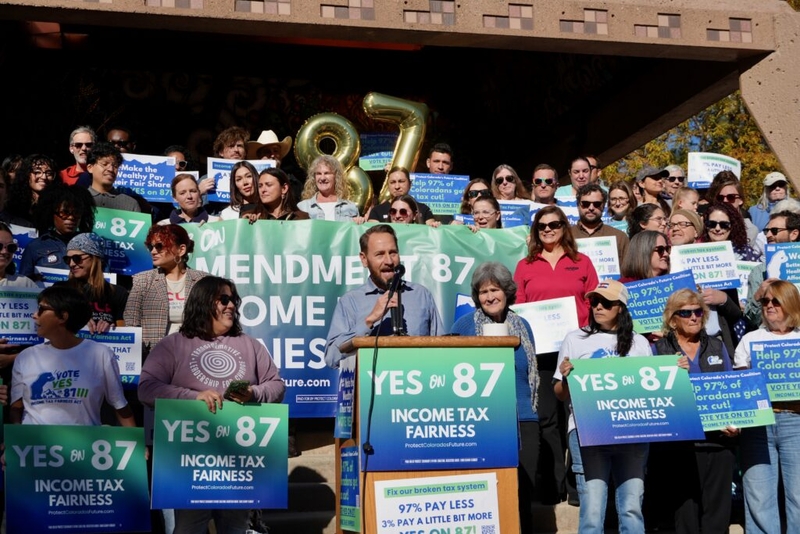
Chris Kennedy, center, president of the Bell Policy Center, spoke as Amendment 87 supporters declared victory at a press conference in Denver's La Raza Park on Thursday, Nov. 5, 2026. (Photo by Chase Woodruff/Colorado Newsline)
Younger voters in Colorado propelled two major tax reforms to victory in November’s elections, according to bipartisan exit polling.
Seven in 10 voters between 18 and 44 years old supported Proposition NN and 68% of that age group supported Amendment 87, compared to 45% and 38% of older voters, respectively. Together, those two measures will restructure longstanding tax rules in the state and add a significant amount of additional tax revenue to the state’s coffers for healthcare and public education.
“It was really those younger voters that pushed some of these major changes to our taxes and fiscal system here,” Lori Weigel with the Republican-aligned group New Bridge Strategy said during a Monday media briefing on the poll results. “This major change was very much grounded in those young voters wanting to make a real shift.”
New Bridge Strategy and the Democratic-aligned Aspect Strategic conducted the exit poll for the Colorado Polling Institute with Rose Community Foundation between Oct. 30 and Nov. 5, sandwiching Election Day on Nov. 3. They reached 606 voters through an online survey and oversampled in Denver and El Paso counties. The statewide margin of error was plus and minus 3.98%.
Proposition NN will increase public school funding over the next decade by permanently increasing the state’s revenue cap set by the Taxpayer’s Bill of Rights. Instead of returning money to taxpayers in some years, the state can keep more and direct it to education. Amendment 87, which passed by a smaller margin, creates a graduated income tax system in the state in which people and companies who earn more than $500,000 annually will pay a higher tax rate.
The two measures are among the biggest transformations to Colorado tax policy in over 30 years.
Supporters of Colorado’s graduated income tax measure celebrate victory
Older voters were more likely to support Proposition 136, an unsuccessful ballot measure that would have capped the state income tax at 4.4%. About 49% of people older than 45 said they voted for that proposition, compared to just 39% of younger voters.
Voters also like the direct democracy that ballot measures offer: 82% said they like voting on specific policy questions.
The poll showed a 48% favorability rating towards the incoming Democratic Gov. Phil Weiser, who won the governor’s race by a 27-point margin over Republican Victor Marx. And for the first time, CPI found that a majority of voters hold an unfavorable opinion on Gov. Jared Polis, the Democrat leaving office. Last November, 46% of voters didn’t approve of him. That number is now 58%.
Polis has made a series of controversial and unpopular decisions in the last year. He commuted the sentence of election denier Tina Peters and vetoed a round of progressive bills after the legislative session.
“Usually parties are not abandoning their leader even at the very end,” Weigel said. “In fact, sometimes as governors are going out, they’ll get a halo effect where people are more positive towards them as they leave office. I think it is a real shift, especially among Democrats.”
The Democratic Party as a whole also has a net-negative rating, according to CPI. About 52% of voters view it poorly, a 7-point increase from last November. Voters view the Republican Party worse, with 64% seeing it unfavorably. Around 21% of voters said they had unfavorable views of both political parties, but they were likely to vote for Democratic candidates, and they had a nearly 90% negative view of President Donald Trump.
A plurality of voters, 46%, said the recent midterm elections for Congress was a vote to signal opposition to Trump. Three of Colorado’s Republican congressional seats flipped to a Democrat, leaving the state with a 7-1 Democratic U.S. House delegation. Voters in El Paso County, who elected a Democrat in the 5th Congressional District for the first time, were more than twice as likely to say their vote was a signal against Trump.
While Democrats were almost uniformly supportive of Weiser, only 85% of Republican respondents said they were in favor of Marx, signaling how the controversial Republican nominee divided the party this year. Marx’s favorability was 9 points higher among Republican men than Republican women.
Pollsters also asked voters what they want the incoming state Legislature to tackle next year. Their priorities are addressing healthcare costs at 88%, how to balance the state budget at 87% and improving public schools at 86%. About 70% also said they want state lawmakers to address data centers in some way, which comes after two regulatory bills on the issue died last year and local governments continue to pass their own policies about development.
Denver, CO