Arkansas Republicans confront their party’s Trump dilemma after midterms
Nov 15, 2026 | 6:00 am ET
Description
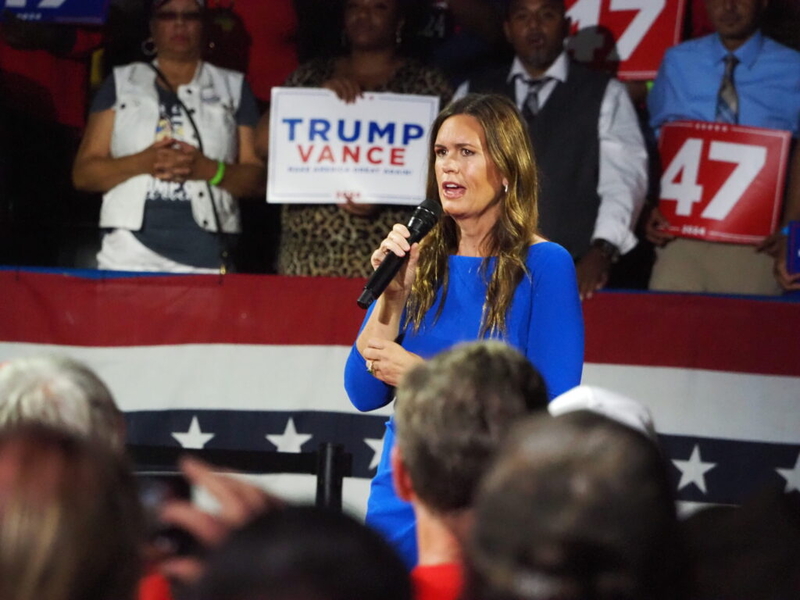
Arkansas Governor and former Trump Administration Press Secretary Sarah Huckabee Sanders speaks ahead of a town hall with former President Donald Trump in Flint, Mich. on Sept. 17, 2024. (Kyle Davidson/Michigan Advance)
If you want to see the divide Republicans face on how to move forward after a midterm election that saw them suffer historic losses in Washington and around the country, look no further than Arkansas’ current and former GOP governors.
The day after the election, former Gov. Asa Hutchinson said the results showed his party needs to understand voters’ concerns and move on from the “chaos” President Donald Trump is sowing. Instead of focusing on things that matter like diesel prices, the president was fixated on the Lincoln Reflecting Pool and building a new arch in the nation’s capital.
“When President Trump is right on policies such as securing the border, he ought to be supported on it,” Hutchinson told the Advocate. “But, you know, the chaos and the concentration on issues that are not important to average Americans has consequences, and that’s what we see in the election results.”
But Hutchinson’s successor, Gov. Sarah Huckabee Sanders, wasn’t willing to blame the president for whom she worked.
“I think each race has to be looked at independently, and the president, while he still remains the most influential voice in all of Republican politics − frankly, in all of politics − his name wasn’t on the ballot,” Sanders told USA Today in an interview to promote her new book.
Sanders made the statement even though Trump in the final weeks of the midterm campaign told voters to pretend that he was on the ballot.
The split between the two isn’t that surprising. Hutchinson left office frustrated with Trump’s brand of politics and mounted an unsuccessful bid against him for the Republican presidential nomination in 2024. Sanders’ ascendance as Hutchinson’s successor owed much to the national profile she gained as White House press secretary during Trump’s first term.
The sharp contrast between the two highlights the challenges Republicans in Arkansas face in navigating Trump.
Sanders launched her book tour days after the election with a victory lap of sorts as a Republican who managed to win reelection by double digits in a difficult political environment for her party. It’s also a soft launch of what could be her 2028 presidential campaign.
But the margin of Sanders’ win belies the setbacks she was dealt in an election where Trump’s unpopularity and concerns about his leadership were a drag. Republicans lost the 75-vote supermajority in the House they needed to pass most budget bills, which complicates Sanders’ legislative agenda next year.
Despite those setbacks, Sanders is clearly testing out a path to the White House as a defender of the president. Her book regularly praises Trump’s leadership and policies on issues like immigration. Appearing on ABC’s “The View” last week, she defended Pete Hegseth as the Defense secretary faced calls for his impeachment.
Sanders is trying to win the pro-Trump lane as other GOP figures are distancing themselves from the president. That includes Vice President JD Vance, who’s blamed the administration’s war in Iran for Republicans’ midterm losses.
One of the few areas where Sanders has split with the president is her book’s call for guardrails on artificial intelligence. Trump has resisted the push for such controls but Sanders’ stance indicates she understands the bipartisan reservations about AI and data centers.
Arkansas governor embraces Trump, calls for AI guardrails in new book
Other Arkansas Republicans are also calculating how much space to put between themselves and Trump.
The most prominent example is Republican U.S. Rep. French Hill, who barely survived a reelection challenge from Democrat Chris Jones in central Arkansas.
Days after his race was called, Hill was noncommittal about whether he’d support an impeachment effort against Hegseth. Hill ultimately voted with the state’s other Republican congressmen to effectively table the effort, but made clear he’s not happy with the progress of the Iran war.
“The question is: Are we leading at the Pentagon in the right way or not the right way? That’s very separate from whether or not somebody’s committed an impeachable offense,” Hill said on CBS’ “Face the Nation.”
Hill faces an especially precarious situation after his razor-thin victory. His district had long been eyed by Democrats who believed it was flippable, and last week’s results will encourage the party to focus even more attention on it when the next election rolls around in two years. But Hill also has to manage Trump’s unfavorability in a district while also guarding against primary challenges from the right of his own party.
The divide could also play out in other races in Arkansas in two years, especially if Republican Sen. John Boozman seeks another term. Boozman will lose his chairmanship of the Senate Agriculture Committee with the new Democratic majority in Congress and has also been targeted by primary challengers who have tried to paint him as insufficiently pro-Trump.
The midterm election revealed the limits of the president’s pull in even the Trumpiest of states, but how Arkansas Republicans position themselves in the coming months for 2028 could define the party for even longer.
Little Rock