Polis warns budget writers Medicaid costs could eat up revenue from new graduated income tax
Nov 13, 2026 | 4:09 pm ET
Description
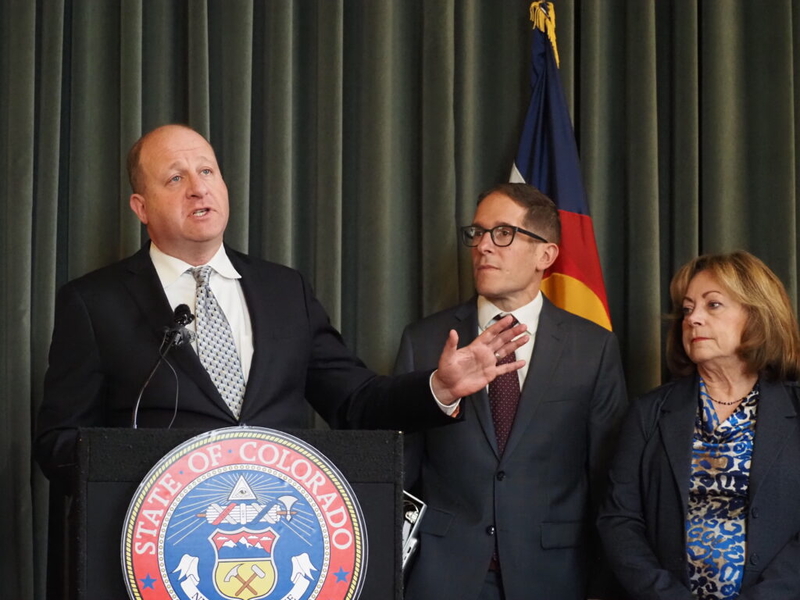
Colorado Gov. Jared Polis presents his budget request for the 2027-2028 fiscal year in his office at the Capitol in Denver on Nov. 2, 2026. (Photo by Sara Wilson/Colorado Newsline)
Gov. Jared Polis once again urged the Colorado lawmakers tasked with writing the state budget to slow state Medicaid spending, warning that new revenue from a recently-passed ballot measure would soon go entirely to the program if it’s left unchanged.
“In three years, if you don’t rein in Medicaid, all that (Amendment) 87 money goes to Medicaid. Zero for education. Zero for actually making people healthier. Zero for early childhood,” Polis told members of the bipartisan Joint Budget Committee on Thursday morning.
“None of it goes to the promises of why some people supported 87 — to support our schools and education and early childhood and better health outcomes for Coloradans. I hope that we can avoid that scenario,” he added.
Amendment 87, the voter-approved graduated income tax scheme where higher earners will pay a higher tax rate, will add about $2 billion in annual revenue to head towards health care, education and child care. There is no prescribed split between those allowable uses.
Thursday marked the last time Polis will present a budget proposal to the JBC, as he leaves office in January and Gov.-elect Phil Weiser, another Democrat, takes over. The governor is required to submit a budget request every November, even if there will be an administration change. Polis again suggested a hard growth cap on Medicaid spending tied to population growth and inflation. That would be 4.3% next year, the same amount state spending is allowed to increase overall under the Taxpayer’s Bill of Rights. It would still amount to about $250 million more for the program, but his budget proposal suggests measures like eliminating adult dental care to make the numbers work.
Lawmakers have already acknowledged that Amendment 87 will not fix the longtime budget woes caused by Medicaid spending. The entitlement health insurance program for low-income Coloradans takes up close to 40% of the state’s entire yearly budget.
“The projected Medicaid overage for the coming fiscal year was a billion dollars,” Rep. Kyle Brown, a Louisville Democrat on both the JBC and the Medicaid Commission, said during a Tuesday commission meeting. “(Amendment) 87 is expected to raise a billion dollars in its first year and $2 billion in the second year. If (Medicaid) continues to grow at 15% per year, we will eat up all that money unless we make changes.”
The commission this week started voting on recommendations to include in its final report on how to make Medicaid more sustainable. It rejected a hard growth limit on the state Medicaid contribution by an 8-1 vote. That suggestion had a legal note from the Department of Health Care Policy and Financing, which runs Medicaid, that the state is required to cover all eligible people and cannot enforce a growth cap by denying or reducing services.
“We have hard caps in our budget, and the piece of our budget that is growing the most should reflect those hard caps that we have to deal with,” Sen. Jeff Bridges, a Democrat who will be Colorado’s next treasurer and voted for the recommendation, said. “To just have Medicaid come back every year and say, ‘Oh, we’re $500 million over budget. Sorry,’ that is not a great way for any agency to run, and it’s not a great way for us to manage a budget.”
Polis will submit a revised budget proposal in early January before he leaves office. That should reflect the budget impacts from Amendment 87 and the other successful ballot measures that will either create more revenue or force the state to spend more money. The JBC submits a budget for the entire Legislature to vote on, typically in late March.
Denver, CO