Menhaden fishery cuts should have gone further, Marylanders say
Nov 12, 2026 | 10:22 pm ET
Description
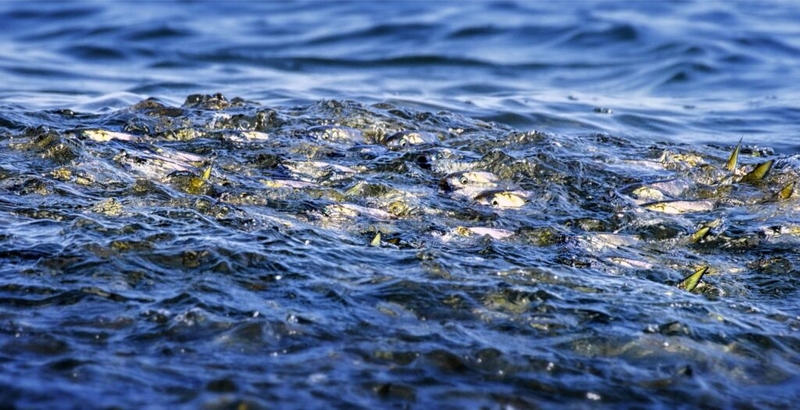
A multistate commission approved a 9% cut to the menhaden fishery on the Atlantic Coast this week, and determined that 21.8% of those fish could be caught in the Chesapeake Bay. (Photo by Vicki Jauron/Babylon and Beyond Photography via Getty Images)
An East Coast fisheries commission voted this week to cut the coastwide harvest of menhaden in each of the next two years and, for the first time, to limit the number of the baitfish caught in the Chesapeake Bay to a specific portion of the overall harvest.
The vote by the Atlantic States Marines Fisheries Commission reduces the total harvest limit from 187,000 metric tons to 170,000 tons next year, and drops it to 150,000 tons the year after. And the harvest in the Chesapeake Bay would be limited to 21.8% of the total catch.
The vote did not go far enough for Maryland representatives on the panel, given menhaden’s critical position at the base of the bay’s food chain. A shortage of menhaden is one possible reason for troubling declines in the number of osprey and striped bass, for which menhaden is a critical source of food.
The Chesapeake Bay Foundation criticized the fisheries commission’s decision to drop the coastwide harvest by 9% next year, when the commission’s data indicated it should drop 39% to maintain the fishery. The foundation’s Maryland director sits on the commission.
“ASMFC failed to follow its own ecosystem science when it mattered most,” said Will Poston, forage fisheries campaign manager at the Bay Foundation, in a statement Thursday. “We are extremely disappointed with other states and the federal agencies that once again folded on true ecosystem-based menhaden management.“
But Virginia, home to a reduction fishery operation that catches the vast majority of menhaden as they enter the bay from the ocean, pushed back on steeper cuts suggested by Maryland. Officials from the commonwealth said there is not enough science to make an informed decision on harvest reductions that could result in the loss of jobs in the reduction fishery.
Earlier this year, Virginia lawmakers greenlit a study of the bay’s menhaden population that is just getting underway.
“We’re begging you to please wait until the recently funded research is complete, so we can have time to provide a data-driven case before we act,” said Virginia Del. Adele McClure during Wednesday’s portion of the multiday commission meeting.
Advocates at the Bay Foundation said fishing data in the Chesapeake is evidence enough that the baitfish are in decline in the estuary.
“We have seen declining pound-net menhaden harvests and catch-per-unit-effort. That tells us there are far fewer menhaden in the bay than in previous years,” Poston said during a news conference Thursday.
Studies showing ospreys are struggling to find food to feed their chicks are also “impossible to ignore,” Poston said.
The annual meeting of the commission, which includes members from Atlantic states and federal agencies, capped months of debate over appropriate restrictions for the menhaden fishery.
The public comment period on the menhaden plan drew 48,320 comments from up and down the East Coast. Most commenters wanted to see the bay cap set at 13.6% of the total catch, and many cited concerns about the impact of declining menhaden availability on osprey, according to an analysis of the comments from the commission.
A bipartisan group of 29 Maryland lawmakers in September had also called for the bay catch to be limited to 13.6% of the total coastal harvest, but that plan was voted down Thursday.
“While we are encouraged by the decision to reduce the industrial menhaden harvest in the Chesapeake Bay by a third, we are disappointed that the Commission failed to take stronger action coastwide,” said Del. Dylan Behler (D-Anne Arundel) and Sen. Sara Love (D-Montgomery) in a joint statement on Thursday.
A single company, Ocean Harvesters, catches menhaden in large purse seine nets at the mouth of the Chesapeake before they can swim up into the bay. The catch is processed into fish oil and fish meal by another company, Omega Protein. It’s known as a reduction fishery.
Maryland does not have a reduction fishery, though the fish are harvested in small numbers for bait. The state has banned the practice of purse seine netting for menhaden in its portion of the bay since before the 1950s.
Virginia representatives argued that stricter limits for the fishery could threaten the hundreds of jobs in the menhaden harvesting and processing operations. Omega Protein and Ocean Harvesters are the largest commercial employers in Virginia’s Northumberland County, the companies stated in a news release.
Ocean Harvesters CEO Monty Deihl said in a statement that the cuts “affect our union workers, African American and other minority fishermen, processing employees and families, as well as businesses throughout the Northern Neck.”
But the Bay Foundation’s Maryland director, Allison Colden, argued at Wednesday’s meeting that the population’s decline in the bay has already reduced the number of Maryland fishermen who harvest menhaden for bait, using pound nets to catch the fish coming up into the estuary.
“We have gone from 100 pound-netters to 10 pound-netters to now maybe two, who are maybe putting in one net,” Colden said. “So these economic impacts in Maryland have already happened, and people have already lost their jobs because of the lack of availability of menhaden to Maryland fishermen.”
Critics of the commission’s decision to cap the harvest at 155,000 metric tons in 2028 point out that the fishery only landed 147,000 metric tons in 2025. But Deihl blamed that catch on poor weather conditions in 2025, and said the coastwide cut could be more damaging in future years.
“If we have a good weather season next year, unlike 2025, these lower quotas will mean lost fishing opportunities and real hardship. These are the paychecks and benefits families rely on and the economic activity that supports our region,” he said.
The companies “will do our best to manage through these restrictions and support our people,” Deihl said. “We look forward to completing the recently funded research and believe it will show that these severe restrictions were never necessary.”
Osprey nesting woes in the Chesapeake Bay worsen, survey finds
Maryland ASMFC commissioner Mike Luisi, who directs fishing and boating services at the Maryland Department of Natural Resources, wanted the bay catch set below 20% of the total catch, but he ultimately supported the 21.8% limit, citing the industry’s concerns.
“I believe that this option is the middle ground that we should all be able to agree to,” he said.
The Maryland lawmakers’ letter had also proposed splitting the harvest into three, allowing 25% of the catch in each of the first two periods and 50% in the third. Colden said timed harvesting could “make a real difference for some of our predators and our fisheries in the bay,” but it failed Wednesday, when only Maryland voted for it.
Virginia representative Joseph Grist argued that packing half of the Chesapeake Bay quota into a mid-September to mid-November period would be problematic, as hurricanes and other storms are common at that time of year.
“There’s a crew safety issue here. We’re asking them to put themselves at risk at a time of year when it’s either go fish or go pay-less,” said Grist, who serves on the Virginia Marine Resources Commission.
But there was one thing that all of the states at the table could agree on: That the menhaden quotas should be revisited in three years, when more data is expected to be available.
“It’s proof that Maryland and Virginia can still work together,” Grist said with a chuckle.
Annapolis, MD