Blue Ribbon Commission on education settles on key policy ideas
Nov 12, 2026 | 7:01 pm ET
Description
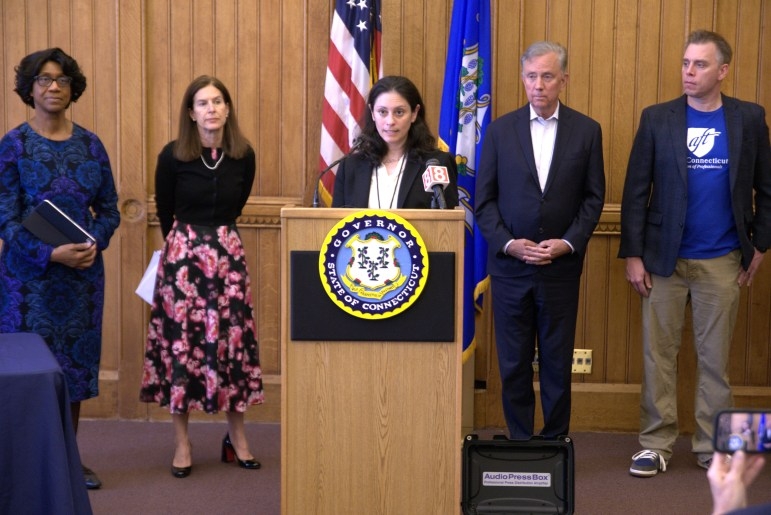
Photo courtesy of CT Mirror
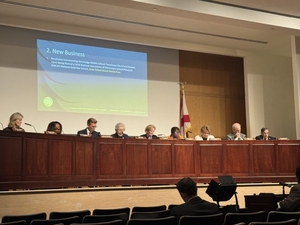
Gov. Ned Lamont’s Blue Ribbon Commission on K-12 Education Funding and Accountability has largely settled on a list of policies around which to shape its final report, due Jan. 15.
The recommendations include changes to Connecticut’s main school funding formula, the Education Cost Sharing or ECS grant; restructuring special education funding, including the SEED grant; strengthening Regional Educational Service Centers to promote greater inter-district collaboration; and stronger state accountability mechanisms for academic and fiscal performance. More details, including concrete dollar amounts, will be determined in December.
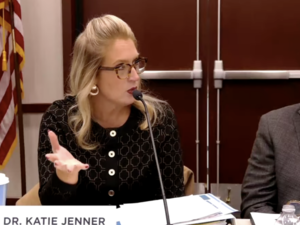
Commission members reviewed the full list Thursday. After a break for small group discussions, members appeared generally satisfied with what they had in front of them — though several noted that, without firm dollar amounts, there was still a great deal of uncertainty.
“I think, fundamentally, we’re OK with where we are,” Windsor Board of Education Vice President Leonard Lockhart said.
New Haven Mayor Justin Elicker expressed concern about the commission’s timeline vis-a-vis the governor’s budget proposal, which is due at the start of the session.
“A concern that I’ve heard from a number of people is that we come up with the recommendations and it’s too late, because the [Lamont] administration’s already put together a package,” Elicker said.
Natalie Wagner, the chair of the commission and Lamont’s deputy chief of staff, reassured him that the budget proposal was already taking the commission’s work into account.
“That process is going on very much informed by the work of this commission,” Wagner said.
Key takeaways
The commission is considering several changes to the ECS grant in the hope of making it more effective and more resilient over time.
The current ECS grant has a number of problems. The most glaring is the foundation amount — ostensibly what it costs to educate one student. The whole formula is based on that number, but it has been stuck at $11,525 since 2013 and has not been adjusted for inflation. If it had, the number would be over $16,000 — that’s a difference of hundreds of millions of dollars annually schools could be receiving from the state.
Another problem is how the grant handles enrollment declines. Per the formula, districts with declining enrollment should get less ECS money. In practice, however, the state has held those districts harmless year over year, with the result that many are now considered overfunded. The term is potentially misleading; many “overfunded” schools get much less money than they would have if ECS had been rising with inflation this whole time and are struggling financially.
Increasing the ECS foundation amount is one of the policy ideas the commission is advancing, though it will not determine the amount until December. It is also advancing tying ECS to inflation, updating weights in the formula for certain groups of students and ensuring choice schools receive similar increases.
The commission is also advancing changes to how enrollment declines are handled. That includes basing ECS on a three-year enrollment average to limit the shock of yearly declines, as well as phasing districts out of hold-harmless as the rising foundation amount lifts them over their current funding level.
Education Committee co-Chair Rep. Jennifer Leeper, D-Fairfield, told her fellow commission members she expects that last point to be a tough sell.
“I think just realistically, politically, that will be really a nonstarter for a lot of folks. Even if we’re gonna say that likely won’t happen until year 10,” Leeper said.
Raising the foundation amount may not be easy, either. Even a relatively modest boost will quickly run up hundreds of millions of dollars in additional costs for the state budget. Lamont, who does not sit on the commission himself, has signaled he does not like the idea of raising the income tax to pay for that.
University of Connecticut education professor Casey Cobb pointed out the state still lacks an empirical basis for determining what the foundation amount should actually be — in other words, it doesn’t know how much it actually costs to educate a student. He also suggested the state should conduct a regular adequacy study to confirm the foundation amount remains accurate.
The commission is also advancing the idea of increasing the SEED grant, which legislators created in 2025 to direct state dollars into in-district special education programming. It is currently funded at $30 million; fully funded, it would distribute about $180 million annually.
The commission also wants to expand what SEED money can be used for so that the state’s six Regional Educational Service Centers (RESCs) and other state-approved vendors can access it.
Commission members are advancing a number of ideas to expand the role RESCs play in meeting Connecticut’s education goals. Those include expanding RESC capacity and expertise to deliver on state priorities (for example, expanding special education services) and staffing RESCs with fiscal advisors or business managers to help districts manage their finances. The expansion would come with new progress reporting and other accountability mechanisms.
The commission also discussed reconfiguring Connecticut’s fiscal accountability systems. Many states require districts to submit multiyear budget projections to a state office annually, but Connecticut does not (though a recent law did require districts to share some budget information locally). Also common outside of Connecticut: a formal tiered system of support and oversight when problems pop up.
The overall goal is to make it easier to catch problems and intervene early, before schools are in crisis — ideally preventing a repeat of what is currently happening with the Hartford and Bridgeport school districts.
Elicker flagged some potential concerns.
“That assumes adequate state funding, correct?” he asked. “Because if the state doesn’t adequately fund, and then says, ‘Ah, but we need to hold you accountable, you have financial problems,’ I think that’s, you know, a tough thing to swallow.”
He also noted that some districts can’t get adequate funding on the local side — for example, because voters turn down a referendum.
Wagner said it would be important to ensure the new oversight system doesn’t worsen tensions between municipalities and schools.
“Because of that specific relationship in Connecticut, that might look very different than some of these other states,” she said.
Most other states give districts themselves taxing authority, but Connecticut does not.
As commission members offered their closing thoughts, Middletown Superintendent Joseph Macary identified which items he said have his full, unequivocal support: raising the ECS foundation, indexing it to inflation, increasing the weight for poverty, fully funding and removing restrictions on SEED and maintaining hold harmless until a district’s ECS funding lifts it over.
“I think these five are … this is how we need to go forward to make a win for us, to help kids,” Macary said.
Several other commission members voiced their agreement.
Hartford, CT