Democratic state officials, USPS battle over Trump mail ballot rule ahead of 2028 election
Nov 12, 2026 | 3:03 pm ET
Description
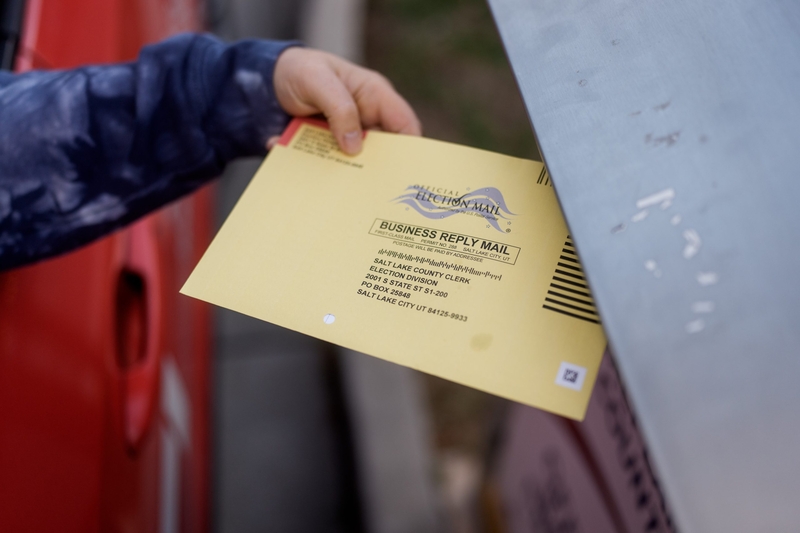
A voter uses a drive-up ballot box outside the Main Library in Salt Lake City, Utah, on Election Day, Nov. 3, 2026. (Photo by Spenser Heaps/Utah News Dispatch)
The U.S. Postal Service faces renewed calls to drop restrictions ordered by President Donald Trump on mail ballots, setting up a major clash between states and the federal government ahead of the 2028 election.
Postal worker unions, civic groups and Democratic secretaries of state are demanding the Postal Service rescind a rule that imposes sweeping new requirements on states if they want ballots delivered through the mail. As part of the rule, states must submit the names of likely mail voters to the federal government.
The U.S. Supreme Court blocked the Postal Service from implementing the rule for the midterm elections. But the decision applied only to this year’s elections, leaving its ultimate fate unclear.
With the midterms over, opponents of the rule have quickly turned to pressuring the Postal Service to abandon the restrictions — warning that the Trump-backed rule undermines the USPS’ closely guarded image as outside of partisan politics.
“We should not allow a policy that threatens public confidence in the Postal Service neutrality to remain in place while its long-term status is debated in court,” Jonathan Smith, president of the American Postal Workers Union, said at a news conference in Washington, D.C., on Tuesday.
The rule’s future carries significant consequences for states with large numbers of mail voters. Eight states — California, Colorado, Hawaii, Nevada, Oregon, Utah, Vermont and Washington state — authorize all-mail elections. Nationwide, at least 33.9 million mail ballots were cast in the November general election, according to the University of Florida Election Lab.
The Postal Service declined to answer questions from States Newsroom on Thursday, citing pending litigation.
Executive order
Trump signed an executive order in March directing Postmaster General David Steiner to put forward a rule requiring states, at least 90 days before a federal election, to notify the Postal Service whether they intended to allow ballots to be sent through the mail. States would then have to submit to USPS at least 60 days before the election a list of voters planning to vote by mail.
Separately, the executive order required the U.S. Department of Homeland Security, with help from the Social Security Administration, to compile a list of voting-age U.S. citizens living in each state and then provide that information to state officials at least 60 days before each federal election. The order did not tell states how to use the data.
The Supreme Court didn’t make clear its position on the mail ballot rule if it comes before the court again in the future. But Justice Brett Kavanaugh, who agreed with the decision to halt the rule for the midterms, wrote in a concurring opinion that there was “at least a fair prospect” the rule falls within the Postal Service’s authority.
The Trump administration and some Republican states argued the rule would provide additional security safeguards. Ahead of the election, Republican officials in 11 states, led by Missouri, urged a federal judge not to pause implementation of the rule.
“The Rule — if implemented — would help bolster the security of mail voting in Missouri and reduce the risk of fraud,” Missouri Secretary of State Denny Hoskins, a Republican, wrote in an August court declaration.
Hoskins’ office didn’t respond to a request for an interview this week. The other states included Alabama, Florida, Indiana, Kansas, Louisiana, Montana, Nebraska, Oklahoma, South Carolina and South Dakota.
The White House didn’t respond to a request for comment.
Opponents of rule filed suit
Democratic states argued the rule encroached on their power to run elections. The U.S. Constitution assigns states the responsibility of administering elections.
Multiple lawsuits were filed against the executive order in the spring. U.S. District Judge Indira Talwani, an appointee of President Barack Obama in Massachusetts, issued a preliminary injunction halting USPS from implementing the rule, which the Supreme Court declined to block.
“This executive order is trying to force federal control over who can and cannot receive a ballot in the mail,” Chelsey Wininger, executive director of the Democratic Association of Secretaries of State, said at the Tuesday news conference.
When the Postal Service published the final version of the mail ballot rule in August, the agency wrote that the rule doesn’t place the Postal Service in the role of an election administrator or dictate how states run elections. States maintain complete control over their voter registration rolls and decide who votes by mail, the USPS wrote.
“States also retain complete autonomy to determine the extent to which they utilize the postal system as an aspect of their elections,” the USPS statement said, adding that the rule was consistent with the Constitution.
During a USPS Board of Governors meeting on Tuesday, the board members didn’t discuss the mail ballot rule, according to a recording of the Tuesday meeting posted to the Postal Service website. The meeting mostly focused on the agency’s difficult financial condition, though postal workers received praise for their performance during the election.
“In this election, the USPS did exactly what we always do,” Steiner, the postmaster general, said. “We put our heads down and we got the job done.”
All States Newsroom content is free to republish. Read our republishing policy for more information.