Michigan’s US Senate results challenge the claim that criticism of Israel alienates Jewish voters
Nov 12, 2026 | 2:00 pm ET
Description
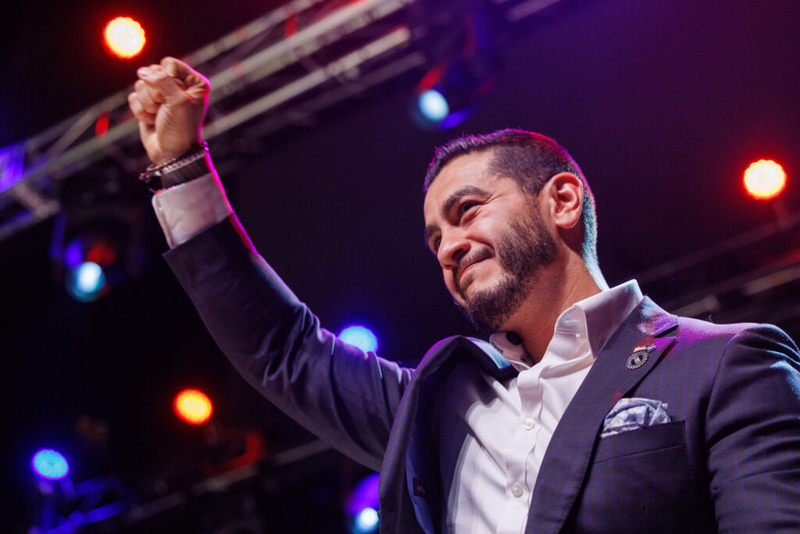
Former Wayne County Health Director Abdul El-Sayed speaks at a primary election night watch party in Detroit, Mich., on Aug. 4, 2026. (Photo by Andrew Roth/Michigan Advance)
As Jewish voters overwhelmingly supported Democratic candidates in last week’s midterm elections, new polling data shows that the Democratic Party’s Jewish support was not an outlier and likely won’t change anytime soon. At the same time, growing opposition to unconditional U.S. support for Israel could create opportunities for Democratic candidates in 2028 who take a more critical approach to the Israeli government’s policies.
Polling data released after the election by J Street, a progressive Jewish organization that advocates for a two-state peace solution between Israel and Palestinians, indicated that 72% of Jewish voters cast ballots for Democrats in the 2026 midterm election. That number has remained consistent compared with past cycles. The organization’s polling also found that 70% opposed unconditional U.S. aid to Israel. That’s comparable to the 68% who in 2022 said they supported restricting aid if it expanded Israeli settlements in the West Bank.
The survey of 800 self-identified Jewish voters was conducted by GBAO Strategies from Oct. 28 to Nov. 3 among those who cast their ballots on Election Day or prior to Election Day. It has a margin of error of +/- 3.5 percentage points.

Jewish voters remain reliably Democratic, even as views on U.S. aid to Israel shift
Some 2026 candidates were critical of the Israeli government over conflicts with its Arab neighbors, as well as the outsized spending against them from the American Israel Public Affairs Committee, or AIPAC, including U.S. Senator-elect Abdul El-Sayed of Michigan.
That stance exacerbated tensions among Michigan Jewish Democrats, some of whom called for voters in the U.S. Senate race to leave their ballots blank or vote instead for the Republican nominee, former U.S. Rep. Mike Rogers. Although J Street did not specifically poll Michigan’s U.S. Senate race, Tali deGroot, the group’s vice president for digital and political strategy, said those factors did not sway Jewish voters in Michigan from supporting El-Sayed.
“The vast majority of Jews voted for Democrats across the country,” deGroot said. “It was just another chapter, ‘Will the American Jewish community abandon the Democratic Party?’ And the answer is no. The American Jewish vote is a reliably Democratic vote.”
In terms of the moral conflict that faced American Jews at the ballot box this year, deGroot said “American Jews support a relationship with Israel that is grounded in values and shared interest.”
Few races better illustrated those tensions than El-Sayed’s contest against Rogers, following a contentious Democratic primary against U.S. Rep. Haley Stevens (D-Birmingham) that appeared, at least on the surface, to damage his standing with some Michigan Jewish voters. But once all the votes were counted, El-Sayed defeated Rogers by 7 percentage points, a much wider margin compared to the Senate race between U.S. Sen. Elissa Slotkin (D-Holly) and Rogers in 2024, which was within a single percentage point in a Republican wave election.
An analysis by Millions of Michiganians, the super PAC for Progress Michigan, a nonprofit that supports progressive policies, found that El-Sayed’s share of the vote in 72 precincts with large Jewish populations was just 1.3 percentage points lower than Slotkin’s share in those same precincts in 2024.
That said, Jim Gerstein, the principal at GBAO, in a call last week presenting J Street’s polling data, cautioned against looking at precinct-level data in areas with a large Jewish voting population as a way to distill how the community voted in the 2026 election.
“These precinct level data, they also have non-Jews in those precincts, so we don’t know which way those votes went and what percentage of those were moved by Jewish voters versus the larger number of people in those precincts that are not Jewish,” Gerstein said. “The other thing is, in the precincts where they are overwhelmingly Jewish, those Jews are going to have different perspectives than Jews who live in less Jewish-dominated precincts.”
Millions of Michiganians also argued that El-Sayed performed well among Jewish voters despite an active campaign by Nonnegotiable Michigan. The coalition of rabbis and Michigan Jews said they could not vote for El-Sayed unless he publicly recognized the right of Israel to exist as a Jewish state, and ensured the safety of American Jews if elected. Nonnegotiable also championed a write-in campaign for “Emma Lazarus,” a 19th-century author and Jewish political activist.
Jewish groups disagreed over what the election results showed
Millions of Michiganians noted that there were only 470 anti-El-Sayed write-in votes across the 72 precincts that it polled, and just 253 undervotes, meaning that less than 0.25% of total voters in the governor’s race, decisively won by Democrat Jocelyn Benson, chose to leave the ballot blank for El-Sayed.
Nonnegotiable Michigan represented Michigan Jews who opposed El-Sayed, but deGroot said that opposition represented only a small portion of Jewish voters who considered Israel a top issue. She believed El-Sayed did well to shift his general election campaign away from Israel and AIPAC toward “the issues that affect the vast majority of Michiganders: affordability, healthcare, cost of gas, issues that the American Jewish community is actually voting on.”
That notion tracks with the J Street polling, which indicated that the future of democracy and the cost of living were by far the top concerns for Jewish voters, at 44% and 34% respectively, while policy toward Israel stood at just 14%.

Debbie Rosenman, a member of the progressive Michigan Indivisible Fighting 9 activist group, supported El-Sayed because of his progressive values and the issues he championed. Rosenman said Jewish voters like her shared those values and voted accordingly.
David Kramer, a Democratic fundraiser and member of Nonnegotiable Michigan who ended up publicly supporting Rogers, said he had “zero regrets” about the stance he and other Jewish Democrats had taken during the election.
“I think that we spoke from a point of moral clarity and a position of caring about Jewish safety and security, and our place in the community,” Kramer said. “Even though Abdul failed to meet us on those points, we still put an important marker down, and it’s a template for other candidates and for other elected officials. It was never about just one race and one person.”
Israel policy could reshape the Democratic coalition heading into 2028
While there was no way to avoid the U.S.-Israel relationship being a political football in the years to come, deGroot warned candidates and outside groups against the “instrumentalization and weaponization” of the Jewish vote, because the data shows that younger American Jewish voters are becoming more progressive, and are shifting toward ending military aid to Israel.
“Something we found in this cycle is that a candidate’s willingness to buck AIPAC was an indication of their general willingness to buck the status quo, and I expect that to continue,” deGroot said. “Voters want to see candidates say the status quo is not right, and we’re going to change it.”
Rosenman said that Jews who supported El-Sayed could easily transfer their support to another progressive candidate in the presidential election if they had preconditions on the U.S.-Israel relationship. That was especially true if that presidential candidate possessed qualities they saw in El-Sayed, like his ability to communicate complex issues.
State of the Race: Democratic U.S. Senate race pits old guard, vanguard in battle for party’s soul
Rosenman also said that many American Jews were waiting to give the Israeli government a chance to reform itself before they fully agreed to completely reexamine its ties. That could depend in part on the outcome of Israel’s recent parliamentary elections, which left Prime Minister Benjamin Netanyahu’s governing bloc short of a majority in the 120-seat Knesset. Opposition parties and Arab-led parties collectively won enough seats to prevent Netanyahu’s bloc from securing a majority, leaving the formation of a new governing coalition uncertain.
If Netanyahu were to lose power, Rosenman said progressive Jews like her could be more “patient” with Israel if it becomes more “open-minded and responsive to the needs of the Israeli people and their neighbors.”
Another factor is El-Sayed’s performance as a senator, and if he can deliver on his baseline promises for healthcare and ending the corrupting influence of money in politics.
“I think there were a lot of people who were elected who he can find partners with, and so we’re going to be watching him,” Rosenman said. “And based on how he does, or what the impression is of how he’s doing, that will have an effect on how people feel, because I don’t think Jewish voters are changing their values.”
Lansing, MI