El Niño could mean snow for Georgia this winter, but it’s not a sure thing
Nov 11, 2026 | 4:58 pm ET
Description
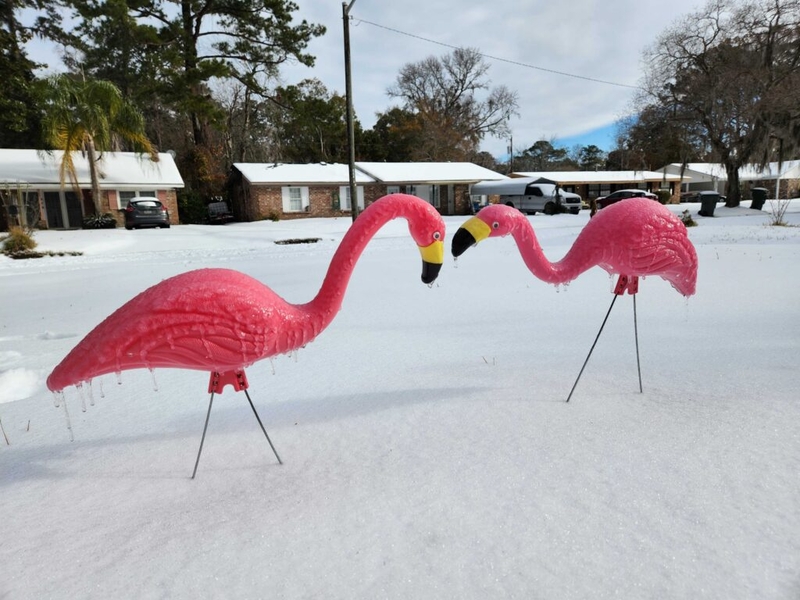
Icicles hang off plastic flamingos following a winter storm in Savannah, Ga. in January 2025. (Emily Jones / WABE)
This coverage is made possible through a partnership between WABE and Grist, a nonprofit environmental media organization.
The Pacific Ocean is heating up — and while it’s a continent away, the impacts from El Niño are expected to reach Georgia.
For the notoriously hot and humid Southeast, El Niño typically has two main effects: it gets wetter, and it can bring bouts of cold weather. That could mean snow for Georgia this winter – though there’s no guarantee.
What is El Niño and what does it mean for Georgia?
Warming sea surface temperatures off the coast of South America happen every three to five years, a natural phenomenon known as El Niño. It’s just a few extra degrees of heat that lasts for nine to 12 months, but it ends up injecting an extraordinary amount of extra energy into the sky. This year’s is already the strongest El Niño on record, and it might not even peak for another couple of months.
The expected wet weather comes down to the same forces that inundate the West Coast during an El Niño cycle, according to Chuck Watson, a Georgia-based disaster researcher who tracks weather impacts worldwide.
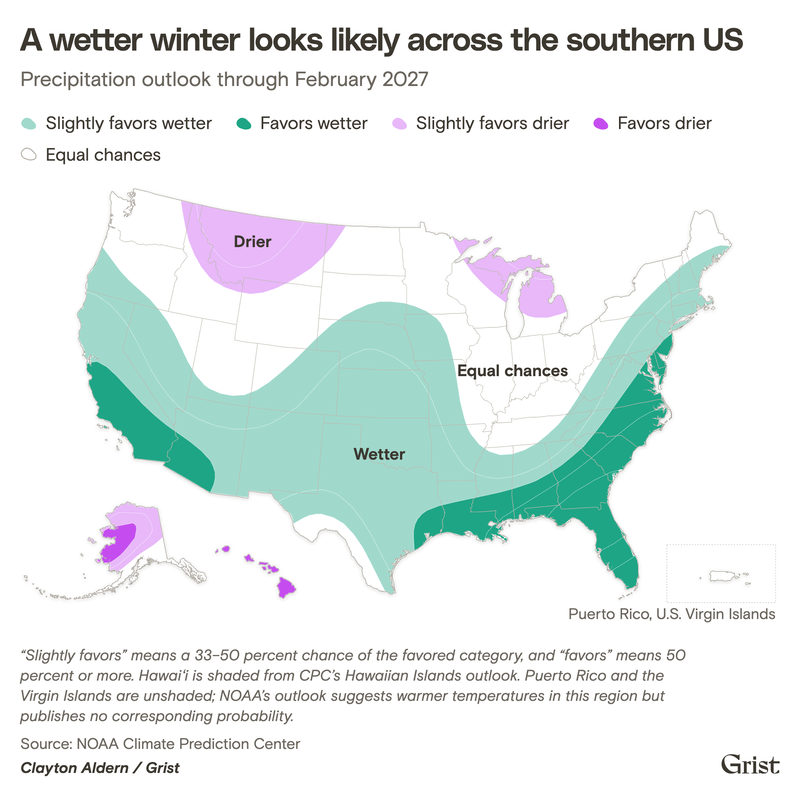
“That jet of air that’s coming across California continues on across the Gulf of Mexico and drags moisture from the Gulf and whatever was left over after it rained all over California,” he said. “It drags that across the Southeast.”
The effects of El Niño are complex, the excess energy from the overheated Pacific interacting with innumerable other factors in the atmosphere. That makes specifics hard to predict. It’s not even guaranteed that this year’s stronger El Niño will directly correlate to each impact being more severe, Watson said. Because the level of heat in the ocean is higher than it’s been since record-keeping began, scientists expect to learn a lot about what a superheated ocean does to the weather.
“I just wish it wasn’t potentially at the expense of so many people in the way,” Watson said.
Here, we break down some impacts Georgia can expect this winter, based on the current modeling and on past El Niño cycles.
Potential ice storms
The wet air moving east from California often interacts with a flow of Arctic air high in the atmosphere, Watson said, cooling things down. For a state that doesn’t deal with sustained temperatures too far below freezing most winters, the combination can mean ice storms that people and infrastructure aren’t accustomed to.
“That’s really just a recipe that’s ripe for disaster,” Watson said. “That tends to be just bad news all around for tree limbs falling and slick roads and particularly extended power outages.”
But it’s too soon to make any firm predictions about possible snow or ice storms, even though El Niño makes it more likely the right atmospheric ingredients will be there. Forecasters can’t tell how much snow or ice might fall until a few days before a storm, and even then there’s still uncertainty.
“History says that all of these strong El Niños have at least produced a snow event,” said Keith Stellman, meteorologist-in-charge at the National Weather Service station in Peachtree City. “So the likelihood of at least a snow event is probably pretty high. To say that you’re going to get a specific amount is, it’s a stretch.”
There’s uncertainty, too, about how much colder this winter might actually be than normal.
“There’s other things and other variables that can have very big impacts on whether or not we see those more Arctic air masses move into our area,” meteorologist Dylan Lusk said during a recent National Weather Service online briefing.
Possible drought relief
While colder weather is likely but not guaranteed, forecasters are confident the area will see above-average precipitation.
NOAA is predicting enough rainfall between mid-October and the end of January to improve or eliminate what drought conditions persist across Georgia. It will be much-needed moisture for a state that’s grappled with an unusual level of drought over the last year.
The period from September 2025 through April 2026 was the driest in Georgia history according to NOAA, fueling wildfires in the spring that destroyed homes and forced evacuations. The US Department of Agriculture declared a disaster due to drought for much of the state in the spring. The water level in Lake Lanier, Atlanta’s main water supply, remains low.
The colder, wetter weather could be good for Georgia’s farmers, according to UGA climatologist Pam Knox. The state’s parched soil will likely have a chance to rebuild some moisture over the wet winter, welcome news for spring planting.
When it comes to municipal water supply, though, nothing is necessarily guaranteed. Lake Lanier, for instance, is fed by a small watershed, and a rainy winter in a different part of the state won’t refill the reservoir.
Fewer hurricanes
One piece of good news for much of the Southeast is that El Niño typically suppresses hurricane formation in the Atlantic. That’s thanks to increased wind shear, which refers to how the wind changes speed or direction with height.
“Wind shear is bad for hurricanes,” Lusk said. “Hurricanes want to be straight, vertical, and when they have wind shear over them it basically knocks over the thunderstorms that help maintain these systems.
So while Hurricane Isaias brought rainfall and power outages in early October, it was also the first Atlantic hurricane this year — an incredibly late occurrence. Hurricane season ends November 30, and so far no more hurricanes have formed in the Atlantic.
Despite the damage and power outages Isaias brought, Georgia has escaped the kind of widespread devastation the state experienced from storms like Helene, Michael, Irma and Matthew in the last decade.
As for next year, while models suggest El Niño could persist into next summer, it’s too soon to make predictions about the 2027 hurricane season.
Matt Simon of Grist and Melissa Feito of WABE contributed to this story.
Atlanta, GA