Energy costs among top issues for battleground voters, polling finds
Nov 11, 2026 | 2:45 pm ET
Description
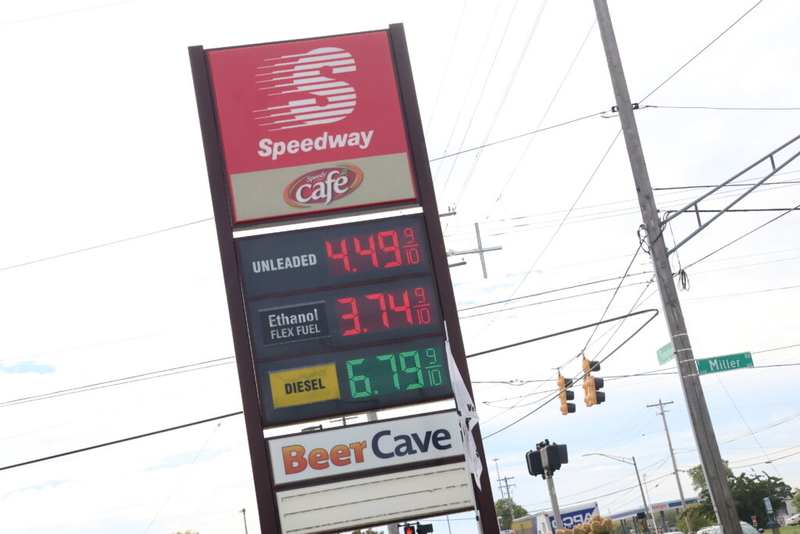
Gas prices at a Speedway gas station in Lansing, Sept. 25, 2026. (Photo by Kyle Davidson/Michigan Advance)
In the wake of Democrats’ sweeping victories across the nation, post-election polling commissioned by organizations focused on clean energy and environmental issues found that energy affordability was at the top of many voters’ minds as they cast their ballots.
On Tuesday, Climate Power, a strategic communications organization focused on building support for climate action, shared polling data examining how energy costs shaped the midterm results. Climate Power, alongside the League of Conservation Voters, EDF Action and the NRDC Action Fund, commissioned Hart Research for an online survey of 1,778 individuals across 62 competitive U.S. House districts who had either voted, or were certain they would be voting.
Breaking down the findings at a press briefing, Jay Campbell, a partner at Hart Research, said while voters were ready to be done with Republicans and President Donald Trump, that rejection did not mean that battleground district voters were enthusiastic about Democrats.
Survey results showed 61% of respondents had negative feelings about Donald Trump, while 57% expressed negative feelings toward congressional Republicans. Even though Democrats won majorities in both the U.S. House and Senate, 46% of voters still held a negative perception of Democrats while 41% said they held positive feelings towards the incoming majority party.
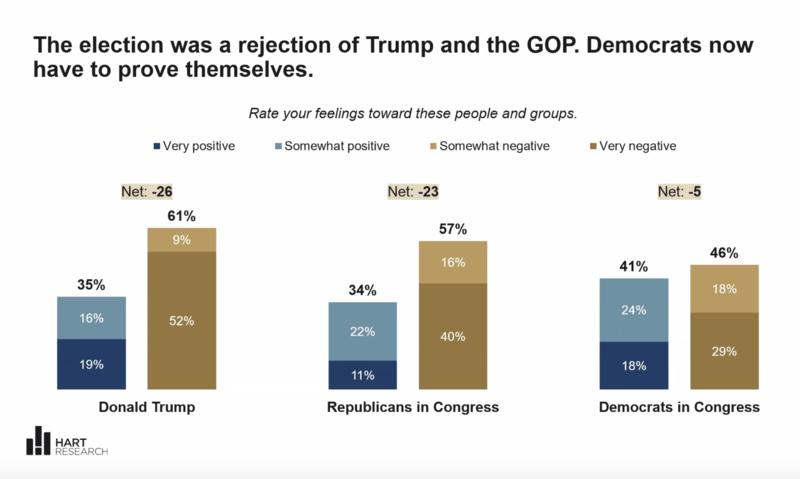
As for the takeaway from these responses, Campbell said the people are giving Democrats a chance in Congress, and that they would need to take on that mantle and prove themselves.
Looking into the issues that were most pressing for voters, the cost of food and groceries “blew everything else out of the water,” Campbell said, with 66% of all voters surveyed listing that as their top issue.
However, two separate energy issues were among the top four concerns for voters. Just below the cost of groceries was the cost of gasoline, which was a deciding factor for 41% of voters. The cost of utilities, such as electricity and heating, was the fourth-most prominent issue for voters, with 32% of survey respondents noting it was a key issue in determining their congressional vote.
“The long and short of it is the cost of food and groceries, the cost of gasoline, the cost of heating, these are what people need to see Democrats working on going forward,” Campbell said. “The affordability crisis is very real, and energy is very much a part of it.”
When asked how the United States produces, delivers and manages energy, 58% of voters said the U.S. should have different policies and approaches from those put forward by Trump, while 28% said that the country should stay the course.
Additionally, respondents were asked who they felt benefited more under the Trump administration’s energy policy, consumers like them, or the oil and gas companies and electrical utilities. Twenty-two percent of voters said they had benefited more from the administration’s energy policy while 78% said the companies had benefited more.
“Even when you look at self-identified Republicans, it’s 61 to 39 saying corporations versus people like me have been benefiting,” Campbell said. “That’s a pretty clear and damning sense of where people stand.”
Moving forward, 62% of respondents said it should be a priority for Congress to bring down electricity prices, while only 7% said it was not what lawmakers should be working on.
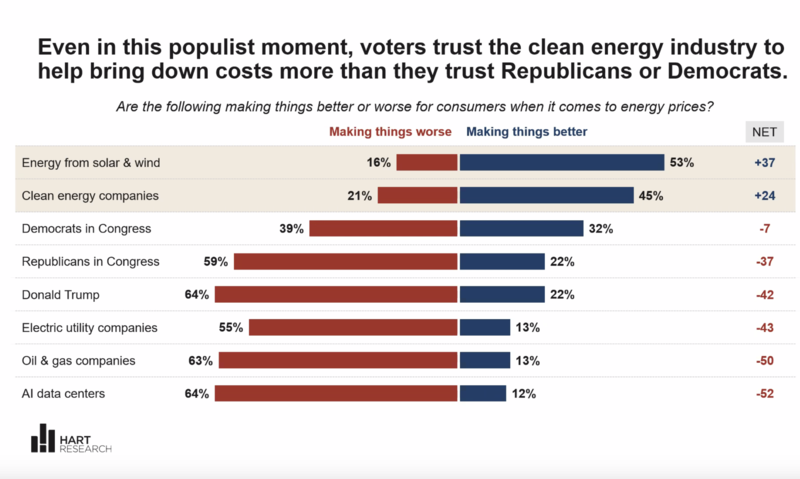
Campbell also challenged the notion that clean energy is a liberal-coded idea that only appeals to voters on the far left, noting that a majority of swing district respondents said that clean energy was having a positive impact on energy prices.
“Those who voted for a Republican candidate say that using more clean energy rather than less would make energy more affordable by a margin of 40% to 29%,” Campbell said. “Not overwhelming, but very much on the positive side rather than on the negative side.”
However, there is work left for Democrats to do, Campbell noted, citing polling data that showed only about a third of voters say Democrats are making things better for consumers.
And the voters trust them to do that work, Campbell explained, pointing to a comparison between voters surveyed in January, and the most recent survey, conducted between Oct. 26 and Nov. 6.
In January 30% of voters surveyed said they trust Republicans more than Democrats to lower monthly energy bills compared to 26% who had more faith in the Dems.
However, the more recent survey found 43% of respondents trusted Democrats to lower their energy bills, compared to 24% who had more faith in the Republicans.
In the polling data from October and November, 45% of respondents also said they had more faith that Democrats would prioritize the interests of the consumer over corporate profits compared to 23% who placed their trust on this issue in Republicans. Voters also trusted Democrats more on issues like regulating AI data centers, lowering the cost of gas and diesel and improving the reliability of the electrical grid.
“The narrative around these issues has changed dramatically from what we were hearing in previous elections,” Geoff Garin, the president of Hart Research, told reporters at the top of the press briefing.
“The old Republican mantras of ‘drill, baby, drill’ and American energy dominance were and are wholly irrelevant to the current energy debate,” Garin continued. “Instead, the energy debate now is focused on Trump’s ill-conceived war, on data centers, on price gouging by oil companies, and on Trump’s war on clean energy. Every one of these elements led to a damning indictment of Republicans and gave Democrats the high ground in the energy debate.”
Lansing, MI