Congress has to act first before nuclear campuses take shape, US Energy secretary says
Nov 11, 2026 | 1:20 pm ET
Description
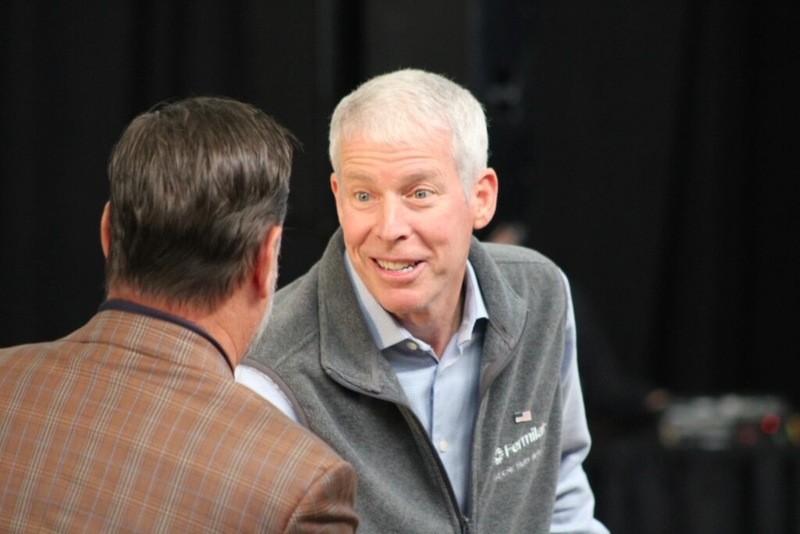
U.S. Energy Secretary Chris Wright greets attendees Tuesday, Nov. 10, 2026, at the Dufresne Community Center in Luling. (Photo by Greg LaRose/Louisiana Illuminator)
LULING — The Trump cabinet’s top energy official acknowledged Tuesday that Congress will have to approve the creation of a second U.S. nuclear waste disposal site before the administration’s nuclear energy visions can become reality.
Chris Wright, secretary of the U.S. Department of Energy, said he believes lawmakers back the agency’s proposed nuclear lifecycle innovation campuses. The sites would encompass all aspects of nuclear energy production — from uranium enrichment to permanent storage of the end waste product.
“I think we have bipartisan support on the effort that we’re doing, so we don’t expect trouble getting that done,” Wright said during a visit to Louisiana to announce a federal loan for energy exploration off the state’s coast.
Earlier this year, the Energy Department asked states to submit proposals to host nuclear lifecycle innovation campuses and received applications from 26 states. Idaho, Louisiana, Oklahoma, Tennessee, Utah and West Virginia were chosen as finalists.
West Virginia Gov. Patrick Morrisey has since backed out of the competition, under pressure from residents who oppose storing nuclear waste inside old coal mines.
For any campus to move forward, Congress has to approve a permanent storage location for the waste material left over from spent uranium rods. Nuclear facilities currently store the used material on site, first in steel-lined, covered concrete pools and then years later in steel and concrete dry casks after they have cooled.
The only existing approved permanent storage site is Yucca Mountain in Nevada, which was first proposed nearly 40 years ago and has yet to accept any waste. There’s been no federal funding provided to complete the project since 2011, and the site’s neighbors have opposed advancing with permanent waste disposal plans.
“We do need to have a statutory change to make it so it’s not exclusively tied to Yucca Mountain,” Wright said. “… To actually move forward, we need an act from Congress.”
No one in Congress has stepped up to carry the needed legislation since the Energy Department first asked for nuclear campus applications in January. Republicans will lose their majority in both chambers on Jan. 3.
Louisiana’s pitch to the Trump administration calls for using underground salt domes off its coast as permanent nuclear waste storage sites, which the legislature would also have to approve. State officials also envision Louisiana becoming a hub for uranium fuel rod recycling, noting that only 5% of the fuel they contain is used in reactors. They have pointed to technology in France that can extract 80% of the unused uranium.
Gov. Jeff Landry has also championed bringing nuclear energy manufacturing to Louisiana in anticipation of growing demand for small modular nuclear reactors. Their proponents say they are ideal for localized placement to meet the high electricity needs from industrial facilities such as data centers.
The industrial construction company Turner Industries announced in April it would add a combined 1,000 jobs at its New Iberia and Port Allen facilities to create components and piping for the next generation of nuclear reactors.
The Department of Energy could pick more than one state for a nuclear lifecycle innovation campus, though only one site in each state will be chosen. Wright confirmed Tuesday the choices are still expected to be made public later this year or early 2027.
St. Charles Parish and West Feliciana Parish, both home to nuclear power plants, have expressed interest in being selected for a nuclear campus, as have East Feliciana Parish and the authority that oversees Port Fourchon, the closest point of access for proposed salt dome storage.
The Trump administration has not pledged any financial support or preferential permitting treatment for the states picked, while promoting the concept as an avenue toward building the U.S. nuclear industry.
China is projected to overtake the United States in nuclear power production within the next 10 years, according to the Institute for Energy Research. Only one nuclear energy project, the Vogtle 3 and 4 reactors in Georgia, has come online in the U.S. in the past 10 years. China, meanwhile, has tripled its nuclear generating capacity over the same period.
Baton Rouge, LA