Spanberger, Va. Democrats pitch medical debt relief, data center limits for 2027
Nov 11, 2026 | 5:28 am ET
Description
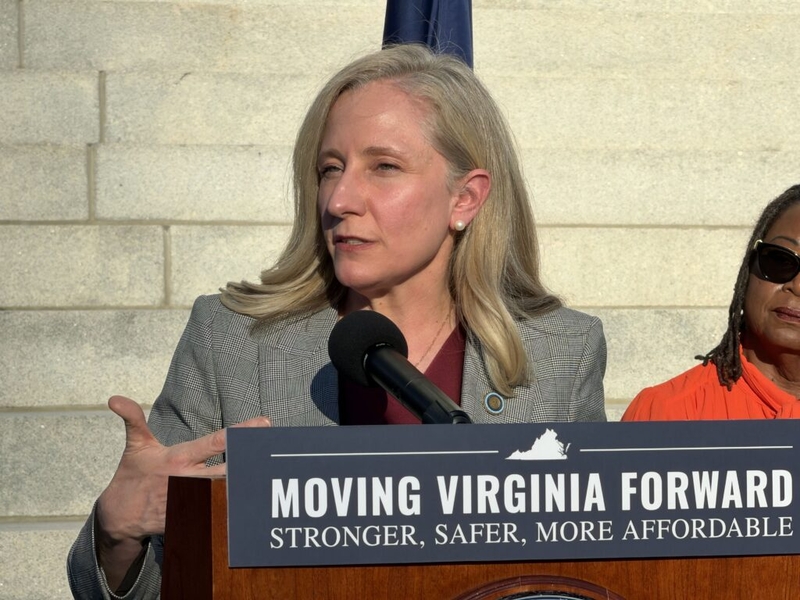
Gov. Abigail Spanberger on Tuesday unveiled Virginia Democrats' slate of legislative priorities ahead of the General Assembly session that starts in January 2027. (Photo by Shannon Heckt/Virginia Mercury)
Gov. Abigail Spanberger and Virginia’s top Democrats unveiled their 2027 legislative agenda Tuesday, proposing medical debt relief, limits on classroom screen time and tougher oversight of data centers and artificial intelligence as they seek to address rising costs for Virginia families.
Announced on the South Portico of the state Capitol in Richmond, the Moving Virginia Forward Agenda builds on Spanberger’s first-year affordability initiatives while adding proposals to address workers, help small businesses and crack down on AI-generated child sexual abuse material.
Spanberger said healthcare, housing and energy costs remain priorities for her administration, warning that high living expenses could make Virginia less attractive to workers and businesses.
“If the cost of living is too high, it impacts where talented people choose to live and work, where they choose to build their lives and their businesses,” she said.
The lawmakers presented several data center proposals, including requirements for local approval of facilities using more than 25 megawatts, a ban on nondisclosure agreements with local officials and stronger oversight of cooling water use.
Democrats also want to encourage solar development on previously developed land and working farms and create a new disaster preparedness declaration.
The leaders repeatedly criticized President Donald Trump’s administration, blaming federal policies for adding to families’ financial uncertainty.
Tuesday’s announcement comes ahead of another legislative election year. Democrats won 64 of the House of Delegates’ 100 seats in November 2025, a net gain of 13 that gave them a 64-36 majority. All 40 seats of the state Senate will be on the ballot in November 2027, along with the House.
Sen. Louise Lucas, D-Portsmouth, the Senate’s president pro tempore, did not attend Tuesday’s event. She was indicted on federal corruption charges last month, a situation the governor declined to comment on Tuesday.
Spanberger said the Democratic agenda is not yet complete, with more proposals to be announced around Virginia in the coming weeks.
House Speaker Don Scott, D-Portsmouth, invited Republicans to work with Democrats on the legislation, saying affordability concerns extend across party lines. Senate Majority Leader Scott Surovell, D-Fairfax, said lawmakers could take steps to help Virginia families even when federal policies are beyond their control.
Healthcare: Debt relief and upfront prices
State Democrats want to create a medical debt forgiveness program that would work with a national nonprofit to buy outstanding debt from Virginia healthcare providers at steep discounts and cancel it.
North Carolina, Michigan, Illinois and Arizona have established similar programs. Spanberger said the goal is to eliminate millions of dollars in medical debt.
The package would also require healthcare providers and insurers to give patients good-faith cost estimates before non-emergency treatment. Hospitals would face new financial assistance requirements, including offering payment plans.
“No one should walk into a doctor’s office with no idea what they’ll owe when they walk out,” Spanberger said.
Scott said medical bills should not push families into financial hardship. Sen. Lashrecse Aird, D-Henrico, described hearing from a Virginian who was left with debt after an ambulance ride and treatment following an accident.
The proposals follow legislation Spanberger signed earlier this year to address prescription costs, including restrictions on pharmacy benefit managers, which negotiate prices among insurers, drug manufacturers and pharmacies.
The 2027 agenda, however, does not specify how the medical debt forgiveness program would be funded or who would qualify.
Data centers and energy: Greater oversight, expanded solar
Spanberger highlighted some of her previously announced Data Center Accountability Framework, which outlines potential legislation that would tighten regulations on the data facilities growth and oversight as public pressure to rein in their growth intensifies.
Among those proposals is a move to ban nondisclosure agreements between data center companies and local governments. Del. Kathy Tran, D-Fairfax, said at Tuesday’s event that the controversial documents have left local residents in the dark as their elected officials make these development decisions.
“Communities deserve transparency, and a meaningful opportunity to weigh in on projects that will have lasting consequences for their neighborhoods,” Tran said.
The governor’s priority list also includes a proposal to eliminate by-right approval for data centers using more than 25 megawatts of power and require local approval regardless of prior project approvals.
By-right permitting is often allowed in specific zones deemed “technology overlay districts” or growth zones of counties. Projects can proceed under existing zoning without a project-specific rezoning or special-use vote in view of the public.
Also in the governor’s plan are ways to protect “water scarcity” areas from evaporative cooling methods for the centers, putting more costs of transmission infrastructure onto those companies, and several other ideas. Official bills have not yet been filed.
Legislators also promised an increased investment in solar power on brownfields and in agrivoltaics — the method of putting solar panels on active farms that can maintain their crops concurrently.
“That means expanding solar without paving over Virginia’s working families, working farms, and forests,” Scott said. “Through agrivoltaics, the former keeps forming, and the land produces food, and power at the same.”
Housing: Building near transit
Spanberger wants to increase housing near public transportation and give priority to affordable housing and transit-related infrastructure when the state sells or leases land.
She said building homes near transit could help residents save on both housing and transportation. Scott called for more walkable neighborhoods where people can reach jobs and businesses without relying as heavily on cars.
Surovell said additional housing near transit stations and above retail spaces could make it easier for younger workers to live near growing employment centers.
The proposals follow this year’s debate over “housing near jobs” legislation, which would allow apartments, townhomes and mixed-use developments in certain commercial corridors. Republicans raised concerns about the state overriding local zoning decisions.
Spanberger also signed legislation this year using Virginia’s bonding authority to support affordable housing and expanding efforts to reduce evictions.
Education: Less screen time, more career pathways
Under a Democratic proposal lawmakers previewed Tuesday, Virginia school divisions would have to limit unnecessary student screen time, prioritize teacher-led instruction and regularly evaluate the technology used in classrooms.
Districts would also be required to develop plans to reduce excessive or ineffective use of digital learning tools.
The proposal goes beyond restrictions on students’ personal cellphones to address technology used during instruction.
Parents and former educators urged state officials in August to strengthen classroom technology guidelines, calling for greater use of physical books, handwriting and face-to-face learning.
Senate Democratic Caucus Chair Mamie Locke, D-Hampton, said Tuesday technology can help students learn but should also not distract them or interfere with instruction.
Locke also called for additional investments in early childhood education, teachers, literacy, mathematics and school facilities.
Meanwhile, lawmakers are also considering changes to how Virginia funds public education. A legislative subcommittee approved hiring an expert last month to examine alternatives to the state’s decades-old K-12 funding formula.
Democrats also want to expand pre-apprenticeship and youth apprenticeship programs, improve access to career training for underserved populations and establish quality standards.
Transportation and childcare assistance would help more Virginians participate.
AI regulation: Child protection and worker pay
Democrats proposed banning the creation, possession and distribution of AI-generated child sexual abuse material and holding AI companies accountable when their platforms or models produce such content for users.
House Majority Leader Charniele Herring, D-Alexandria, said the legislation would establish civil penalties for companies whose technology allows the material to be created.
She warned that advances in artificial intelligence could give predators new ways to exploit children while making it harder to identify victims and prevent abuse.
“The risks to our children and our communities are real, and they are growing,” Herring said.
Another proposal would restrict employers from using AI and machine learning to determine the lowest wage or salary a job applicant might accept based on surveillance data and assumptions about their personal finances.
Spanberger said employers should not be allowed to use the technology to take advantage of applicants’ financial circumstances.
Small businesses: A central source of help
The administration wants to expand the Department of Small Business and Supplier Diversity’s role in helping entrepreneurs find financing, technical assistance and other resources.
Spanberger said small business owners often struggle to navigate the various programs offering capital, counseling and government contracting assistance.
Under the proposal, the department would serve as a central point of contact, directing businesses to programs that fit their needs.
Aird said workforce development is another challenge, particularly for businesses looking to expand and hire local workers who have the necessary skills.
Republican lawmakers respond, as legislature stares down January return
In a statement Tuesday afternoon, House Minority Leader Terry Kilgore, R-Scott, dismissed the Democrats’ affordability message.
“If there was anything ‘affordable’ in that press event, I didn’t hear it. There was nothing that will bring down power bills, nothing that will end the car tax, nothing that will end the grocery tax, nothing that will help young people get started in life.”
Kilgore said House Republicans would put forward their own proposals to cut taxes for working families, lower electricity bills and expand economic opportunities.
The bills lawmakers described Tuesday don’t yet appear in Virginia’s Legislative Informative System. Drafts of all bills must be available for public review by Dec. 31, according to state law. The 2027 General Assembly session is slated to convene on Jan. 13.
Richmond, VA