A ‘Green Wave’? New Crop of Climate Champions Heads to Albany
Nov 11, 2026 | 5:00 am ET
Description
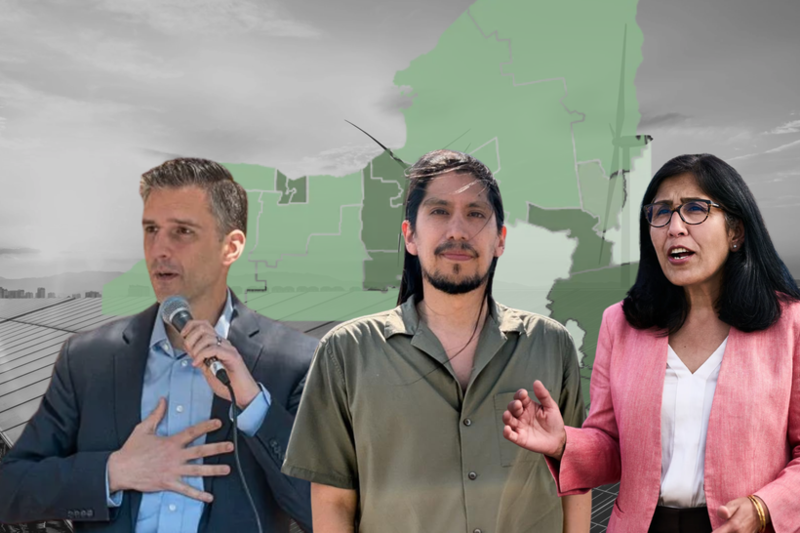
Adam Bojak, left, Illapa Sairitupac, and Lisa Kaul all championed climate action and won their recent elections. / Photos: Dutchess County Government; Illapa Sairitupac and Adam Bojak campaigns; hrui / Getty Images; Map: Kyle Constable / New York Focus | Illustration: New York Focus
After weathering a stinging blow in Albany this year, New York’s climate movement could be back on the offensive following last Tuesday’s elections.
The newly expanded Democratic supermajorities in the state Assembly and Senate include some 50 newcomers to the legislature, among them a slew of climate-minded progressives.
In the Hudson Valley, county legislator Lisa Kaul, who’s said she “entered electoral politics because I really wanted to do something about climate change,” flipped a Republican-held Senate seat.
In the Buffalo area, democratic socialist Adam Bojak — a housing rights lawyer who wants to build green public housing and expand transit — won an Assembly seat.
And across the state, candidates rode a tide of anger over energy-hungry data centers and high utility bills to oust incumbents.
Altogether, at least 15 incoming Senate and Assembly members campaigned explicitly on climate issues, according to a New York Focus tally. About a dozen championed greater public control of the energy system — through building more publicly owned wind and solar, taking over local utilities, or both.
They will be entering Albany at a rocky time for the state’s energy transition. President Donald Trump has stymied New York’s plans to build offshore wind, and the repeal of federal clean energy tax credits is throttling efforts to build renewables on land, too. Governor Kathy Hochul pushed through a major rollback of New York’s flagship climate law earlier this year, saying Trump’s policies made it impossible to meet the state’s targets.
Will the new green cohort be able to move the needle on Albany climate debates? Some advocates think so.
The New York League of Conservation Voters, one of the state’s most prominent environmental groups, declared a “green wave.” More than 95 percent of the group’s endorsed candidates won their races, according to its tally.
“This is a repudiation of Trump’s energy policy … the fossil fuel–only approach, as opposed to really building out the clean energy that you need to help stabilize energy prices,” said the group’s president, Julie Tighe.
Brown University researchers estimate that high gasoline prices have cost New Yorkers an extra $3.3 billion since the start of the Iran war. “It’s a real wake-up call that we don’t need to be on this fossil fuel rollercoaster ride,” Tighe said.
It was that anger over the spiraling cost of living — not climate change — that defined the elections. But a growing number of politicians, both nationally and across New York, see the solutions as intertwined.
“The climate crisis is at the heart of our affordability crisis,” said Kaul, the Hudson Valley senator-elect. “It’s really about whether we can afford to deal with extreme weather events that are damaging infrastructure.”
On the campaign trail, she blamed climate change for driving up the costs of roads and bridges, insurance, and food, and accused the electric and gas utility Central Hudson of “fleecing us.” Her answer? “Affordable solar power on every roof” and higher state subsidies to defray the upfront costs of electric vehicles and heat pumps.
In addition to Kaul, at least four other incoming lawmakers want to expand access to community solar. About the same number have voiced support for “cap and invest” — a carbon pricing program that was at the heart of New York’s climate plan, but that Hochul has put on ice.
Albany’s growing caucus of democratic socialists has its own policy priorities, including state support for green retrofits of schools — a top item for New York City mayor Zohran Mamdani — and stronger implementation of the Build Public Renewables Act. Several are championing a bill that would enact a public takeover of Central Hudson, and at least two have floated a similar push for Con Edison.
Assemblymember Sarahana Shrestha, who sponsors the bill to take over Central Hudson, said the election results reflected wider public pressure to take profit out of the energy system. She campaigned alongside Kaul — not a DSA endorsee — who has called the Central Hudson bill a priority.
Shrestha said an expanded progressive bloc could set the tone for the wider Democratic conference.
“The small group of progressives have always been very effective at setting the agenda,” she said. “We expect that to be obviously more impactful going in next year.”
Perhaps the most unifying theme on the campaign trails, though, was data centers.
Nyack mayor and senator-elect Joe Rand, who unseated GOP incumbent Bill Weber, backed a data center moratorium bill this spring that his opponent voted against. He won by eight points.
DSA endorsee Adam Bojak, of Buffalo, said his campaign had its most viral moment with a social media clip declaring, “F*ck AI. NO data centers.”
Bojak also took Hochul to task in his campaign platform for weakening New York’s climate law this spring. But it appears Hochul’s climate gamble did not hurt her electorally.
A pair of influential green groups spent more than $500,000 supporting her this fall after fighting her bitterly over the rollbacks. That’s even as Hochul has over the past year espoused an “all of the above” energy strategy — including approving new gas infrastructure — that much of the climate movement sees as incompatible with the state’s emissions targets.
Asked whether she felt vindicated in that approach after her 20-point win over GOP challenger Bruce Blakeman, her office said it was a necessary response to Trump’s war on renewables.
“The Governor remains firmly committed to keeping New York’s status as a clean energy and climate leader while also open to projects that can enhance our grid capacity as long as they meet all required state laws and regulations,” said Hochul spokesperson Ken Lovett in an email.
New lawmakers with their own ambitions on clean energy will have to contend with Hochul’s tight grip over this arena. Most of the big items currently at play are in the governor’s court.
The one-year data center moratorium that passed the legislature this June is awaiting her signature or veto. Meanwhile, she issued her own version over the summer, asking her energy regulators to study the facilities’ impacts on the grid and environment. It’s not clear where she stands on the legislature’s version, which would give her environmental agency a stronger role in controlling pollution from the facilities; Hochul said Tuesday that she’ll give it a “very thoughtful review.”
“The climate crisis is at the heart of our affordability crisis.”
—Lisa Kaul, Hudson Valley senator-elect
Then there’s cap and invest, which was supposed to anchor New York’s efforts to cut emissions. After this spring’s climate law rollbacks, the state has a new 2028 deadline to enact a plan for meeting its targets — and a resurrected cap and invest program remains the top candidate. The legislature put Hochul’s agencies in charge of the process, and she has given no indication yet of whether she plans to reboot it in the new year.
Vanessa Fajans-Turner, executive director of Environmental Advocates NY, hopes pressure from incoming members will help get the plan back on track.
“The anti–special interest backlash we’re seeing does support the cap and invest model, which is to make polluters pay for energy transitions and rising energy costs,” she said.
“There’s a really big, exciting window of opportunity here,” Fajans-Turner added. “There are a lot of new leaders … who are going to be really strong allies.”
The legislature will have more of a say in other arenas. The past two state budgets have each allocated $1 billion for clean energy funding. Leading green groups want to hike that to $3 billion, on par with what a cap and invest program is supposed to raise.
All four incoming legislators reached by New York Focus for this story voiced support for renewing or increasing the state’s clean energy spending.
On thornier debates, though, at least one incoming lawmaker said it’s too early to draw hard lines.
Senator-elect Sarah Rogerson, a Saratoga-area Democrat, campaigned on “major investments in clean, affordable energy,” and unseated the longest-serving sitting member of the legislature. She said Hochul’s all-of-the-above approach made sense.
“I do think it’s smart to take a look at every option and to not take any off the table immediately,” she said.
But Rogerson, a law professor who has lately been studying climate migration, says she won’t be downplaying climate change, as many Democrats have done since Trump’s election.
“This is an issue that’s really, really a top priority for especially a lot of younger voters,” she said. “It also requires elected officials to prioritize it.”
Bojak, who has two children under the age of five, was more emphatic.
“These fights are existential and we are not going to back down on the things that are going to keep this planet alive,” he said.
Albany