High court axes Oklahoma Legislature’s efforts to overhaul initiative petition process
Nov 10, 2026 | 5:23 pm ET
Description
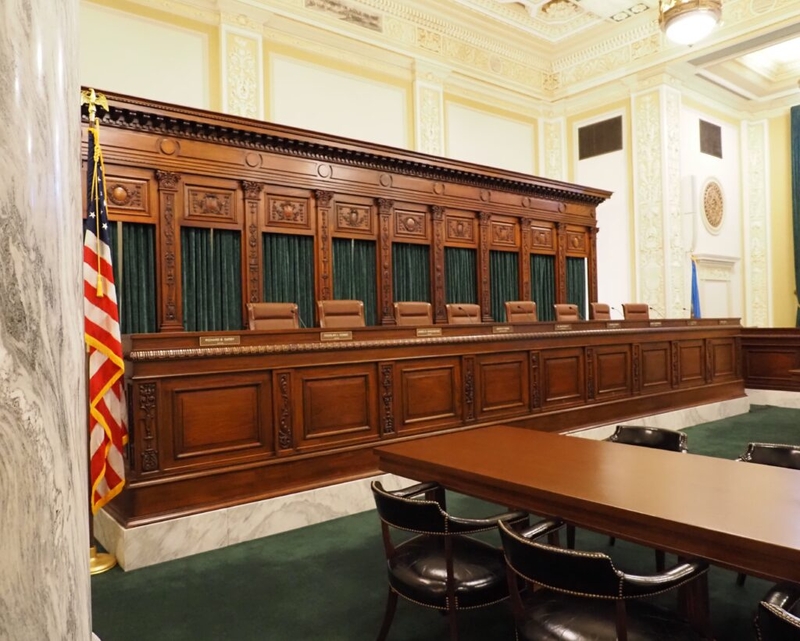
The Oklahoma Supreme Court chamber is pictured Dec. 7, 2023. (Photo by Carmen Forman/Oklahoma Voice)
OKLAHOMA CITY – The Oklahoma Supreme Court on Tuesday tossed out a controversial law that made it more difficult for Oklahomans to get their issues on the ballot.
In a 5-4 ruling, the state’s high court found that Senate Bill 1027, passed into law in 2025, violated the U.S. and Oklahoma Constitution, was legally void and lacked enforceability.
Instead of severing the offending portions of the law and letting the rest remain, Oklahoma’s high court tossed out the entire statute.
Sen. David Bullard, R-Durant, and House Speaker Kyle Hilbert, R-Bristow, were the authors.
Hilbert said the law protected the integrity and fairness of the initiative petition process.
“We encourage the state to appeal this decision and continue defending the Legislature’s authority to establish reasonable safeguards for this important process,” Hilbert said. “The fight to uphold the integrity of Oklahoma’s initiative petition process is not over.”
Bullard declined to immediately comment, saying he wanted to read the opinion.
Senate Bill 1027 was among a number of recently passed laws that made it more difficult for people to use the initiative petition process to collect signatures to get issues on the ballot.
The law put caps on how many signatures could be collected by county. For a change in state law, it limited the number of signatures that could be gathered to 11.5% of the number of votes cast in the county during the most recent general election for governor. For a constitutional change, it was 20.8%.
It also sought to put more restrictions on signature collectors and to control the wording contained in a petition’s description.
The signature restriction caps pose broad First Amendment problems and do not accomplish the stated goal of rural participation, the court ruled.
Despite the state Constitution guaranteeing all registered voters the right to sign initiative petitions, the law prohibited them from signing the petition once the cap is met, the court said.
“Never before have legal voters been outright prohibited from signing an initiative or referendum petition,” the court said. “In short, this Act severely disenfranchises voters in all 77 counties.”
The court noted that the Legislature’s caps would disproportionately harm rural residents living in less populated counties because a fewer number of people would be eligible to sign petitions than in more populated urban areas. The high court said it would result in fewer petitions being circulated in rural areas.
The new law’s restrictions on the wording of the petition’s gist, or description at the top of the signature page, also violated the First Amendment, the court ruled.
The court found the requirement to be prior restraint, a type of government censorship that attempts to prohibit free speech ahead of time.
The law’s ban on incentive-based compensation, such as pay based on collected signatures, is unconstitutional, the opinion said, adding that the defendants failed to justify the burden.
The court found that the law’s prohibition of contributions from certain entities restricted political speech.
Requiring petition circulators to disclose if they are being paid and by whom also violates the First Amendment, the court ruled.
It found that the law’s requirement that circulators be registered to vote in Oklahoma violated the First Amendment.
The U.S. Supreme Court had previously ruled unconstitutional a similar effort in Colorado to require that state’s signature collectors to be Colorado residents, Oklahoma’s Supreme Court said.
Justices James Winchester, James Edmondson, Douglas Combs, Noma Gurich and Richard Darby voted to find the law unconstitutional.
Chief Justice Dustin Rowe, Vice Chief Justice Dana Kuehn, Justice John Kane and Special Justice James R. Huber dissented. Justice Travis Jett recused.
The now defunct law was passed after citizens successfully used the initiative petition process to expand Medicaid, legalize medical marijuana and implement criminal justice reform, all issues lawmakers declined to pursue.
Amber England, CEO of Strategy 77, worked to get Medicaid expansion on the ballot.
She said the new rules meant only the wealthiest interests would be able to reach the ballot.
“Having led ballot campaigns across Oklahoma for years, I’ve seen what voters can do when they’re trusted to fix what the Legislature won’t,” she said. “I’ve seen what happens when politicians try to manipulate the process and take power out of the hands of the people. Today’s ruling means Oklahomans keep the one tool that works when their government doesn’t.”
Senate Minority Leader Julia Kirt, D-Oklahoma City, was among those voting against the measure.
“This ruling puts power back where it belongs – with the people,” she said.
Oklahoma City, OK