Young, diverse voters showed up for midterms as older, Trump voters stayed home
Nov 10, 2026 | 4:22 pm ET
Description
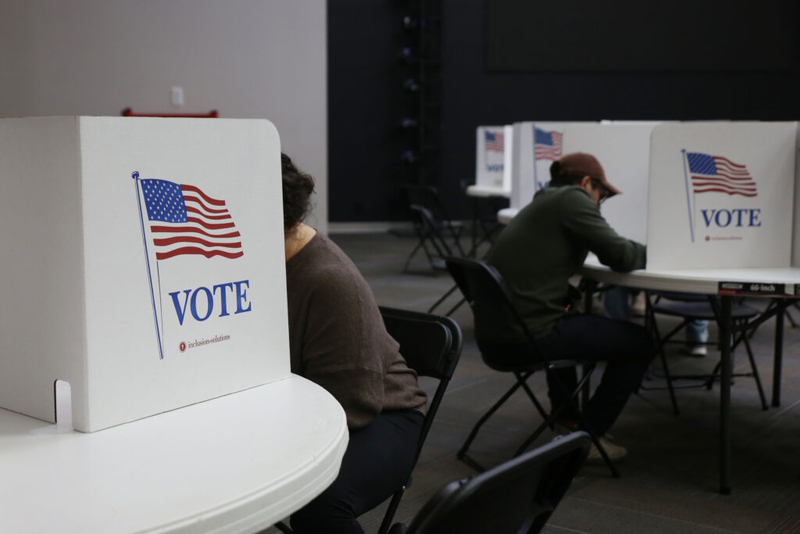
Sioux Falls residents vote in South Dakota's general election on Nov. 3.Turnout fell to a historic low in the state as Democrats gained in the Republican-dominated legislature. Democratic gains in many states could be explained more by the turnout gap than by voters switching their allegiance. (Photo by Makenzie Huber/South Dakota Searchlight)
Much of the midterm “blue tsunami” came from diverse, enthusiastic young voters with financial struggles who flocked to the polls, and also Trump voters sitting out the election, according to two experts analyzing turnout in a handful of states with detailed results.
The results, they say, could mean a mandate for bringing costs down and more power for young Latinos, but also a danger for Democrats if Republicans rally back to the polls in 2028.
“It looks like more Trump voters who didn’t vote Republican stayed home rather than switching (to Democrats),” said Lenny Bronner, founder of Broome Street Labs and a data scientist formerly with the Washington Post, based on his analysis of 13 states with detailed results.
“Those voters are easier for the GOP to win back than those who chose a Democratic candidate,” Bronner said.
Bronner estimated 75% of Democratic gains came from a turnout gap and about 20% from Republicans switching sides and voting for Democrats.
His analysis included turnout data for Texas, Georgia, South Carolina, Colorado, New Mexico, Virginia, North Carolina, Arkansas, Iowa, Florida, West Virginia, Minnesota and Michigan. The share of Democrats’ gain that came from a turnout gap ranged from 40% for Texas to 133% for Michigan among the states he studied; some states had only partial detailed results.
Bronner wrote on X (formerly Twitter) that partial results in Texas showed that voters flipped their ballots more than expected; 45% of Democratic gains there came from voters switching away from Republicans. “So far, Texas is the only state where our model indicates that persuasion explains more of Democrats net gain than turnout does!” he wrote.
A University of Florida political science professor, Michael McDonald, also saw a turnout surge for young voters faced with high grocery bills, student loan debt and sluggish wages, based on detailed results from Georgia and Colorado. Trump’s older voter constituency was more likely to stay home, he wrote in a Substack post.
In both Colorado and Georgia, 18- to 25-year-olds had the biggest jump in turnout compared with the 2022 midterms, he wrote, while it fell for voters older than 40.
“This all makes sense when you realize that we just witnessed the most diverse electorate for a midterm election in U.S. history, with big increases over 2022 in Latino turnout,” McDonald wrote. “Latinos are markedly younger than whites, so if their turnout increases it means more younger voters are in the mix.”
Democrats romped in state elections. What will they do with their newfound power?
Even in Florida, where Republicans continued to dominate elections, GOP turnout was lower than in 2022 despite a registration drive that increased Republican registration by 400,000, McDonald wrote in another Substack post. Republican Gov. Rick DeSantis’ drive to purge voter rolls, affecting mostly Democratic and unaffiliated voters, may have played a role, he wrote.
“DeSantis’ shrewd politics appears in part due to suppressing Democrat and unaffiliated votes through a massive voter registration purge that pushed Florida red, rather than rallying Florida Republicans to vote,” McDonald wrote.
On a statewide basis, midterm turnout increased almost 13 points in Mississippi since the last midterms, as the state appears close to electing its first Black senator since Reconstruction. Turnout fell to a historic low in South Dakota, where Republicans still dominate voting.
The University of Florida’s turnout calculations provide a window into overall turnout, which it measures as a share of voter-eligible population, excluding noncitizens and ineligible felons. McDonald did the calculations for the University of Florida’s Election Lab, and Stateline compared them to 2024 and 2022 turnouts for a state-by-state map.
The analysis shows the highest turnout for 2026 in Maine, Minnesota and Michigan, all at more than 63%, and lowest in West Virginia (33.3%), Oklahoma (37.1%) and Hawaii, Indiana and Tennessee (all 38.2%).
South Dakota’s midterm vote remained heavily Republican, though Democrats gained legislative seats for the first time in 18 years. They took four new seats, for a total of 12 in the 105-seat legislature.
South Dakota had higher turnout in 2022, possibly in part because of contentious statewide ballot measures for Medicaid expansion, which passed, and marijuana legalization, which failed.
Stateline reporter Tim Henderson can be reached at [email protected].