Likely Speaker-elect Reives signals bipartisan approach as Democrats flip NC House
Nov 10, 2026 | 2:20 pm ET
Description
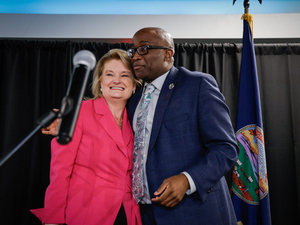
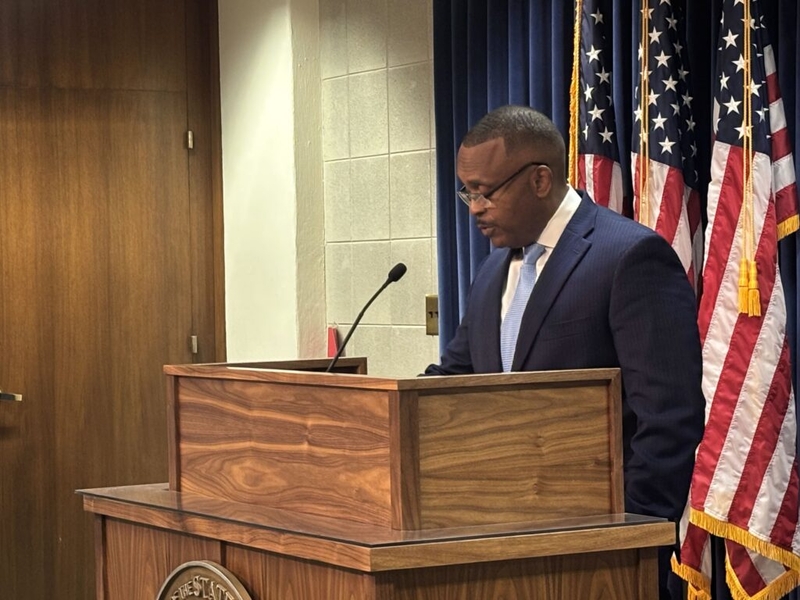
North Carolina House Democratic Leader Robert Reives speaks to reporters on Nov. 10, 2026. (Photo: Christine Zhu/NC Newsline)
With Democrats winning a near-supermajority in the North Carolina House, likely House Speaker-elect Rep. Robert Reives said Tuesday he’s open to bipartisan efforts to lower costs across the state.
“Compromise is not capitulation. Compromise is the job,” Reives, a Democrat from Chatham County, told reporters during a press conference Tuesday.
Democrats flipped control of the North Carolina House during last week’s elections, gaining a majority for the first time in 15 years. They’ll hold a 71-48 advantage with one independent in the 2027 term. In the state Senate, in unofficial results, it appears Republicans will hold onto a narrow 26-24 majority, with one race possibly subject to a recount.
Reives said the House Democratic Caucus will meet early next week for an organizational meeting as lawmakers return to Raleigh for a lame duck session. Members will announce key legislative leadership roles after that. However, Reives announced last week he has secured majority support in his caucus for the speakership.
Republicans have controlled both legislative chambers in North Carolina since 2011, often with a veto-proof supermajority. That’s allowed the party to sideline Democratic governors. Lawmakers passed measures to redraw congressional and legislative districts, limit reproductive freedom, boost private schools, and expand firearm access.
NC Senate Democratic leader sees a path to bipartisanship next year
When lawmakers return next week, Republicans will still hold veto-proof or near-veto-proof majorities in both chambers. Their terms don’t end until Dec. 31.
During past lame duck sessions, Republicans have stripped power from incoming Democratic elected officials and cut their agency staffing, as well as making changes to election law and proposing constitutional amendments, all along strict party lines. In 2024, lawmakers passed a 131-page bill branded as Hurricane Helene relief, but it also made drastic changes to state government.
Reives is hoping this year will be different.
“This is the first opportunity to show what kind of atmosphere we’re going to have next year,” Reives said. “If we come in here with the lame duck sessions that we’ve had every cycle since I’ve been here, then that will be a signal to the caucus that there is no interest in working with us and there’s no interest in any bipartisanism or camaraderie.”
Reives applauded his GOP counterpart, Speaker Destin Hall, for bipartisanship during the 2025-2026 legislative biennium. Republicans elected Hall, a representative from Caldwell County, to the position two years ago. Hall succeeded recently ousted Republican Congressman Tim Moore, who was state House Speaker for ten years.
“Speaker Hall did an amazing job of working with us, and we passed the budget,” Reives said. “First time that we passed a bipartisan budget in this building since Republicans took over, so I know the House Republicans are ready to get to work.”
Looking ahead to next year, Reives said he wants to tackle affordability issues when it comes to housing, groceries, energy and healthcare.
“We’re going to work as hard as we can to make life more affordable,” he said.
More than 3 million North Carolina voters are registered as unaffiliated with a party. An independent candidate, April Montgomery, won election to serve Lee and Moore counties in the House. She’s the first unaffiliated legislator elected in North Carolina since 2010.
Reives said Montgomery ran a great campaign.
“I want her in a position that she can operate in the way that is most comfortable and aligns with her philosophies,” he said. “I want her to know that she has got 70 people who are cheering for wherever she goes. If she decides she wants to caucus with Republicans, caucus with Democrats, if she wants to caucus with nobody, I want her to be supported because she’s been elected by our people.”
Raleigh, NC