140 years later, voters may have elected second Black Kansan to hold statewide office
Nov 10, 2026 | 12:03 pm ET
Description
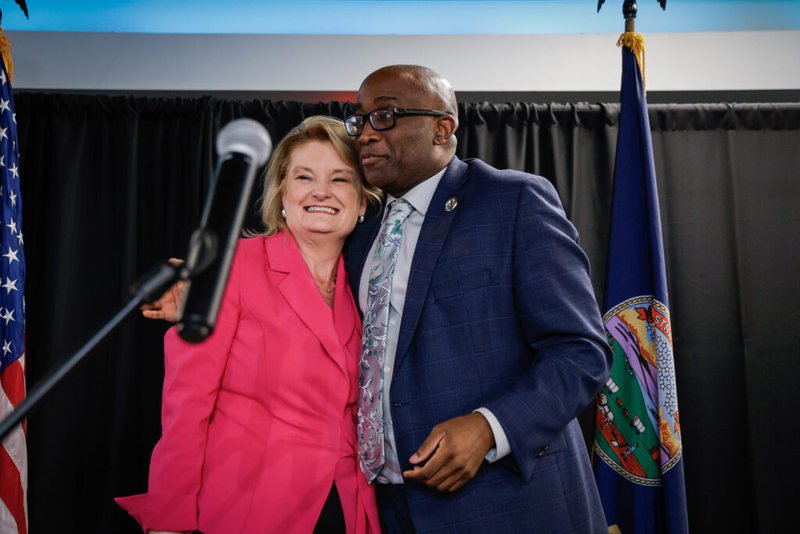
Cindy Holscher, left, and KC Ohaebosim share the Democratic ticket for the Kansas governor’s office. They appear on Nov 3, 2026, at an election night watch party in Lenexa. (Photo by Baya Burgess for Kansas Reflector)
TOPEKA — Edward McCabe was a two-term state auditor in Kansas, making waves as the first Black Kansan to serve in a statewide office.
McCabe served as a Republican until 1887, when party members forbade him from running for a third term, and that was the last time a Black Kansan served in a statewide office.
That is, until Kelechi “KC” Ohaebosim appeared to win the lieutenant governor’s seat on Nov. 3.
“That is a gap of nearly 140 years, and that is significant,” said Angeline Johnson, chair of the Kansas African American Affairs Commission.
“It is significant because representation in governance matters,” she said. “And that’s important because when the people making decisions at our state’s highest levels of elected leadership reflect the communities in which they serve, those communities and priorities are more likely to be a part of those decisions.”
While official data is still pending, early indications show Black and Latino voters across the state turned out on and ahead of Election Day to boost Democratic candidates, leading to historic victories.
The Democrats’ gubernatorial win hasn’t been called yet. The Kansas Secretary of State’s Office announced the governor’s race will undergo a close-race audit, along with two other statewide races. However, as of Monday, the Democratic ticket featuring Cindy Holscher and Ohaebosim was leading Republican Ty Masterson’s ticket by roughly 7,600 votes.
“What we do know is that this race is separated by only a few thousand votes out of more than — I’ve seen over a million cast — which reiterates the importance of voting, because it shows that each and every vote in every community counts, and we have to get out the vote,” Johnson said.
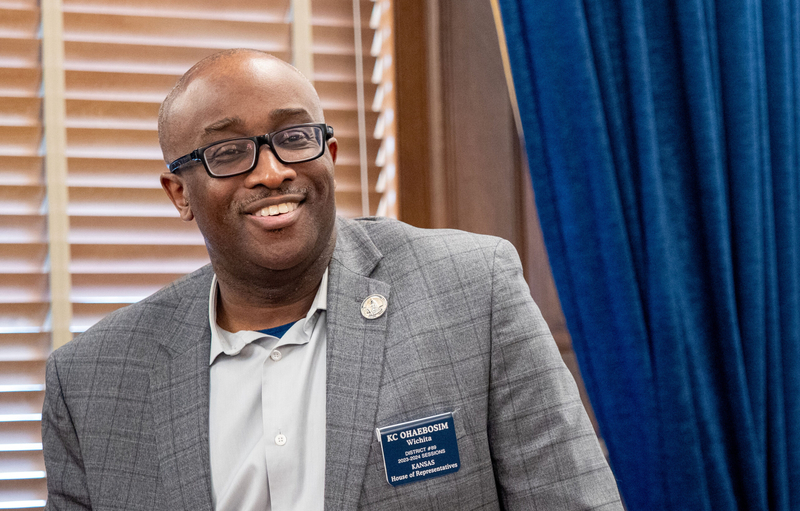
Ohaebosim has represented parts of Wichita in the Kansas House for nearly a decade. He was born and raised in Wichita and spent some of his childhood in Nigeria. One of the hallmarks of his legislative career that he highlighted during the gubernatorial campaign was voting to repeal the tax experiment instituted by former Republican Gov. Sam Brownback that left the state in a revenue crisis.
‘Blansas’
Counties in Kansas with large Black populations, including Sedgwick and Wyandotte counties, were Democratic strongholds in the 2026 election across all statewide races, according to secretary of state data.
U.S. Sen.-elect Adam Hamilton, Holscher and Democratic Attorney General-elect Chris Mann won the two counties, which are home to the state’s most populous areas, in the Wichita and Kansas City areas. The counties also are home to the state’s largest Black populations.
Social media users lauded the demonstrable effect of Black voters in Democratic victories across the country by combining the demographic group with battleground state names, including “Blexas,” “Bleorgia,” and “Blansas.”
According to a New York Times voter trend analysis, 86% of Black voters in Kansas voted for Hamilton, helping him defeat Republican incumbent U.S. Sen. Roger Marshall. Black voters make up about 5.5% of registered Kansas voters. Half of white voters in Kansas voted for Marshall.
Johnson said that when Black and Latino voters increase their turnout, the electorate more accurately reflects the people of Kansas.
Without representation in government “our needs get missed,” Johnson said, and those needs run the gamut.
Nedra Locke, the leader of the African American Democratic Caucus of Kansas, said this particular election made it apparent that every vote counts, and she celebrated the fact that Black Kansans made their voices heard.
Black Kansans in leadership positions “opens the door for future leaders,” Locke said, “and brings more perspective into public service.”
“Our concerns are just the same as the rest of Kansas,” Locke said.
She is concerned about Medicare affordability and availability as a senior citizen, the quality of public schools as a grandmother to school-age grandchildren, and comprehensive public services as someone who witnesses ineffective public infrastructure in her day-to-day.
“Representation in gender or nationality is important, and not only who they see but what they hear in the conversation and not only what they hear but the results,” Locke said.
‘Beyond a long time coming’
Not only was McCabe the first Black Kansan to hold statewide office, he was the first African American to hold public office outside of the South, according to the National Park Service.
Originally born in New York, McCabe moved in the 1870s to Nicodemus, an all-Black settlement where he became county clerk. In 1880, McCabe became the highest-elected Black official outside of the South when he won the state auditor seat in a landslide, according to the park service, which operates a national historic site in Nicodemus.
“With his skill and attention to detail, McCabe easily won re-election as state auditor in 1884,” according to the park service. “However, when McCabe made a bid to run for a third term in 1886, the Kansas Republican party refused to nominate him. This was possibly due both to the party’s dislike of candidates running for third terms and the fact that the Republican party was increasingly alienating its Black members.”
McCabe left Kansas for Oklahoma, established an all-Black settlement and university and continued to work in politics despite persistent racism.
The park service’s biography of McCabe said he “forced Kansans to look beyond race when electing officials.”
“His long political career and persistence inspired other African Americans to run for public office and break racial barriers,” it said.
The Kansas African Affairs Commission and the Democratic Caucus have prioritized engagement among Black voters in recent years, and the work isn’t ending with the 2026 election, Johnson said.
“So much of the legislation that takes place in Topeka has an impact on minority populations,” she said.
And representation of those minority populations results in more mindful and insightful legislation, she said.
The governor’s race being separated by only a few thousand votes shows the importance of voting, Johnson said. If results hold, Ohaebosim’s win means Kansans will have a government that better reflects the people, she said.
“This is beyond a long time coming,” she said.
Topeka, KS