As ‘child predator hunters’ go viral, states grapple with the risks of civilian stings
Nov 10, 2026 | 9:45 am ET
Description
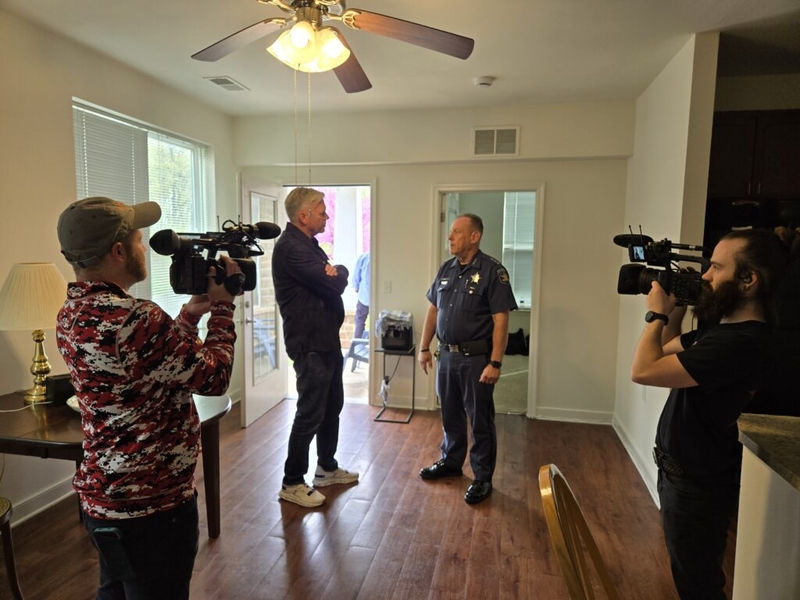
Harford County, Md., Sheriff Jeff Gahler speaks with Chris Hansen, the host of “Takedown with Chris Hansen” on the TruBlu streaming network. The sheriff’s office conducted several operations featured on the show to highlight how local investigators identify and apprehend suspected child predators. (Photo courtesy of Harford County Sheriff’s Office)
Across the country, dozens of civilian groups, or vigilantes, are posing as children online, arranging meetings with adults they suspect of seeking sex with minors and livestreaming the confrontations to thousands of viewers.
The groups say they are helping protect children and bring suspected predators to justice. But some law enforcement officials and legal experts warn that their tactics can jeopardize criminal investigations, complicate prosecutions and put public safety at risk. Public accusations can also have lasting consequences for people who are never charged with a crime, while some groups encourage their followers to pressure police to make arrests.
There is no definitive count of civilian predator-hunting groups, but dozens of groups operate across different parts of the country, including major cities. Stateline identified nearly 50 individuals or groups nationwide that have posted online content exposing suspected child predators.
When foster care kids are sex trafficked, some states fail to figure it out
For state lawmakers and law enforcement officials, the growing presence of these groups adds another layer of complexity to efforts to combat online child sexual exploitation while protecting children and preserving the integrity of criminal investigations.
“What is beyond dispute is we have a massive problem of child exploitation in this country that takes various forms,” said Mary Graw Leary, a law professor at the Catholic University of America whose work focuses on the exploitation of women and children. Graw Leary is a former state and federal prosecutor. “We cannot criminalize our way out of it only because there’s just too much of it.”
Catching and prosecuting people who sexually exploit children is important, experts say, but it addresses only part of the problem. Preventing abuse also requires teaching adults and children to recognize warning signs, creating environments where children feel safe speaking up and are heard, and holding institutions and online platforms accountable.
“The criminal justice response, I think, is appropriate, warranted, and important, but it’s not the only thing that we should be doing as a society or as communities,” said Stacy Vaughan, the vice president of growth and prevention at Childhelp, a nonprofit dedicated to preventing and responding to child abuse.
When a viral video isn’t enough
The scale of online child sexual exploitation is immense.
The National Center for Missing & Exploited Children received 21.3 million reports through its CyberTipline in 2025, including about 1.4 million reports of online enticement of children for sexual acts — a 158% increase from 2024 –– and more than 19.5 million reports involving child sexual abuse material.
Popularized by NBC’s Dateline series “To Catch a Predator,” which aired in the early 2000s, civilian predator-hunting groups use adult decoys posing as children or teenagers online to contact people they suspect of seeking sex with minors, then confront them on camera.
The accusations can make for compelling viral content. People accused of targeting children often have little public sympathy, and videos promising to expose and humiliate them can attract viewers with little interest in what happens after the camera shuts off.
The best way for these groups to be helpful would be for them to involve law enforcement when they get the first nibble on their line.
Some vigilante groups involve law enforcement only after a sting is complete, or if a confrontation turns violent. That can leave responding officers with an incomplete picture of what happened, how the encounter unfolded and whether the evidence supports criminal charges.
Digital evidence — the online conversations and promises — must be authenticated and preserved to establish its origin, integrity and handling. Recordings can also raise legal questions, experts say, including whether groups violated state wiretapping laws when capturing private conversations.
“The best way for these groups to be helpful would be for them to involve law enforcement when they get the first nibble on their line,” said Matt Irvine, a retired detective with 29 years of law enforcement experience who investigated sex crimes and cold-case sexual assaults in California and Oregon.
When police are involved from the start, he said, detectives can conduct a more thorough investigation, check a suspect’s criminal history and obtain search warrants.
The financial arrangements behind the videos can raise additional concerns if group members are called as witnesses in criminal cases. Some groups can earn advertising revenue from videos posted online, while others offer paid memberships through platforms such as YouTube, Rumble, Kick and Locals, where subscribers can get earlier or exclusive access than nonmembers to videos, updates, unedited footage and chat logs.
Those financial incentives could become relevant in court, particularly if prosecutors or defense attorneys question whether a witness had a financial interest in producing a confrontation or attracting viewers.
“If they are selling the confrontation videos and profiting from that, that would be an ethical issue in a criminal case,” said Kelly Callihan, the executive director of the Pennsylvania District Attorneys Association. “If we’re going to call them as a witness, that would have to be something that we would disclose to the defense.”
Some predator-catching groups also criticize police or prosecutors when a person is not arrested or charged, encouraging viewers to contact and complain to officials about their decisions.
“These predator groups now, I feel like, are escalating from shaming the alleged perpetrators of these acts to crossing a line where they’re shaming district attorneys who aren’t bringing these charges, even though they have valid reasons not to do so,” Callihan said.
Public confrontations
Videos of civilian predator-catching operations sometimes show violent confrontations. In one viral video from 2024, members of Dads Against Predators surround a man at an H-E-B grocery store in Austin, Texas, and strike him in the back of the head with a pumpkin.
The man, James Schellhase, filed a federal racketeering lawsuit against the Ohio-based group in September, alleging that its members assaulted him, tried to extort him and cost him his job as a chief executive.
Schellhase had been communicating online with people who later claimed to be minors, according to the lawsuit. He said he believed the interaction was a prank or scam and wanted to confront them. The group accused him of trying to meet a child for sex.
Their childhoods are on display for millions. States want to protect them.
Schellhase alleges that Dads Against Predators demanded $400,000 to keep the confrontation video from being released and that the footage was sent to his employer, according to the lawsuit. He says the encounter damaged his career. One of the group’s co-founders, Joshua Alvin Mundy, has denied wrongdoing.
Dads Against Predators has been linked to multiple suicides involving people the group filmed. The group has also faced scrutiny from law enforcement in California, Florida, North Carolina and Texas, where members have been arrested or authorities have urged them to stop their activities. In 2020, the Sandusky County Sheriff’s Office in Ohio warned the group that it could face prosecution if it continued its “vigilante efforts.”
But the concerns extend beyond physical safety. Public accusations may also target people who have committed no crime and jeopardize investigations by alerting suspects before police can gather evidence, identify additional victims or pursue other leads.
In April of this year, livestreamer Vitaly Zdorovetskiy and his crew falsely accused a 25-year-old man of trying to meet a 16-year-old girl for sex during a confrontation at a Southern California park, prompting online harassment of the man and his family. Police detained the man, but released him after questioning, and Zdorovetskiy later apologized for the mistaken accusation, but clips of the confrontation continued circulating online.
Public confrontations can also expose civilian predator hunters themselves to potential criminal charges, especially if encounters turn violent or involve threats.
For some groups, that tension has changed how they operate.
Brian Knepp founded 814 Pred Hunters in Pennsylvania in 2022 after learning that a man he had considered a friend had raped a child. The group initially focused on publicly confronting suspected predators and exposing them online, but frustration over local prosecutors’ inability to bring charges prompted Knepp to change course and seek closer cooperation with police and prosecutors.
“We wanted these guys to be held accountable, and just us exposing them, in my mind, wasn’t acceptable anymore,” Knepp said in an interview.
More states are tracking rape kits. But key support for survivors may be slipping away.
Josh Moody, chief operating officer of Alabama-based Covenant Rescue Group, a nonprofit that trains police, said effective undercover operations require preparation and coordination. The group’s training covers evidence handling, communication, intelligence gathering and surveillance, as well as avoiding conduct that could undermine a prosecution, including actions that could support an entrapment defense. The group generally does not post any content online.
“If we come in and do a one-off operation and arrest a few guys on the operation –– that’s great, but really, we want (law enforcement) to be able to continue the work,” Moody said.
Some law enforcement agencies have adopted a different approach to publicizing undercover operations, partnering with television programs while maintaining control over investigations and evidence.
Sheriffs Chris Swanson of Genesee County, Michigan, and Jeff Gahler of Harford County, Maryland, whose investigations have been featured on the TruBlu series “Takedown with Chris Hansen,” described how their agencies conduct these operations.
Swanson said G.H.O.S.T., the office’s specialized sex crimes unit, conducts investigations that can span months, involving background checks, surveillance, recorded online conversations and interviews. Investigators do not pursue people who chat online but never show up at a planned meeting location.
Since 2018, which is when the unit was founded, more than 270 people have been prosecuted in connection with these investigations, Swanson said.
He said the Chris Hansen segments take place in a controlled environment, and footage is not used in investigations. His office provides exculpatory video to both prosecutors and defense attorneys. He sees media partnerships such as the Chris Hansen show as a way to raise awareness and encourage victims to seek help. By contrast, he warned that civilian groups seeking viral content without coordinating with law enforcement can jeopardize investigations.
“We’re going to keep doing it, and we’re going to do it the right way,” Swanson said.
Gahler said his office has arrested at least 21 people in three separate operations in partnership with the show, adding that the public attention they generate serves as a strong deterrent.
“That’s part of why we do this job — to deter crime and prevent crime,” Gahler said.
Beyond the confrontation
Others disagree. Former detective Matt Irvine said public exposure can work against another important goal of an investigation: getting suspects to talk. In his experience investigating sex crimes and cold-case sexual assaults, interviews are more effective when investigators build rapport in a calm, controlled setting.
Public confrontations designed to humiliate suspects can undermine those efforts, he said, making it harder to learn what happened or whether others may have been harmed.
High-profile sex abuse case brings test for new Ohio anti-grooming law
“Blowing somebody up and blasting them across the internet is the exact opposite of the sort of psychological environment you need to create if you want to get this person to talk to you,” Irvine said.
Texas-based former prosecutor and criminal defense attorney Veronica Chittister echoed concerns about the consequences of confronting suspects and collecting evidence without law enforcement oversight.
Online confrontations can also create the impression of guilt before someone has been charged with a crime or had an opportunity to defend themselves in court.
Some people targeted by civilian predator hunter groups have pursued defamation lawsuits over the accusations made against them, though some cases have been dismissed or settled out of court.
But publicly accusing someone of a crime does not automatically amount to defamation. Generally, a person bringing a defamation claim must establish that a false statement of fact was communicated to others and caused reputational harm. Truth is a defense, and accurately documenting someone’s online conversations or appearance at an arranged meeting with a decoy may help groups defend against such claims.
Chittister said the consequences extend beyond individual cases, warning of “the erosion of the criminal justice system.”
“Even if you catch somebody in this way, you may not have the elements or the evidence necessary to secure a conviction in a courtroom,” she said. She also warned that intense public hostility can make it harder to seat an impartial jury.
Laws lag behind
States generally rely on existing criminal laws to address civilian predator-hunting groups, rather than statutes specifically governing their activities.
Some states, including Illinois, Maryland, Ohio, Pennsylvania and Tennessee, have laws declaring that only law enforcement officers can pose as a minor. An interaction with a civilian posing as a minor may not qualify as a prosecutable offense under those specific statutes.
“Our unlawful contact of a minor statute is very clear. That’s why a lot of DAs are having difficulty with charging here,” said Callihan of the Pennsylvania District Attorneys Association. Instead, local prosecutors might only be able to charge suspects with lesser offenses, or none at all.
Other states, including Delaware, Florida, Kansas, Michigan and Texas, do not explicitly specify who can pose as a minor in online undercover operations, potentially making it easier for civilian groups to assist law enforcement and prosecutors in bringing charges.
In 2023, Pennsylvania lawmakers considered legislation that would have allowed anyone to pose as a minor online for the purpose of identifying suspected predators. The bill stalled in committee and never reached a vote in either legislative chamber. Since then, no other states appear to have considered similar legislation, according to Stateline research.
Meanwhile, state lawmakers still face the challenge of addressing online exploitation as technology and offenders’ tactics evolve.
“It’s almost impossible to keep up,” said Graw Leary, the law professor at the Catholic University of America.
Stateline reporter Amanda Watford can be reached at [email protected].