State audit finds ‘sense of secrecy’ at Alabama Department of Corrections
Nov 10, 2026 | 5:59 am ET
Description
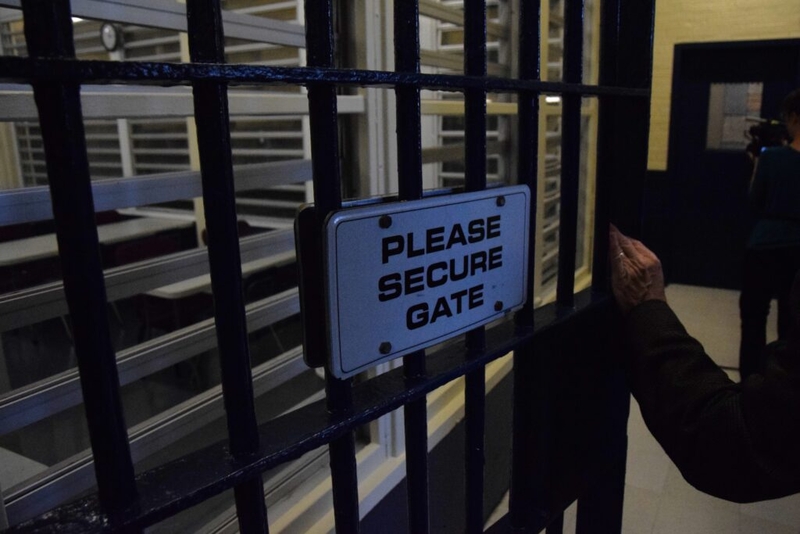
A gate opens at Holman Correctional Facility in Atmore, Alabama on October 22, 2019. An independent audit of the Alabama Department of Corrections' central office and Kilby Correctional Facility in Montgomery released Friday found issues consistent with a federal lawsuit, set to go to trial on Nov. 30. (File)
An independent audit of the Alabama Department of Corrections (ADOC) found issues with “secrecy” in its central office and documentation of violence at an intake facility that are consistent with complaints in a federal lawsuit.
The 367-page audit released on Friday by the Alabama Department of Examiners of Public Accounts (ADEPA), an arm of the Legislature, described “an underlying sense of secrecy within the agency, whether perceived or actual” during its review. Examiners were required to route all requests through ADOC’s Legal Division.
ADOC is set to go to trial on Nov. 30 over conditions of the state’s men’s prisons, a lawsuit brought by the U.S. Department of Justice in 2020. The charges followed the release of reports in 2019 and 2020 detailing the use of excessive force by corrections officers against inmates and physical and sexual assault of incarcerated men in the state’s prisons.
“While ADEPA understands ADOC is involved in extensive litigation, such a requirement is not typical and should not be normal procedure when ADEPA conducts oversight activities with state agencies. ADEPA had great difficulty obtaining requested records from ADOC,” the audit said. “Records that should be readily available at any state agency were not at ADOC. Ultimately, ADEPA had to issue a subpoena to ADOC to obtain certain records.”
In ADOC’s response to the audit, Commissioner Greg Lovelace acknowledged that the department could do better but questioned the depth of review that the audit could have based on the thousands of files examiners needed to audit the Kilby facility alone.
“ADEPA’s Report, including conclusions drawn from limited samples and observations made at a particular point in time, should be cautiously considered. A facility condition observed during a visit reflects what was present on that day; it does not, alone, indicate conditions during the remaining days of the year,” Lovelace said.
A spokesperson for ADOC said Monday the agency had no further comment beyond Lovelace’s letter.
Examiners wrote that the lack of transparency and difficulties obtaining records “raised red flags,” as it would for any other state agency it reviewed. The department recommended leadership that would promote a “fundamental change of culture” at ADOC.
“ADEPA is the oversight body in the State for state agencies like ADOC. If ADEPA is forced to operate with restricted access, this reflects a significant disregard for the oversight functions that are essential to ensuring transparency, accountability and effective governance within ADOC and the prison system,” the audit said.
The audit was done specially as part of a pilot program that stemmed from legislation sponsored by Sen. Larry Stutts, R-Tuscambia, that did not pass this spring. Stutts said in a phone interview Monday afternoon that while he had not fully reviewed the audit yet, what he had read proved that the culture of the ADOC needs to change.
“It starts from the top, and we’ve got to change the culture of the Department of Corrections,” Stutts said. “We can’t move into a new facility and take the old culture with us.”
The state plans to open a $1.25 billion 4,000-bed men’s prison in Elmore County, which has been delayed multiple times. A second prison in Escambia County was supposed to be built with the same funds, but the cost of both prisons has ballooned to nearly $2.25 billion and drawn mounting criticism from legislators.
Legislators look to upcoming audit as frustrations with Alabama prisons mount
Elaine Burdeshaw, Policy and Advocacy Director at Alabama Appleseed, a nonprofit focused on criminal justice reform, said in a phone interview Monday that the audit’s finding of a “culture of secrecy” proved the need for the pilot program.
“The fact that the one entity that most people could agree and most people believed would be able to create this transparency, they would be able to gather this critical information, even they struggled to get information,” Burdeshaw said. “Even their access was restricted in their own words, to the point that they had to issue a subpoena at one point, which they report is highly unusual in their work.”
Stutts plans to file a similar bill, which would have allowed the Alabama Department of Examiners of Public Accounts to investigate the activities and treatment of people housed in the state’s prisons.
Gov.-elect Tommy Tuberville, a Republican, has promised to overhaul the department as governor. Multiple messages seeking comment from Gov.-elect Tommy Tuberville’s team were left Monday.
Stutts said he has talked with Tuberville about a new commissioner to lead the ADOC, replacing Commissioner Greg Lovelace, who Gov. Kay Ivey appointed to lead the department in May.
“That’s the governor’s appointment, and I’m sure that he’s going to look for somebody with the mindset of we we’ve got to change the culture and change how we do things,” Stutts said.
House Speaker Nathaniel Ledbetter, R-Rainsville, said in a statement Monday that improving the department is a top priority for him, referring to Tuberville as “Coach.”
“That begins with Coach making a strong appointment to head up that agency, which is something I have full faith in him doing,” he said. “We will follow his lead and look for opportunities on the legislative side to back him up.”
The findings
The audit, which was conducted between May and October, found numerous issues at the ADOC’s central office, located in Montgomery. Beyond the “underlying sense of secrecy,” examiners said staff were not familiar with Administrative Rules and Regulations or Standard Operating Procedures, known as ARs and SOPs, respectively.
“Numerous times throughout this review, key central office staff referenced what the ARs stated, and their reference was either inaccurate or was not the actual procedure taking place at the facility,” the audit said. “Overall, ARs and SOPs should be consistent across all facilities with variances, only when needed, due to the type of facility.”
There are also many “Restricted ARs” within the agency, and it was “unable to clearly articulate” the reason for Restricted ARs or how some ARs become restricted. The audit said that ADOC could not identify the authority that allows it to designate policies and procedures as “restricted” or “confidential.”
“During the review, ADEPA identified several ARs had been designated as restricted despite the nature of their content not appearing to warrant such classification. Additionally, ADEPA could not locate the legal authority and process that allowed for the ‘restricted’ designations,” the audit said.
The definition of “use of force” is defined by a restricted AR, as is the definition of a chemical agent. Almost half of the use of force incidents reviewed by the examiners used a chemical agent at Kilby Correctional Facility (KCF) in Mt. Meigs. Physical use of force is not defined in ADOC’s rules.
Kilby Correctional Facility opened in 1969, and was designed to house 440 inmates, according to the audit. The current bed capacity is 1,461 and at the time of inspection there were 1,389 inmates present at the facility. In eastern Montgomery County, Kilby serves as an intake facility for all male inmates, except death row and youth prisoners, into the state prison system for assignment to other correctional facilities.
Alabama House Speaker calls for pause on Escambia prison construction project
Burdeshaw said Kilby has the “most transient” population of the state’s facilities and has the least amount of influence from gangs because of that.
“That this facility is different than most other men’s facilities in the state, means how much more we need to continue this oversight and look at other facilities in the Department of Corrections because Kilby is just the tip of the iceberg,” she said.
One of the biggest problems that stuck out to Burdeshaw was the issues with surveillance that examiners witnessed at Kilby.
“If that does not serve as an indicator for where we are at this point with the department, not just facility-by-facility, but a culture at the Department of Corrections and systemic issues. I don’t know that there are better examples in this report than that,” she said.
According to the audit, examiners asked to see the surveillance room and ADOC staff struggled to log in to the system without asking for help from another staff member.
That problem continued at the central office, the audit found. A handwritten note reading “be back soon” was left on the surveillance room door. The person in charge of watching those monitors could see cameras from every state prison.
“When ADEPA and ADOC staff attempted to locate the individual, they discovered the officer in another area of ADOC central office folding inmate uniforms,” the audit said.
The issue was directly addressed in the examiner’s recommendations.
“Implement staffing requirements that guarantee staff is physically present and monitoring cameras during all assigned shifts. Create an accountability log to record shift changes, monitoring breaks, and any temporary absences from the post,” the audit said. “Establish policies prohibiting staff from being redirected to unrelated tasks during scheduled monitoring duties.”
The living quarters at Kilby were inspected on Aug. 18. The weather recorded that day in Montgomery was a low of 76 degrees and a high of 98 degrees.
The audit found that many of the dorms, although controlled by an HVAC system, were supplemented by several box fans. The rooms were dirty, with many dead roaches and spiders. The communal bathrooms often did not have many working showers, commodes or sinks, and the rooms were infested with mold and mildew.
“Inmates in nearly every housing unit inspected reported they were not receiving adequate cleaning supplies. Inmate survey responses also indicated that adequate cleaning supplies were not being provided at KCF,” the audit said. “KCF leadership also stated their requests to use the facility’s institutional account to purchase additional cleaning supplies had been denied at times by ADOC central office.”
The audit also found that ADOC did not properly discipline at least one correctional officer (CO) when they repeatedly demonstrated excessive use of force. Because the documentation of the first instance was not in the disciplinary section of the officer’s file, the second infraction within three years resulted in a one-day suspension and mandatory 60-day leave. It should have been an automatic termination, according to the audit.
“As a result, the individual remains employed as a CO and now has 3 excessive use of force incidents over the course of their career,” the audit said.
Examiners placed paper surveys in common spaces around Kilby. In 58 responses, some inmates chose to describe their encounters with staff and other experiences at Kilby.
“Officers will beat you to death,” one wrote. “They will tell us we’re better off dead.”
“We are threatened. Talked to crazy. Told to get away. Bullied,” another wrote. “And white people are discriminated 24/7. This place is [redacted].”
Moving forward
Lovelace said that he is making changes to the cultures, specifically with Administrative Rules and Regulations, but it takes time due to the agency’s size.
“Progress is rarely immediate or uniform. Improvements in staffing allow us to strengthen training; stronger training improves supervision; better supervision improves accountability; modernized technology provides better information; and better information allows leadership to make better decisions,” he said.
Burdeshaw said that Lovelace’s response demonstrated a total disconnect between reality and the administration’s world.
“The issues, the culture, the conditions are horrific, and seemingly DOC is on a completely different planet because they either don’t see those same issues or they believe they have taken the appropriate action steps to improve those issues,” she said.
Lovelace addressed the concerns he deemed “legitimate” in his response.
“ADOC does not agree with every conclusion or recommendation in the report, but disagreement should not be mistaken for resistance to oversight,” he said.
Montgomery