Don’t Fall For This Hawaiʻi Government Website. It’s Not Real
Nov 10, 2026 | 5:01 am ET
Description
Photo courtesy of Honolulu Civil Beat
Environmentalists may have found an unusual e-newsletter in their inboxes last week, from a site appearing to be the official Hawaiʻi Invasive Species Council.
“We failed to listen,” the subject line said. “We are sorry. Here is our commitment to change.”
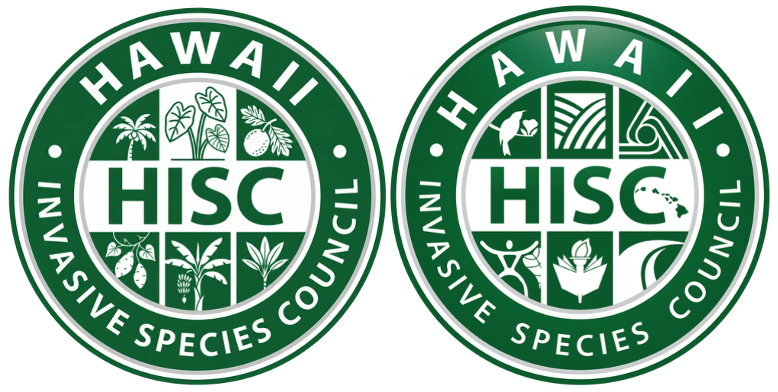
The name on the email, along with the logo it contained — and the website it linked to — bore an uncanny resemblance to Hawaiʻi’s official 23-year-old coordinating body for biosecurity efforts. But the fine print contained the first clue that something was amiss: “Independent Community Initiative.”
Environmental researchers and advocates were left scratching their heads over who the impersonators were and why they were masquerading as an official government body. The state launched an investigation into the website after being alerted to it early last week by some of the email's recipients.
It didn't take too much sleuthing for Civil Beat to get to the bottom of it. Behind the ruse are longtime environmental and cultural activist and recent lieutenant governor hopeful Daniel Anthony and, among others, Brian Bardellini, a Maui resident who has had a rocky relationship with state and county authorities over invasive species control efforts, among other things.
In many ways, their newsletter and website serve as a proxy for growing public frustration about how the state is fighting — and losing — the invasive species battle.
The website calls itself a “community resource for people who care for Hawaii,” with a focus on Native Hawaiian knowledge and questioning the government's approach to invasive species. The site focuses on coconut rhinoceros beetles and little fire ants. It also contains a form soliciting reports from the public of pest sightings.
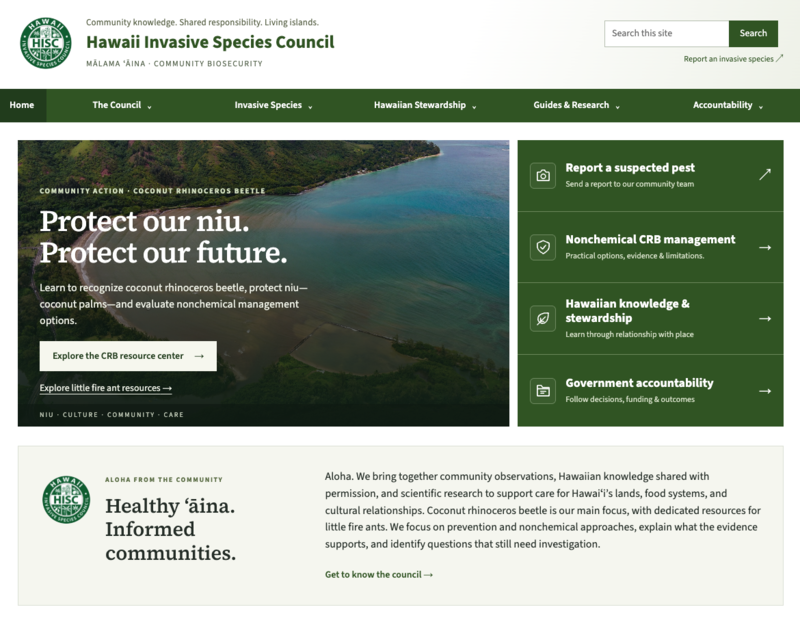
That is particularly worrisome for the state because it could confuse existing efforts to stay on top of the problem through the state's online reporting tools and hotline, according to Andrew Laurence, spokesperson for the Department of Land and Natural Resources.
Critics have said state officials have resisted clamping down on the movement of invasive species to protect businesses in the plant trade. Nurseries are considered the main culprit for transporting rhinoceros beetle larvae and little fire ants, as well as coqui frog eggs, throughout the islands.
The beetles threaten the islands’ palm populations, having spread throughout the major inhabited islands in recent years, while use of chemical treatments has dredged up historic concerns about the use of pesticides in Hawaiʻi.
Officials at DLNR, which manages the real invasive species council, believe the “fraudulent” site “is impersonating a government agency with intent to confuse the public,” Laurence said. The department is trying to get the site taken down, he added.
Keeping The State Accountable?
Screenshots of the website and newsletter started appearing in conservation groups on social media over a week ago.
“Whoever is duping the public with this post/email is thwarting the work already done … to combat invasive species. Shame!" wrote Jonee Peters, executive director of the Conservation Council for Hawaiʻi, an environmental protection group. "Be transparent on who you are and your agenda.”
Some wondered whether the site was created by AI, who was behind it and why, and whether it included any solicitation for donations. At least one had a suspicion, which turned out to be another clue.
“There’s a certain farmer turned political figure who’s been outspoken about the use of m. anisopliae for CRB and has been extremely critical of HISC and the ISCs… wouldn’t surprise me if he or someone in that hui put this together,” wrote LikeableOtter8613, referring to metarhizium anisopliae, a pathogenic soil-borne fungus.
Using online tools to check the domain's owner, all signs pointed to Aloha Organic, a company owned by Anthony, who ran on the Republican ticket this year.
But why would he and Bardellini parody the coordinating entity?
Some suspected it could be a protest about chemical treatments deployed by the state and counties, which temporarily poison palm fruits and render them inedible to humans and pollinators. Once Anthony's name was out there, others thought it might be a subtle sales pitch for his own organic products.
An Anonymous Apology
The email newsletter related to the website offered a long list of reasons for apologizing. It said the council had failed to listen to “indigenous practitioners, land stewards, and community groups,” whose approaches were too often met with “dismissal or silence.”
The newsletter continued with a commitment to better acknowledging community ingenuity and knowledge and indigenous practitioners, with additional sections focused on different eradication techniques, increasing scientific transparency and disclosing potential conflicts of interest.
The email ended with another plea for forgiveness and another disclaimer in small print that said: "Independent community initiative. This is not an announcement from the State of Hawaiʻi or the government Hawaii Invasive Species Council."
It was signed only by “The Leadership, Hawaiʻi Invasive Species Committee.”
In February, the site’s domain name was registered to “aloha organic," according to a registrant search on Whoxy, an online database of domain names and owners.
Those domain names include the website for Aloha Organic. The business sells its own sulfur-based treatment for the rampant coconut beetles, at $18 to $50 an ounce.
According to the Department of Commerce and Consumer Affairs' business registry, the associated "Hawaii Invasive Species Council" has been registered as a nonprofit corporation since January. It is registered to the same Kāneʻohe address of Anthony's Aloha Organic.
Civil Beat also found that Aloha Organic registered other websites earlier this year that pose as various committees, including mauiinvasivespeciescommittee.com, oahuinvasivespeciescommittee.com and kauaiinvasivespeciescommittee.com. Articles of incorporation had been submitted for those "independent island initiatives" in September, Bardellini said in response to an email from Civil Beat asking about those urls.
Civil Beat was unable to reach Anthony by email or phone in time for publication. Bardellini, a former county council aide and postgraduate environmental sciences student at Oregon State University, acknowledged that the email could confuse people. But he said the apology was part of the group's advocacy, expressing the accountability it believed the state should shoulder.
A casual observer would be hard-pressed to differentiate the group's logo from the state's — kind of like a game of spot the difference. But Bardellini said that "our logo is also distinct from the state’s design. Its natural colors and depictions of ancestral canoe crops reflect the cultural and ecological relationships we seek to protect.
"We intend to retain our name and logo," he added.
Faced with the state's looming investigation, Bardellini also insisted his group's communications clearly "identify this initiative as independent and we are not asserting that the state has appointed us or transferred any governmental authority to us."
Defending Coconuts, Culture
Anthony has a long history of advocating for a stronger food system, largely based on indigenous practices and knowledge and responding to invasive pests with natural, chemical-free solutions.
In lengthy videos shared on social media, he has chastised state agencies and invasive species groups associated with the University of Hawaiʻi, mostly about the beetles and how they threaten the islands' food security and culturally important coconuts.
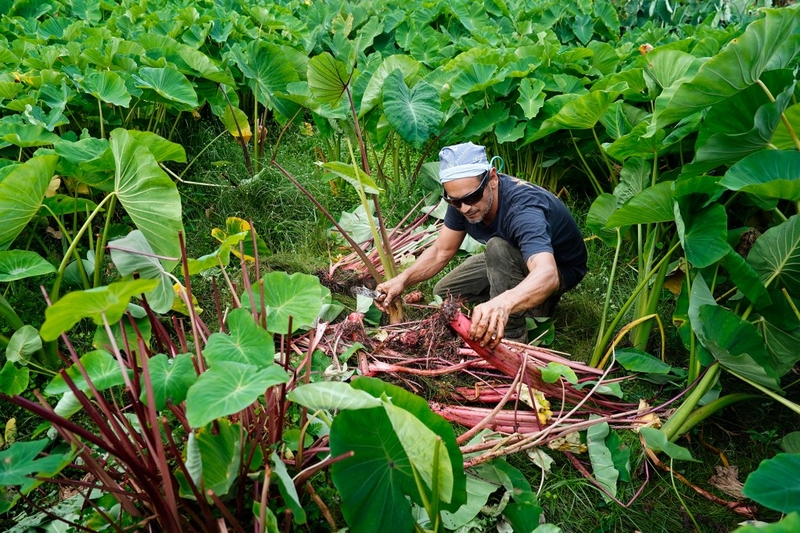
As news spread about the initiative, others weighed in to say that Anthony and Bardellini had targeted the wrong state entity.
“It looks like it’s intended to be negative,” Franny Brewer, program manager for the Big Island Invasive Species Committee, told Civil Beat. “But I think, first of all, it’s a lack of understanding what the HISC is or what the HISC does.”
The real Hawaiʻi Invasive Species Council was formed in 2002 to help state agencies coordinate to combat invasive species. The council’s membership includes the state’s agricultural, economic, environmental, health and transportation departments, as well as the University of Hawaiʻi.
But ultimately, the state Department of Agriculture and Biosecurity is in charge of the state’s fight against invasive species, not the council.
Bardellini responded: "Our choice was deliberate." He added that being called the council infers a level of responsibility that isn't being met.
"To us, 'Hawaiʻi Invasive Species Council' describes a responsibility to protect the ʻāina, prevent and reduce the spread of invasive species, and bring people and practical knowledge together to do that work," he said. "We believe the responsibility should be measured by results, not solely by who holds an established title."
Disunited Front
Anthony and Bardellini do take issue with the state Department of Agriculture and Biosecurity, just about every other invasive species group in the islands, and their approaches to mitigating the spread of pests. That includes the current hit-or-miss methods of eradication.
The world of biosecurity in Hawaiʻi has been rife with disagreements over how to best stem the inflow of pests and diseases threatening Hawaiʻi’s ecological balance. That has been especially true for the state agriculture and biosecurity agency, which has spent millions of dollars in recent years while invasive species have continued to spread.
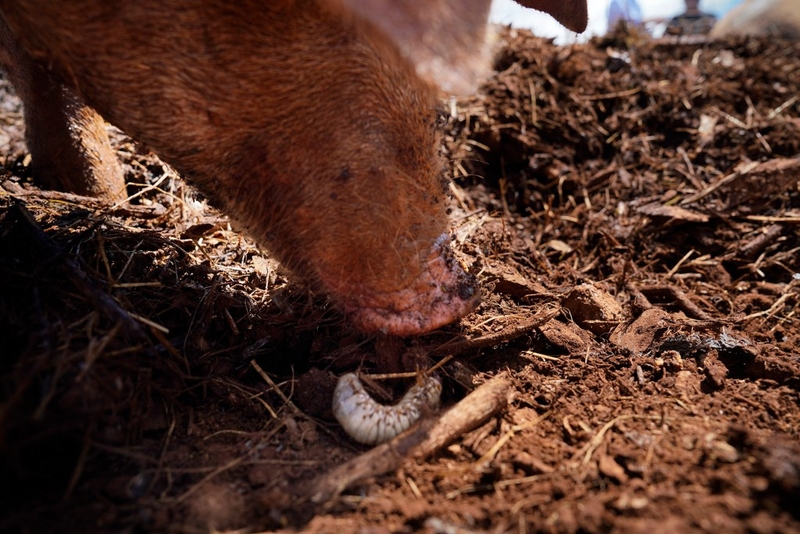
Anthony was part of a group of Oʻahu residents in 2023 who proposed enlisting pigs and chickens to help control the populations of the beetle. The state showed interest in funding the plan but never did.
The state did give Anthony $25,000 in 2024 for a “Three-Pronged Coconut Rhinoceros Beetle Management Model o Kahaluʻu.” The model included Korean natural farming techniques, the pigs, coconut palm planting and green waste management in Kahaluʻu.
Aloha Organic's use of metarhizium anisopliae, a soil-borne fungus, has proven useful in controlling the spread of little fire ants, Bardellini wrote in his series of extensive emails to Civil Beat. The business' products, he added, also help control the palm-killing beetles.
Still, Bardellini said, their work in the space has been dismissed at every junction by just about every invasive species group and state agency.
Others sympathize with the cause but note that for the beetles in particular, there are few fully effective treatments — if any.
“I agree with them in the sense that our Department of Agriculture is failing,” said Anne Frederick, executive director of Hawai'i Alliance for Progressive Action, a nonprofit that, among other things, monitors the effect of pesticides on health and the environment. “But I think there’s not a silver bullet.”
Sharon Hurd announced her resignation as director of the Department of Agriculture and Biosecurity just days before Josh Green was reelected as governor last week.
The fungus promoted by Anthony and Bardellini could be helpful in the fight against pests, having been tested by UH research, said Keith Weiser, incident commander for the CRB Response team. But producing the fungus in sufficient quantities to deal with the beetle is challenging.
"I think they're frustrated with the high barrier to getting a product on the market, in terms of research and cost and time," Weiser said.
It not only requires going through a federal and state regulatory process akin to that for a chemical pesticide, which can take years, but also a producer willing to invest — which UH staff has been unable to find. The sulfur solution sold by Aloha Organic has not been tested, Weiser said, adding he was not familiar with the product.
Nevertheless, Bardellini said, the nonprofit wants to see greater transparency in decision-making processes across the board. He and Anthony's website, newsletter and the underlying campaign are "a deliberate challenge to the existing response," Bardellini said, "and to the impression that all credible solutions are receiving a timely, fair hearing."
Honolulu, HI