Is West Virginia the most exploited state?
Nov 09, 2026 | 5:55 am ET
Description
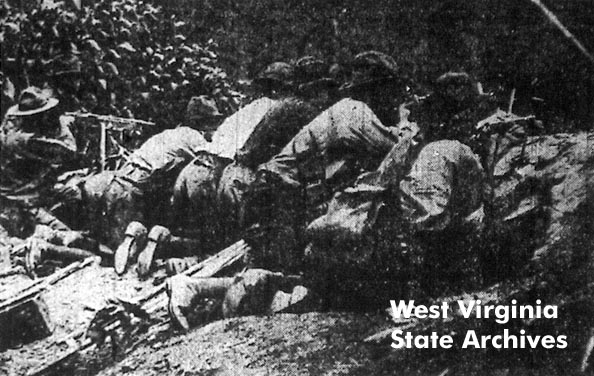
Scene of actual fighting at the Battle of Blair Mountain, showing armed Logan County deputies returning the attack of miners in the dense thickets hundreds of feet in front of them. This photo appeared in the Charleston Gazette on Sept. 10, 1921. (West Virginia State Archives photo)
Of all the states in the country, West Virginia is one of, if not, the most exploited states. From resources like labor, coal and the state’s natural beauty to less tangible things like class consciousness and worker solidarity, all of these and other things have been stripped down to a state of bareness or nonexistence.
Former Sen. Joe Manchin referred to West Virginia as an extraction state, and as sad as it may be, that might be the most honest thing that he has ever said as a politician. I’d guess he was speaking from his experience of having made a living off the exploitation of his fellow statesmen’s labor and health, via his company Enersystems that has a history of workplace violations and polluting local waterways with toxic elements. Once dubbed “one of the wealthiest Senators in Congress, placing 19th” yet hailing from one of the poorest states in the country; this could only happen with rampant unchecked corruption and exploitation.
Throughout the state’s history, coal had been the primary economic driver of the state. The majority of jobs were coal related, and the coal companies for a time ruled with a near iron fist; having their own towns, stores, housing and currency until they were forced to pay workers in U.S. dollars.
The massive industry in the states’ early history is where both corporate exploitation and worker solidarity butted heads. The carelessness, neglectful and exploitative nature of coal company owners in regard to their workers’ rights, labor, health and working conditions is largely what sparked an awakening and uprising of worker solidarity and class consciousness.
In 1921, the Battle of Blair Mountain was the largest armed conflict on U.S. soil aside from the Civil War, a battle between miners and the coal companies during a series of conflicts referred to as the Mine Wars. This was also the largest display of worker solidarity and unity of the time, and to the exploitative coal barons this was seen as a threat to their positions and their futures that would be at risk. The influential, contagious and effective nature of the miners’ passion and solidarity were viewed as such a threat to profits that the Mine Wars were nearly erased from the history books. Through extracting the state’s main economic resource and crushing worker solidarity at the Battle of Blair Mountain, West Virginia would be set on a path, facing decades of exploitation and immiseration. In the Mine Wars museum there is a plaque that states that the mine wars were:
“The absence of the mine wars and other industrial abuses of power in public discourse and classroom curriculum was no mere oversight but, rather, a deliberate cover up by state officials. During the Great Depression, Gov. Homer Adams Holt threatened to thwart New Deal programs in West Virginia unless the Mine Wars were removed from federally funded history books on the state.
As this collection of publications and textbooks demonstrate, the Mine Wars did not make their way into the narrative for over 50 years, while coal companies were continuously praised as beacons of progress and prosperity.
In the drawers below you will find a chronological series of textbooks, each opened to the portion which should have addressed the West Virginia Mine Wars, but did not.”
Part of the reason this was done was to hide the reality that the mining companies went to extremely violent lengths to prevent the unionization of workers, even establishing the West Virginia State Police as a force to quell and fight protests, protestors and eventually miners turned combatants during the duration of the conflict. Another reason I suspect is to hide the fact that the coal barons effectively defanged, and ruined the reputation of the United Mineworkers of America, even further breaking the state’s worker solidarity.
As someone that took West Virginia history classes, it was surprising but also infuriating to learn that such an important event in our state, and even our nation’s history, was basically glossed over by the time it was taught to me. This choice had huge ramifications and greatly contributes to the current dire state of worker solidarity, union participation, and the lack of class consciousness we have today.
Over 100 years later, West Virginia continues to be exploited by essentially the same perpetrators: corrupt politicians, the ultra-wealthy and corporations. West Virginia has a long history of corrupt politicians that prioritized enriching themselves, their donors or their egos, at the expense of the state’s people, resources and natural beauty.
A clear example of this brazen exploitation is the fact that black lung rates in West Virginia and the rest of Central Appalachia are significantly higher than the national average by 10x. These companies have always had the money and ability to make safety improvements, but time after time they have prioritized profits over people. Even today, the Mountain State is seemingly being sold off to the companies of tech billionaires just for them to level the land, build their data centers, and exploit the land further. The politicians that have the ability to stop or inhibit this from happening are the same ones giving a pass to corporations, with little to no benefit for those living around the centers. All of this has contributed to West Virginia’s near last place national rank when it comes to most categories, like education, happiness, life expectancy and many others.
One of the most egregious exploitations that has happened to the people of West Virginia was the manufactured opioid epidemic. Robbing folks of their health and money, taking advantage of the injured to turn them into addicts and lifelong consumers. Generations personally affected by this crisis, whether it’s from losing family members, friends or even themselves to the grip of opioid addiction. I often think about the amount of human potential lost to this epidemic. Nearly everyone in this state, if asked would be able to give testimony to the damage this epidemic caused them. Those responsible for unleashing this upon West Virginia, hardly faced any consequence and settled for buying their way out of any sort of real repercussions. These opioid settlement funds, ordered to go towards programs that reduce opioid and drug use primarily went into the coffers of the police departments and to buy flock cameras. Absolutely shameful
In order for West Virginia to begin toward a positive trajectory, the state needs working class leaders and politicians that are free of outside influence, willing to stand up to corporations and advocate on behalf of the people they serve. Removing money’s influence in elections starting at the local level to ensure a candidate’s accountability to the people. Ending the commodification of life’s essentials such as food, water, shelter, medicine and education would greatly benefit the people of the state, and work to address the many insecurities people here face.
There needs to be a drastic reassessment of what our priorities are here in the state, as well as, what our government is supposed to be doing and providing for us; perhaps something like fixing a water crisis still ongoing in the southern part of the state? The function of government should be improving material conditions for all its people, instead of the exploitation and immiseration we’ve continued to experience for decades.
Charleston, WV