Doug Jones did what he had to do
Nov 09, 2026 | 5:59 am ET
Description
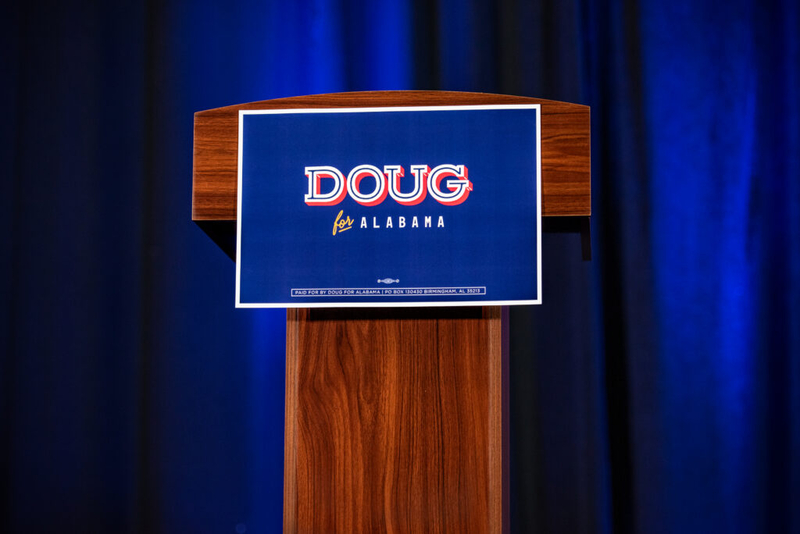
A lectern with a campaign sign for Democratic gubernatorial nominee Doug Jones sits before a speech from Jones in Birmingham, Alabama on Nov. 3, 2026. Jones lost the election to Republican nominee Tommy Tuberville but had the best finish in the race of any Democrat since 2002. (Andi Rice for Alabama Reflector)
The phrase “moral victory” can inspire hard eye rolls.
It’s understandable. Victory is holding power and enacting an agenda. Not watching government go on without you.
So saying something constructive about Democratic gubernatorial nominee Doug Jones could feel like invoking that dreaded pair of words. Elections create winners and runners-up. Politicians work to be the former and not the latter.
Jones’ campaign ended in defeat Tuesday to Republican nominee Tommy Tuberville. In his concession statement Wednesday, the former U.S. senator said that growing the Alabama Democratic Party was one of his priorities in the race.
“We brought new people into the political process and helped lay the groundwork for Democrats to compete in elections for years to come,” he said. “And the results across Alabama give us a lot to celebrate.”
In other elections, one might dismiss this talk as a salve on a wound. But Jones is correct. His campaign filled the huge crater left by the Democrats’ disastrous 2022 campaign, leaving a foundation the party can build on.
And make no mistake. The 2022 Democratic campaign was a catastrophe. The party seemingly forgot to recruit statewide candidates. The Democratic ticket that year featured a lot of first-time candidates and amateurs, none of whom had name recognition. Their gubernatorial nominee had no resources and got an anemic 29% of the vote.
A Democrat losing a statewide race in Alabama is normal. But the candidates couldn’t motivate Democratic voters. And that affected local races. Several legislators in what should have been safely Democratic Black Belt seats found themselves in tighter-than-normal races with Republican challengers.
If that had happened again this year, I would probably be writing about the extinction of the Alabama Democratic Party.
But it didn’t.
Black southerners came out in force after the U.S. Supreme Court gutted the Voting Rights Act in Louisiana v. Callais and the Republican-controlled Alabama Legislature redrew Alabama’s 2nd Congressional District to favor a Republican. U.S. Rep. Shomari Figures, D-Montgomery, tapped into this anger and managed to hold onto his seat, while holding down Republican margins in the Wiregrass, a key region for the Alabama GOP.
But a single U.S. House district cannot stand in for the state. That’s where Jones came in.
The nominee united Democrats who revere the former U.S. senator for his 2017 victory over former Alabama Chief Justice Roy Moore. In a state where leaders demonize minorities at a whim, Jones called for inclusiveness. He delivered a clear message about affordability and accountability and saw no conflict between the two.
Jones pushed to repeal the grocery tax. He said he would appoint a secretary of energy to address the state’s high residential energy prices. Jones also vowed to address the ongoing humanitarian disaster in Alabama’s prisons.
And he showed some ruthlessness. Jones repeatedly highlighted his plan for a one-year moratorium on data centers, an issue that cut across party lines. He attacked Tuberville over the Republican’s baffling, weekslong insistence that data center critics were stooges of the Chinese Communist Party, forcing Tuberville to back down from his missionary work for the facilities (albeit in back-and-forth ways that should leave people wondering where he actually stands).
Jones also seemed far more interested in the people he wanted to govern than Tuberville. The campaign estimated that he held 20 town halls around the state that drew hundreds and sometimes thousands of people, even in deep-red areas. Jones made himself available for all kinds of questions, a politician not afraid of scrutiny.
In the end, Jones fell short. The hole for Democrats was large. Tuberville had too much money. The GOP still gets juice from straight-ticket voting and white rural resistance to Democrats.
And yet, his campaign was not a failure.
A 67% to 29% GOP victory in 2022 became a 52% to 48% one. A 413,000-vote total nearly doubled to over 806,000. A party that could have lost its core legislative districts in 2022 flipped four seats, the best results for Democrats in decades. After years of teasing the party, Huntsville, the fastest-growing city in the state, appears to have turned blue. Jones pulled 43% of the vote in Shelby County, a once unthinkable result in what should be a solid GOP area.
That’s not a win. It’s growth, something Democrats have needed for years. Political environments rarely change in a single election cycle. Coalitions are built with time, fresh ideas and realignments over new issues.
Alabama Democrats have spent the past 16 years struggling to hold what they have. Now they have opportunity. Turning that into victory will require candidate recruitment and investment, especially in city council and county commission races, if Tuesday is going to be more than a one-time surge. It will also require resilience in the face of disappointments and electoral setbacks.
But Doug Jones may have gotten us closer to two-party politics in Alabama. That’s a far better place to be than where Democrats were.
It will be an important legacy. And a moral victory in the best sense of the phrase. In Czech playwright Václav Havel’s struggles with his nation’s communist party, he once wrote that “a moral victory may later become a de facto victory.” And after decades of seemingly futile struggles, Havel won.
Montgomery