Big win, big loss for Democrats in Montana
Nov 06, 2026 | 7:31 pm ET
Description
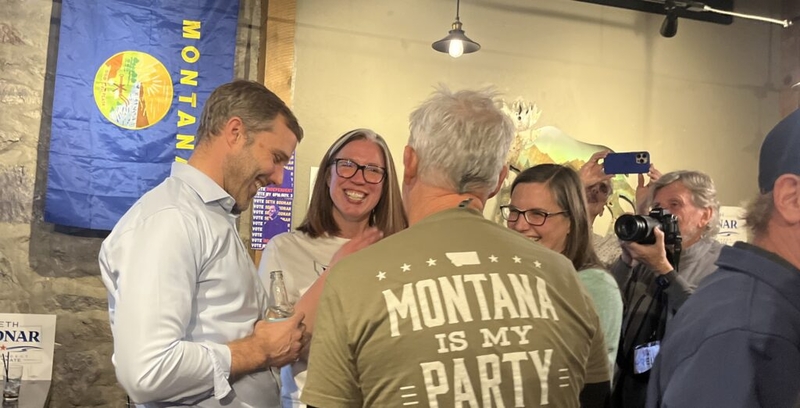
Independent U.S. Senate candidate Seth Bodnar, left, talks with supporters downtown Missoula on election night 2026. (Keila Szpaller/Daily Montanan)
In the “blue wave” that washed over the country this week, liberals in Montana notched both an historic win and a conspicuous loss.
Montanans will send Democrat Sam Forstag to Congress, and supporters of his victory in the western district danced at the Florence building in Missoula in the wee hours Wednesday.
It’s the first time in 32 years a Democrat was elected to represent the Treasure State in the U.S. House.
But a clash on the left that helped Republican Kurt Alme claim victory in the U.S. Senate race showed little sign of a resolution this week.
Voters in states arguably redder than Montana will send Democrats to the U.S. Senate.
Texas hadn’t elected a Democrat to the Senate since 1988 but James Talarico fended off a Republican backed by Elon Musk’s millions. Kansas elected a Democrat for the Senate for the first time since 1932.
In the Treasure State, the left split on strategy and endorsements, and so split the vote — as predicted.
Democratic nominee Alani Bankhead earned just 12% of the vote. The independent, Seth Bodnar, earned 38%.
Bodnar’s supporters tried to push Bankhead out of the race after the primary, and Thursday, the blame game continued.
Montana Democratic Party executive director Emily Marburger described the “independent experiment” as a failure.
On the other side, Nancy Keenan, a Bodnar supporter and former director of the Montana Democratic Party, described Bankhead as a “spoiler” who “refused to withdraw.”
Kal Munis, a political scientist at Montana State University, said the loss is leaving anger and frustration in its wake.
“There’s a huge missed opportunity that’s going to be settling in on people today and over the coming weeks,” Munis said Wednesday. “And someone has to be the scapegoat.”
Political analyst Lee Banville, with the University of Montana, said 2026 is being called a “once-in-a-generation” election, but on the left, the Senate camps “chose to fight themselves” rather than the Republican.
“They’re spending so much time blaming each other that they’re not actually talking about, well, what should we do next?” Banville said.
Dueling strategies
Munis said the loss doesn’t fall on Bankhead, although she was “a C-tier candidate.”
He said people who are part of the “old guard Democratic establishment” devised a plan to run an independent in red Montana and failed to execute.
In 2024, Democratic U.S. Sen. Jon Tester lost his reelection bid in a defeat that left Montana with an all-Republican Congressional delegation.
Tester, who had won three Senate campaigns, described the party as “poison,” and some Democrats worried he was right. Wednesday, Tester called 2026 a “missed opportunity” and said people can “blame whoever they want.”
But Munis said the old guard chose a Democrat to run as an independent to try to fool the voters, though Bodnar insists he’s an independent.
Munis said the tactic was an attempt to “pull the wool over people’s eyes.”
Then his supporters failed to close down the Democratic lane, he said. He said even having Tester himself — or a high-profile surrogate — run in the primary to win and drop out would have done the trick.
Bankhead, a newcomer, won the primary.
Like Bodnar, she’d been in Montana less than a decade and hadn’t run for office before, but unlike him, she didn’t have a high profile or political connections. Bodnar served as president of the University of Montana for eight years until January 2026.
Banville said Bankhead was not successful at raising money, especially compared to Bodnar, and she struggled to rally a base.
They both lost.
Democrat and former U.S. Sen. Max Baucus told “This American Life” that some Montanans directed funding to Bankhead in the primary thinking she would withdraw. He called it a “mistake.”
Munis said Bankhead is “a small fish” who is easy to blame. But he said the idea she would abandon her primary win doesn’t account for the ego of any politician, especially one pledging to fix a problem and earning a win.
“That should have never been left to chance,” Munis said.
‘Humble charisma’
Munis said the electoral environment was right for a Democrat, and dissatisfaction with Republican U.S. President Donald Trump buoyed Forstag to his U.S. House win.
Forstag also brought unique strengths, he said. Munis said he has good instincts, and he or someone in his campaign understands “the power of the ground game.”
Forstag is also young and hip — Munis, a faculty member, said he sees college students much more excited about the 32-year-old than they would have been for older Democrats who sought Congressional bids.
Forstag somehow escaped the pall of the socialist mantle opponent and Republican Aaron Flint tried to place on him — Munis said he stayed focused on wages and affordability.
Bill Lombardi, who helped launch Tester’s first U.S. Senate campaign and worked for Baucus, said he hadn’t seen as much energy for a candidate in 30 years.
“He (Forstag) had a humble charisma that people latched onto,” Lombardi said.
On the Senate side, the big money didn’t flow to Bankhead, and Lombardi said Bodnar’s supporters tried to paint her as a bad candidate — Banville said she remained largely unscrutinized, and he saw no evidence she would have been successful.
But had money flowed to a Democrat, Munis said, it would have helped float all boats because historically, the Senate candidate would work with other Democratic candidates and the Montana Democratic Legislative Campaign Committee.
“All that money that Bodnar brought in? It didn’t help anyone. It didn’t help anyone but himself,” Munis said.
‘Missed the blue tsunami’
In an email after the election, Marburger, director of the Montana Democratic Party, said this state’s U.S. Senate race “could have been part of the blue wave” too.
She pointed to the “independent experiment” as the problem.
“States that attempted to run independents like Nebraska and South Dakota by and large missed the blue tsunami,” Marburger said.
A spokesperson said she didn’t know the reason the party was unable to convince Bodnar to run as a Democrat.
Marburger also touted Forstag’s win as one “for working people.”
Banville said the messages from Forstag and Bodnar sounded similar, and Bodnar proved he could raise money, and he overperformed.
Bodnar earned nearly as great a share of the vote as the independent in South Dakota, who did not have a Democrat or Libertarian in the race. In Montana, he cut into support for the Republican, who won with just 48%.
In her analysis of the election, Keenan said Bodnar’s race helped other candidates, too.
“Bodnar ran a competitive race that forced the GOP to expend resources in Montana (including millions to prop up Alani Bankhead) — resources that thankfully were not redirected to the western Congressional district or Supreme Court races,” Keenan wrote.
Republican U.S. Sen. Steve Daines was expected to run for re-election but tapped Alme at the last minute.
In an email to the Daily Montanan, Keenan said Democrats are a minority in Montana, they need strong candidates who align with their values, and Bankhead could have helped a candidate who “had a real shot at winning.”
Keenan said 42% of Montanans identify as independents.
“The real blown opportunity for democratic values this cycle was the failure to be responsive to the Montanans who are increasingly identifying themselves as politically independent,” Keenan said.
If Montanans on the left want to win in the future, Banville said they need to stop fighting what looks like a “weird sort of civil war.”
He said they can choose to keep running statewide candidates who might be Democrats as independents, or they can create a party that’s more welcoming to an independent voice — and stick with the two-party system.
“Republicans never really had to break a sweat,” Banville said.
Helena, MT