Minnesota sues Trump administration over new Medicaid work requirements, again
Nov 06, 2026 | 4:31 pm ET
Description
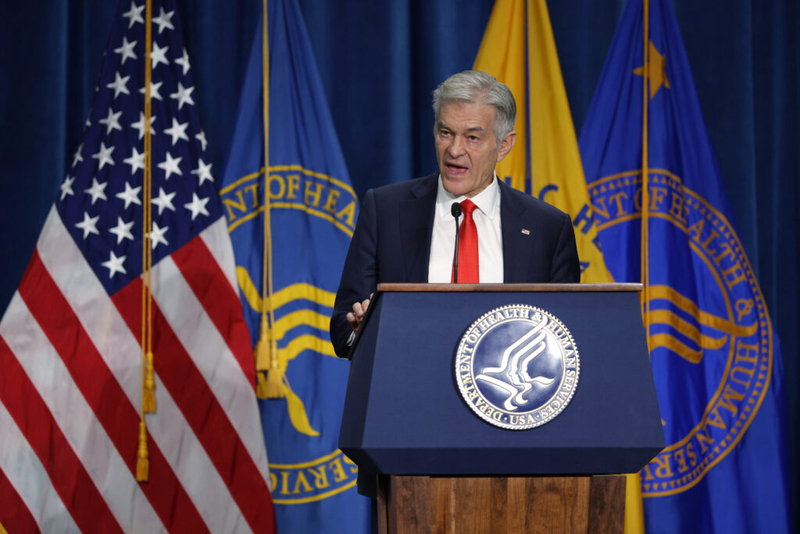
Dr. Mehmet Oz, administrator of the federal Centers for Medicare and Medicaid Services, speaks at the Department of Health and Human Services in Washington, D.C., in December. Minnesota, along with three other states, sued Oz and the Trump administration Thursday over new Medicaid work requirements. (Photo by Alex Wong/Getty Images)
Minnesota Attorney General Keith Ellison, along with attorneys general from Washington, New Mexico and Oregon, is suing the Trump administration over new Medicaid work requirements passed in H.R. 1., the 2025 tax and spending law also known as the One Big Beautiful Bill Act.
The states, which filed the lawsuit Thursday, are employing a legal strategy based on an argument successfully used by conservative states to oppose Obamacare’s Medicaid expansion.
Around 1.2 million Minnesotans are enrolled in Medicaid, the public health insurance program jointly funded by the federal government and state government which serves low-income, disabled, elderly and pregnant people.
The Affordable Care Act, known as Obamacare, expanded Medicaid to cover adults who make between 100% and 138% of the federal poverty line in many states, including Minnesota. The federal government foots the bill for 90% of the care for those adults, instead of the usual 50-50 split between federal and state funding for other Medicaid recipients. Over 200,000 people are in the Medicaid expansion population in Minnesota, as of 2025.
New work requirements in OBBBA make those Medicaid expansion recipients prove that they work or volunteer if they’re able to, starting in 2027. The work requirements, set to take place on Jan. 1, are expected to lead to people losing Medicaid, which is the main way OBBBA lowers spending on the program.
In June, Minnesota joined 25 Democratic-led states in suing the Trump administration over its implementation of the work requirements, arguing that the administration’s new “medically frail” designation was too narrow and would make it too difficult for ill and disabled people to remain on Medicaid. On Oct. 29, a federal judge granted the states a partial victory, ruling against the administration’s narrow definition but upholding other restrictions — and upholding the work requirements in general.
The new lawsuit references a 2012 Supreme Court decision, National Federation of Independent Business v. Sebelius, centering on Congress’s power to enact provisions of the Affordable Care Act. In that decision, the Supreme Court decided that Congress does not have the authority to threaten states with complete loss of federal Medicaid funding if states don’t comply with the expansion. As a result, 10 states were able to forego the expansion.
In the Thursday lawsuit, the states argued that the OBBBA work requirements “dramatically reshaped and redefined” Medicaid “into a vehicle to encourage work, yet did so under the guise of merely amending it,” and that forcing states to administer those changes under threat of all federal Medicaid funding would contradict the Supreme Court’s 2012 decision.
The state is in the process of implementing the new work requirements, and has encouraged Medicaid recipients to use a renewal tool to help the department prepare for the requirements.
According to the Minnesota Department of Human Service’s 2026 supplemental budget, which was passed by the state Legislature, the new work requirements will cost the state $1 million to implement and will save the state $1 million in the 2027 fiscal year and $3 million across both the 2028 and 2029 fiscal years — i.e., $1 million to $1.5 million per year in the next three years.
Budget officials have also previously said that new work requirements may cause some of the expansion recipients to switch from being eligible based on income to being eligible based on disability to avoid the administratively burdensome requirements. Their healthcare would then be funded roughly equally by the state and federal government, meaning the state would pay for more of their care than previously — a win for the federal budget, a loss for Minnesota.

Saint Paul, MN