The Ocean State’s version of a blue wave: 10 Republicans left in the legislature
Nov 04, 2026 | 4:02 pm ET
Description
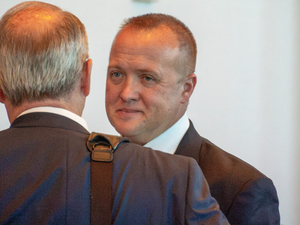
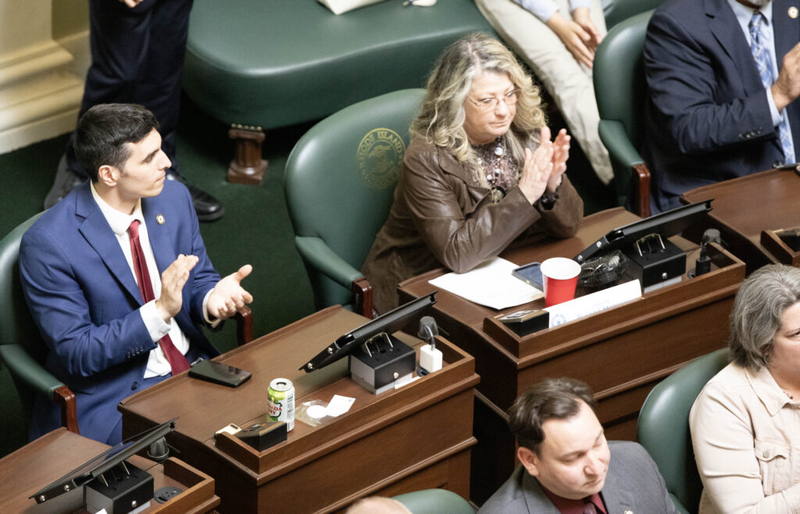
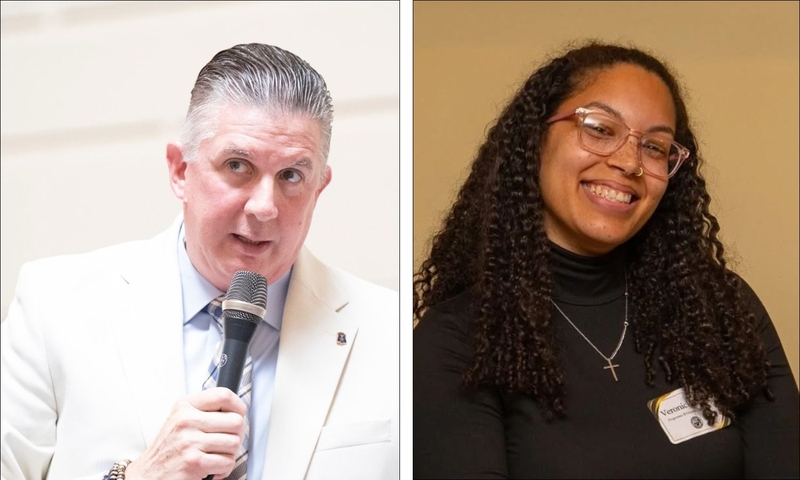
Republicans five-term Sen. Thomas Paolino, left, deputy minority leader, of Lincoln, and six-term Sen. Elaine Morgan, right, of Hopkinton, now deputy minority whip, both lost their seats in the Rhode Island Senate to Democratic challengers in Tuesday's election. (Photo by Alexander Castro/Rhode Island Current)
Democratic dominance of the Rhode Island General Assembly deepened Tuesday night, after five incumbent lawmakers — four Republicans and one independent — were ousted by challengers from the left.
The results leave just 10 Republicans in the 113-member legislature, down from 14.
That includes two GOP members of the 38-person Senate, and 10 out of 75 in the House. And there’s still one independent, as former Republican darling Allan Fung, now disaffiliated and at odds with GOP leaders, won his wife’s old House seat in Cranston.
But don’t mistake a handful of upsets for a harbinger of change on Smith Hill. Excluding open seats, 95% of state lawmakers who won Tuesday are incumbents. Reelection was all but guaranteed for most due to the absence of serious opponents — or any at all.
“There’s no sea change in Rhode Island state government based on these results,” said Adam Myers, associate professor of political science at Providence College. “Republicans were already a non-factor. Essentially, now, they’re going to be even less of a factor.”
The absence of change in the legislature stands in stark contrast to Congress as Democrats flipped at least 30 Republican-held seats, notching enough victories to control both chambers.
Yet, the Ocean State’s few progressive pickups could stem from the same national rebuke of Trump that led to Democratic victories nationwide, Myers said.
“The fact that this happened in very different parts of the state, everywhere from Woonsocket, to Cranston, to Exeter, suggests to me that the best way to explain it is, these were nationalized races,” Myers said. “Voters in Rhode Island were primarily acting on, or responding to, national changes.”
Woonsocket’s about-face
Perhaps the clearest example was in Rhode Island’s House District 49 where independent Rep. Jon Brien lost to progressive-backed Democrat Veronicka Vega by nearly 5 points.
Brien, a former Democratic state representative from Woonsocket who became an independent before his second, non-consecutive legislative career began in 2022, espoused conservative stances on taxes, the Israel-Hamas War and COVID-era public health rules. And Woonsocket voted for Trump in 2024 — the first time the northernmost city backed a Republican presidential candidate since Ronald Reagan in 1984.
“As the lone independent in the House, I couldn’t help but get swept up in a confluence of political events that seemingly affected elected leaders across the country,” Brien said in an email. “It seems that this election cycle was less about the candidate and more about the candidate’s ideology.
Vega, 26, was a first-time candidate who put her personal story of facing homelessness, poverty and food insecurity — and the social safety net programs that helped support her — at the heart of her campaign. She was backed by the Rhode Island Working Families Party, Reclaim RI and Affordable RI, among other progressive groups.
To Dan Denvir, co-chair of Reclaim RI, Vega’s victory shows voters’ appetite for progressive politics extends beyond Providence.
“There are poor and working-class families all over this state who oppose MAGA extremism and the corporate Democratic politics that allowed MAGA extremism to happen,” Denvir said.
Vega did not immediately respond to requests for comment Wednesday.
Across the state in Senate District 34, voters also moved left in electing Democratic challenger Samantha Wilcox over 12-year Republican incumbent Sen. Elaine Morgan.
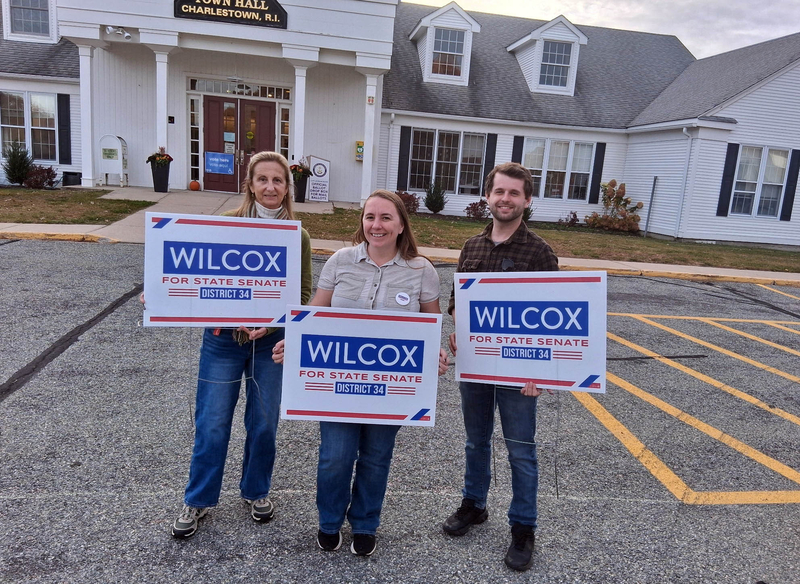
Wilcox, 37, a paralegal and Richmond Town Council president, didn’t think her victory meant anything about a progressive shift in the rural, western district spanning parts of Charlestown, Exeter, Hopkinton, Richmond and West Greenwich.
“We canvassed thousands of doors, regardless of political party,” Wilcox said. “That’s what our district was looking for, someone who listens to both sides.”
Limitations on solar development on rural land, property taxes and housing were what voters wanted to talk about, not political party, Wilcox said.
Morgan did not immediately respond to requests for comment.
Four’s a crowd
The Senate GOP also lost 10-year incumbent Sen. Thomas Paolino, who was defeated by Democrat Nelly Burdette in a four-way race with two independent candidates. The number of names on the ballot — the most of any state legislative race — likely contributed to Paolino’s loss, Myers said.
Indeed, the 2,000 votes combined for the two independents, Jina Petrarca and John Barr II, is four times the 500-vote margin between Burdette and Paolino, according to preliminary, unofficial results Tuesday night.
Paolino also pointed to the split as the reason for his loss.
“I don’t believe the results are indicative of what 57% of District 17 wants,” Paolino said in a text message Wednesday morning.
He did not call Burdette to concede because he said he did not have her number.
But Denvir with Reclaim, which helped canvas for Burdette, argued that the two independents, both of whom ran for and held office before as Democrats, likely siphoned votes away from Burdette, rather than Paolino.
Burdette, a Ukrainian refugee, clinical psychologist and first-time candidate, said she began canvassing the district in April, well before any of her opponents. The Working Families Party also supported Burdette.
Party ideology came up much less than concerns over healthcare access and energy bills, Burdette said.
“People liked that I was part of the community, not from the political world,” Burdette said Wednesday.
However, Senate Minority Leader Jessica de la Cruz warned of the consequences from an even more imbalanced legislature.
“Rhode Islanders are already struggling with some of the highest electricity costs in the country, an increasingly unaffordable cost of living, and a state government that continues to spend more while delivering too little,” de la Cruz, a North Smithfield Republican, said in a statement. “The last thing taxpayers need is even less scrutiny of the decisions being made on Smith Hill.”

The Fung factor
A three-person competition for Cranston’s House District 15 may have also helped Fung defeat freshman Republican Rep. Chris Paplauskas, Myers said. The race, which also included Democrat Colleen Crudele, grew contentious in the final weeks before the election, driven by a rift between the Fungs and Cranston Mayor Ken Hopkins, for whom Paplauskas works as chief of staff. Fung’s wife, Barbara Ann Fenton-Fung ran and lost to Hopkins in the 2024 mayoral primary. Her mayoral campaign opened up the legislative seat, which Paplauskas won by 26 votes in 2024.
Paplauskas did not immediately respond to requests for comment Wednesday, though both he and Crudele called Fung to concede, according to Fenton-Fung.
“I’m incredibly humbled and honored to make history as the first Asian American elected to the Rhode Island House of Representatives, but what means even more to me is the trust people of Cranston have placed in me once again,” Fung said in a statement.
Fung served 12 years as city mayor, and has run twice for governor and once for U.S. Congress, all as a Republican. He disaffiliated this spring, prompting criticism from state party officials including House Minority Leader Mike Chippendale.
“It will be interesting to see how a man who once thought himself gubernatorial and congressional material will operate as but one of 75 in a room that doesn’t embrace independence and rejects disloyalty,” Chippendale, a Foster Republican, said of Fung.
Chippendale, too, blamed national sentiment for GOP losses.
“Rhode Islanders were beaten over the head, day after day and hour after hour, with ads about Donald Trump,” he said. “One might think Trump was running in every RI race. Even after all those ads, I’m still waiting to hear what the Democrats who ran them intend to do about the electric bill, the shortage of primary care doctors or the cost of buying a home in this state.”
A second freshman GOP representative, Richard Fascia of Johnston, also lost his reelection campaign to Democrat Edward Stravato.
“The fact that this happened in very different parts of the state, everywhere from Woonsocket, to Cranston, to Exeter, suggests to me that the best way to explain it is, these were nationalized races. Voters in Rhode Island were primarily acting on, or responding to, national changes.”
Stravato, 40, a lawyer and small-business owner, credited his “old school” campaign — heavy on handwritten letters with little-to-no social media presence — for his victory.
“I think it speaks more to our campaign than it does a blue wave,” said Stravato.
The district spanning Johnston and Cranston backed Trump in the last three elections. Stravato said he identifies as a moderate Democrat, “not a liberal.”
Stravato said Fascia had called him to congratulate him earlier Wednesday morning.
Fascia did not immediately respond to requests for comment.
Almost no luck for The League of RI Businesses
Conservative political group The League of RI Businesses notched one victory from its efforts to put more “business-minded” candidates in the legislature. League-backed Republican Michael Riley defeated Democrat Shaina Smith in the open House District 42 seat, which includes all of Scituate and a piece of Cranston. Riley will succeed Republican Rep. Robert Quattrocchi, who chose not to run for reelection after 10 years in office.
Dave Levesque, co-founder of The League and owner of Brewed Awakenings coffeehouses, said he was disappointed but not surprised by The League’s low success rate among its endorsed legislative candidates.
“We’ve learned a lot of lessons,” Levesque said, citing the need for better vetting of candidates, and being more selective in the process.
The League bypassed the $2,000 per candidate per year donation limit in state law by setting up a political action committee for every city and town in the state. Levesque acknowledged that campaign finance strategy might have worked better if money was spent on advertising and outreach, rather than poured into candidates’ campaign accounts directly.
“It’s not just about money, you need a strong ground game,” Levesque said.
He was unbothered by the prospect of campaign finance reforms championed by lawmakers and good government groups like Common Cause Rhode Island seeking to prevent The League from leveraging multiple PACs to donate more money to candidates.
“There’s ways around it,” Levesque said. “That’s the least of what we have to worry about. The problem now is, what’s going to happen in the General Assembly? What bills and laws are they going to pass that make Rhode Island not as business-friendly as it needs to be?”
Open seat races
Other open seat races decided Tuesday include:
- Providence House District 7: Democrat Amy Santiago defeated Republican Chris Ireland.
- Providence House District 12: Democrat Arlette Hidalgo ran unopposed.
- Warwick House District 22: Democrat Zak Pereira defeated Republican Barbara Quigley.
- Warwick House District 23: Democrat William Muto defeated Republican Dana James Traversie.
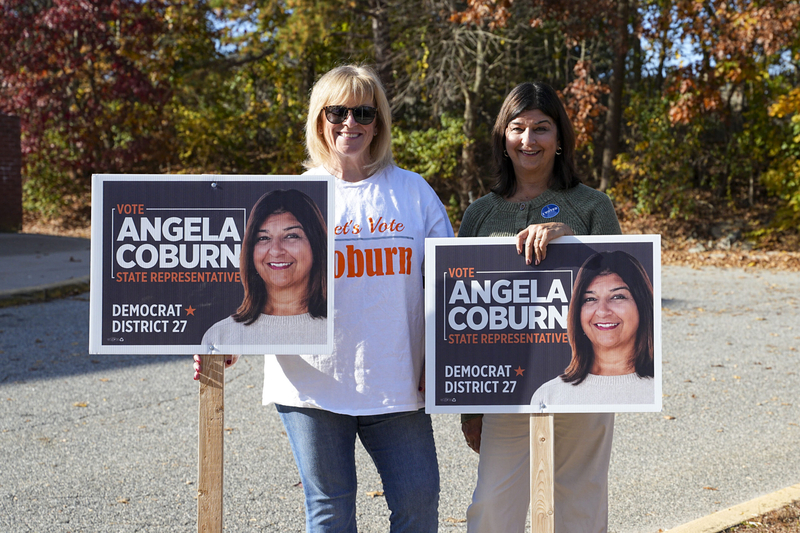
- West Warwick/Coventry/Warwick House District 27: Democrat Angela Coburn defeated Republican Lawrence Almagno Jr.
- North Kingstown House District 31: Democrat Jim Sheehan ran unopposed.
- North Kingstown House District 32: Democrat Robert Craven Jr. ran unopposed.
- Barrington/Warren House District 67: Democrat Nicole Jellinek defeated independent Joseph DePasquale.
Providence, RI