Nebraska Legislature Republican supermajority will end; Democrats could pick up three seats
Nov 04, 2026 | 3:37 pm ET
Description
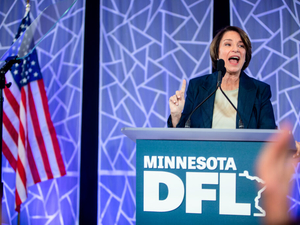
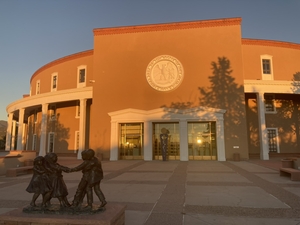
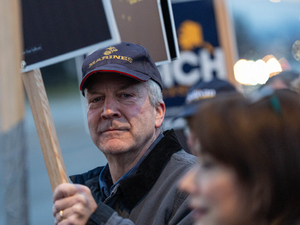
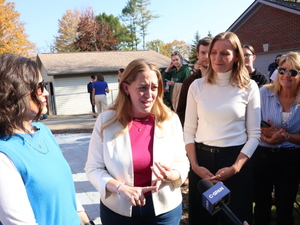
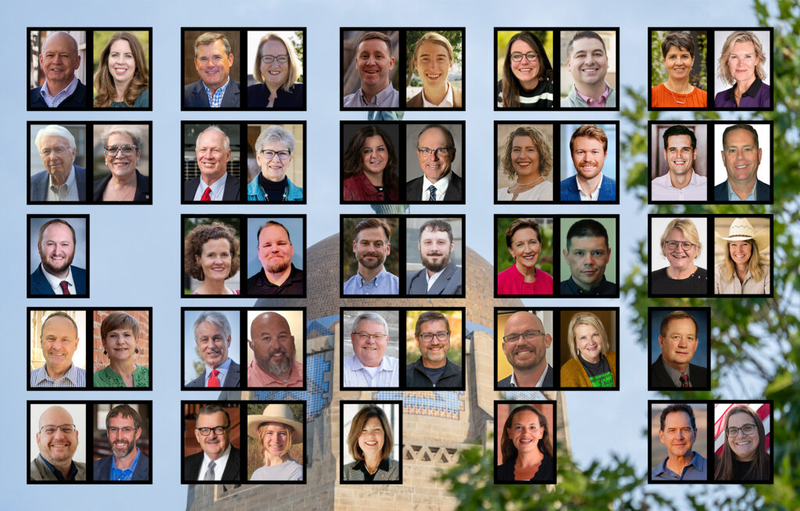
The 2026 candidates for the Nebraska Legislature arranged by district. (Photos courtesy of the candidates/campaigns | Nebraska Capitol photo by Zach Wendling/Nebraska Examiner)
OMAHA — A 33-seat Republican supermajority in the Nebraska Legislature will end come 2027 as Democrats and a Democratic-endorsed nonpartisan led in three key districts by Wednesday afternoon.
Twenty-five seats were before voters Tuesday, including a special election for a two-year term in the officially nonpartisan Legislature. Republicans gained 33 of 49 seats in spring 2024 when a Democratic labor leader switched parties. But come Jan. 6, when the new Legislature convenes, that streak will end.
Riepe: ‘It was a true honor’
The New York Times has called one flip: Democrat Christy Knorr of Omaha has won over state Sen. Merv Riepe of Ralston. By 1:30 p.m. Wednesday, Knorr, a hospice nurse, led Riepe, a former hospital administrator, by 1,313 votes, or 11.3%, for Legislative District 12.

Knorr and her campaign did not immediately respond to a request for comment Wednesday morning.
Riepe, 84, was first elected to the Legislature in 2014. He lost in 2018 but returned in 2022. He became more moderate in his return and was often a central figure on contentious issues.
In a call Wednesday with the Nebraska Examiner, Riepe noted headwinds for Republicans nationwide, particularly anger against President Donald Trump and voters’ frustration at promises he made and bad appointments that “cascaded down” for Democratic successes.
“It was a true honor, and I will always be a better person for having done it,” Riepe said of his service. “I hope that I maybe made one little slight change someplace along the line.”
Knorr’s campaign said Wednesday afternoon that her victory was a win for the people, a message that lawmakers need to uphold the will of voters and a rebuke of politicians who “continue to screw over working-class families time and time again.”
“She’s excited and thankful for all the support and plans to hit the ground running Thursday,” a campaign spokesperson said, adding the senator-elect would always maintain an open-door policy.
Unofficial results
Based on unofficial results as of 1:30 p.m. Wednesday, another Democrat and one registered nonpartisan led in two key races in Douglas County against Republicans:
- Registered nonpartisan Cindy Maxwell-Ostdiek of Omaha led incumbent state Sen. Brad von Gillern of Elkhorn by 292 votes, or 1.7%, for Legislative District 4.
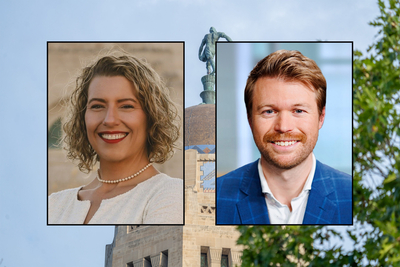
- Jess Goldoni of Omaha led Taylor Royal of Bennington by 367 votes, or 2.4%, for Legislative District 18. State Sen. Christy Armendariz of Omaha decided not to seek reelection.
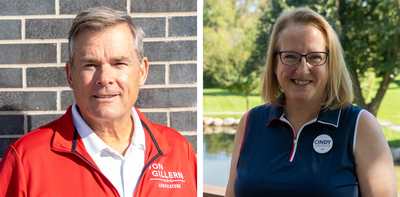
Royal has conceded and congratulated Goldoni. Maxwell-Ostdiek, in a post at about 12:30 a.m. Wednesday, said the race was too close to call. Von Gillern had not yet made a social post as of 1:30 p.m. Wednesday.
The Douglas County Election Commission has not yet said how many early-vote ballots are left to be counted Friday, or how many provisional ballots will be processed next week.
In Sarpy County, two other races are also too close to call, according to The New York Times, one being with Republican state Sen. Rick Holdcroft of Bellevue. He leads Democratic challenger Darin Tompkins of Papillion by 736 votes, or 4.5%. Tompkins has conceded and congratulated Holdcroft.
And in nearby Legislative District 14, Bill Bowes of La Vista, a Republican, leads SuAnn Witt of Papillion, a Democrat, by 231 votes, or 1.5%. Speaker John Arch of La Vista is term-limited after two four-year terms. Witt has conceded and congratulated Bowes.
A shifting Legislature
The New York Times has not called those four races just before 4 p.m. Wednesday but had decided two other races in central and southeast Nebraska that the organization had not yet called.
For Legislative District 38 in central Nebraska, the race to succeed term-limited state Sen. Dave Murman of Glenvil, Sutton Mayor Tim Anderson defeated GROW Nebraska CEO Janell Anderson Ehrke of Orleans by 410 votes, or 2.6%. Anderson claimed victory in the race Wednesday morning.
In part of Lincoln and Cass County, Republican Dean Helmick of Plattsmouth defeated Democrat Caitlin Knutson by 960 votes, or 5.3%, for Legislative District 2. State Sen. Rob Clements of Elmwood, chair of the Legislature’s Appropriations Committee, was term-limited after serving 10 years. Neither Helmick nor Knutson has yet posted statements on the race results as of 1:30 p.m. Wednesday.
Thirty-three Republicans, 15 Democrats and one progressive, registered nonpartisan currently compose Nebraska’s Legislature.
The “officially nonpartisan” moniker means a candidate’s party doesn’t appear on the ballot for the seat, and lawmakers don’t organize by party in the legislative chamber. Some votes can land along party lines, or urban-rural divides, and it takes 33 votes to overcome a filibuster and 30 votes to override a gubernatorial veto or change legislative rules.
Should unofficial results hold, the legislative partisan structure would change to 30 Republicans, 18 Democrats and one registered nonpartisan.
Three incumbent senators and one new face ran unopposed: state Sens. Barry DeKay of Niobrara, Teresa Ibach of Sumner and Danielle Conrad of Lincoln. Dawson Brunswick will succeed term-limited state Sen. Mike Moser. Both are from Columbus.
Of the other 21 seats, 12 pitted a Republican against a Democrat, four had Republicans facing a nonpartisan candidate, two featured two Republicans, two had two Democrats and one was between a Democrat and a nonpartisan.
More than $9.5 million had been raised heading into the election, according to late campaign filings available as of election weekend. Candidates had together spent more than six figures in 17 of the 25 races by mid-October.
The 2027 legislative session
One of the biggest hurdles for lawmakers to tackle in 2027 will be closing a projected budget deficit that state forecasters estimate could be as high as $1.2 billion by mid-2029.
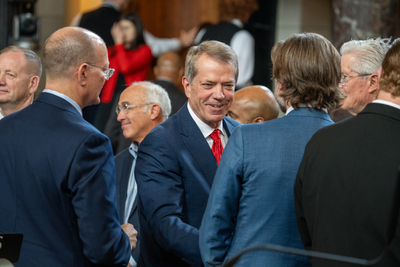
Riepe said a concern he has is the knowledge and skill level of new senators, particularly with the budget. He added: “I wish the state well because it’s going to be an interesting session.”
Nebraska Gov. Jim Pillen of Columbus won reelection. He said early Wednesday at his election night watch party that he didn’t yet know what the legislative breakdown would look like but that a top priority would be balancing the budget. He and dozens of legislative candidates have said addressing property taxes remains a top priority, too.
Von Gillern, current Revenue Committee chair, had been eyed as the frontrunner for speaker of the Legislature in 2027. State Sen. Mike Jacobson of North Platte, who easily won reelection Tuesday, had wanted the Revenue Committee chairship.
Depending on the conclusion of LD 4, Jacobson has said he could step up for speaker. State Sen. Kathleen Kauth of Omaha has also expressed interest in running for the role.
Lawmakers are paid an annual salary of $12,000. They can serve two four-year terms in a row (voters widely rejected a proposal Tuesday to expand the limit to three consecutive terms).
- 3:56 pmEditor's note: This story has been reflected with updated race calls in Legislative District 2 and Legislative District 38.
- 3:00 pmEditor's note: This story has been updated with comment from Sen.-elect Christy Knorr's campaign.
Lincoln, NE