The rest of the country got a blue wave. Don’t ignore Arkansas’ blue ripples.
Nov 04, 2026 | 2:16 pm ET
Description
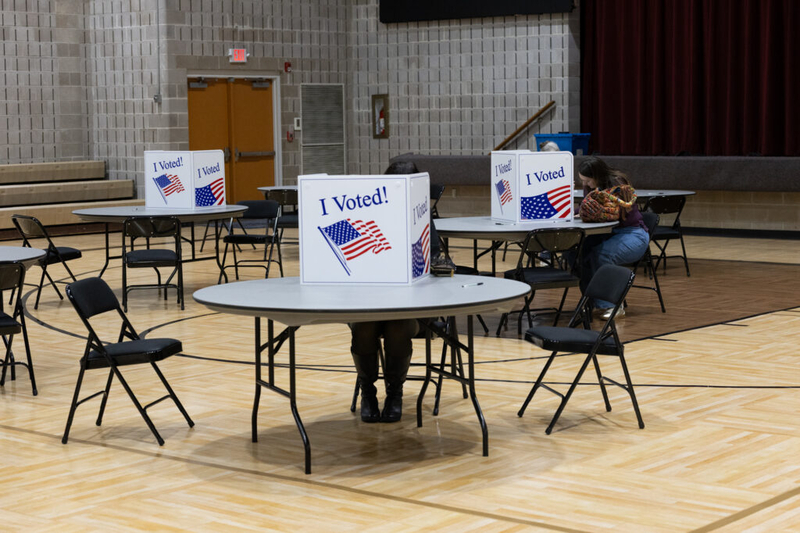
Voters cast their ballots at the Pulaski Heights United Methodist Church in Little Rock, Arkansas, on Tuesday, Nov. 3, 2026. (Photo by Katie Adkins/Arkansas Advocate)
A red state governor and outspoken supporter of Donald Trump winning by double digits in a blue wave election that was a stinging rebuke of the president would be considered a bragging point for many Republicans.
But Tuesday’s election in Arkansas instead dealt a setback to Gov. Sarah Huckabee Sanders that complicates her second-term agenda and 2028 political ambitions. The midterm results also offer hope for a Democratic Party that saw its ranks decimated in recent years in a state it had dominated for generations.
The blue tsunami that swept up the nation and handed Democrats control of the U.S. House, Senate and a majority of governorships mostly passed over Arkansas. Sanders and Sen. Tom Cotton, another national Republican considered to be eyeing the White House, fended off challenges with double-digit margins. Central Arkansas’ 2nd Congressional District, where Democrat Chris Jones hoped to unseat Republican Rep. French Hill, remained too close to call as of Wednesday morning with Hill holding a razor-thin lead.
Instead of a blue wave, Arkansas Democrats enjoyed a series of localized blue ripples that may fly under the national radar. But their implications are still significant for the state.
The biggest impact will be in the Arkansas House, where Democrats broke the supermajority that Republicans have held in the House for the past decade. It takes at least 75 votes in the 100-member House to pass most budget bills, and Republicans’ dominance meant that they didn’t have to worry about winning over Democrats to clear that hurdle.
Democrats flipped 10 state House seats, giving them newfound leverage that could prompt new budget battles when the Legislature meets next year.
It comes at a particularly precarious time for Sanders, with a session where the future of the state’s Medicaid expansion is expected to be at the top of the agenda.
The Trump administration’s decision to not renew the program for another five years has created uncertainty for hundreds of thousands of people who rely on it for health coverage. It’s also worried medical providers who say the state’s hospitals already face significant strains.
The new legislative makeup could create an inverse of the dynamic that led to the first-in-the-nation hybrid program’s creation, a compromise crafted between the state’s Democratic governor and Republican lawmakers in 2013.
Could Sanders, who has reveled in partisan skirmishes and frequently frames her divide with Democrats as “normal versus crazy,” be forced to find middle ground with a party she once vilified?
The picture gets even murkier for Sanders’ other policy priorities. Even before Democrats’ gains, the governor was forced to put her plans for a new 3,000-bed prison in Franklin County on hold after facing resistance from fellow Republicans. It’s hard to picture the project moving forward given the new House party breakdown.
And it opens the door for new funding debates over the school voucher program that was the central part of Sanders’ signature education law. Concerns about the program’s cost and impact on schools had come from some rural Republicans along with Democrats, and could become even louder next year.
The new dynamic comes days before Sanders appears ready to soft launch a potential 2028 presidential campaign, with a book set to be released Tuesday that feels like a precursor to a White House bid.
To be clear, Democrats still face challenges that can’t be ignored in Arkansas. Democratic nominee Hallie Shoffner’s loss to Cotton, who heavily outspent her in a Senate race that national Democrats mostly ignored, shows the party still faces serious resource gaps.
And Democratic state Sen. Fred Love’s performance in the governor’s race was better than expected given his lackluster fundraising but still underwhelming considering how much the Trump brand weighed down Republicans in other predominantly red states.
And the party’s lack of candidates running in other statewide races for attorney general and lieutenant governor shows Democrats have work to do in building a bench for future elections.
Tuesday night’s election showed Democrats haven’t completely overcome those obstacles. But it also may have revealed that the gaps aren’t as insurmountable as they once appeared.
Little Rock