Texas Democrats break Republican hold on statewide courts
Nov 04, 2026 | 11:52 am ET
Description
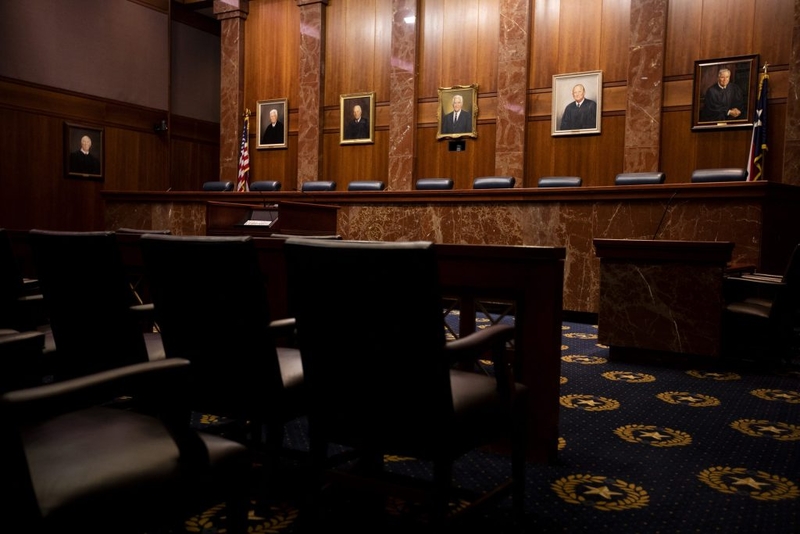
The Texas Supreme Court. (Miguel Gutierrez Jr./The Texas Tribune)
Democrats broke the Republican hold on Texas’ highest courts as part of the blue tsunami, shattering the GOP’s total dominance over statewide judicial offices.
Democrats won all four seats up for election on the nine-member Texas Supreme Court, three contested seats on the Court of Criminal Appeals and swept all three Republicans out of office on the 15th Court of Appeals, which was created in 2023 and filled with justices appointed by Gov. Greg Abbott.
The elections will leave the GOP with a 5-4 advantage on the Supreme Court and a 6-3 lead on the Court of Criminal Appeals.
The wins followed multiple blowout victories by Democrats at the top of the ticket as well as record-breaking early voting turnout this year. The outcomes also mean a stunning end to several GOP incumbents’ tenure and an upset defeat for Republicans who had far outraised their rivals.
A Democrat last won a seat on the Texas Supreme Court and the Texas Court of Criminal Appeals in 1994. Judge Lawrence Meyers, however, changed parties in 2013, giving Democrats a presence on the state’s highest criminal court until Meyers lost his reelection bid three years later.
Here is the election breakdown.
Texas Supreme Court
Four seats on the court were up for grabs this year. Democrats took them all.
Republican Chief Justice Jimmy Blacklock, who has led the court since January 2025, lost to Democrat Maggie Ellis, a justice on the Austin-based 3rd Court of Appeals.
For Place 7, Republican Kyle Hawkins lost his seat after being appointed to the court in October. He fell to Democrat Kristen Hawkins, who is a state district court judge in Harris County.
Place 2 went to Democrat Chari Kelly, a justice on the Austin-based 3rd Court of Appeals. She defeated Republican James Sullivan, who was appointed to the high court in 2025.
Republican Brett Busby, a member of the court since 2019, conceded to Democrat Gisela Triana, a justice on the 3rd Court of Appeals, early Wednesday morning. The Associated Press declared her the winner hours later.
The state’s highest civil court has nine justices elected to staggered six-year terms. Major pending issues include a case asking whether Democratic lawmakers who fled Texas to block redistricting efforts can be kicked out of office.
Texas Court of Criminal Appeals
Three seats on the nine-judge court, which is currently all-GOP, were in play this year. Democrats were leading the vote count in all three spots.
Democrat Okey Anyiam, a criminal defense attorney, led Republican Thomas Smith, an assistant attorney general in Attorney General Ken Paxton’s office, in the race for Place 3. The Associated Press has not yet declared a winner in this race, but 99% of votes have been counted and Anyiam held a lead of more than 237,000 votes.
Democrat Audra Riley, a criminal district court judge in Dallas County, beat out Republican incumbent Kevin Yeary, who was first elected to the court in 2014, in the race for Place 4.
Place 9 went to Democrat Holly Taylor, a criminal and civil appeals attorney who beat Republican John Messinger, an assistant state prosecuting attorney.
The state’s top criminal court is composed of nine judges who are elected to staggered six-year terms. In addition to appeals of criminal cases, the court hears death penalty appeals directly from trial courts.
15th Court of Appeals
All three Republican incumbents, who were appointed by Abbott as the court’s inaugural members in 2024, took part in their first general election for six-year terms. All three were ousted.
Democrat Jerry Zimmerer, a former justice on the Houston-based 14th Court of Appeals, defeated Republican Scott Brister as the court’s chief justice.
Republican Scott Field conceded to Democrat Tom Baker, a former justice on the 3rd Court of Appeals in Austin, for Place 2 shortly after midnight. The AP declared Baker the winner early Wednesday afternoon.
Republican April Farris lost to Democrat Marc Meyer, who runs a private law firm, in the contest for Place 3.
The court hears civil cases involving the state, cases from business courts and challenges to the constitutionality of state laws.
Austin, TX