A disquiet follows West Virginia’s supermajority
Nov 04, 2026 | 11:18 am ET
Description
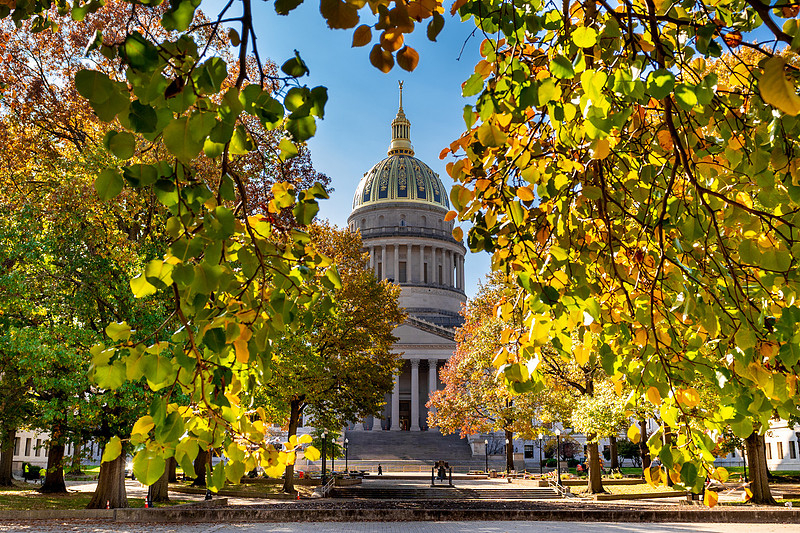
The West Virginia state Capitol in fall 2021. (West Virginia Legislative Photography)
On a night where shocking results dominated election-watching media, U.S. Sen. Shelley Moore Capito, R-W.Va., having her re-election race insta-called was a reassuring respite of routine for a Republican Party having a terrible, horrible, no good, very bad night.
The win for the fourth-ranking Republican in the Senate this midterm was only half the margin of the 40-point drubbing she delivered in 2020, but comfortable enough given the wider circumstances. Her nephew, Rep. Riley Moore, and his congressional compatriot Rep. Carol Miller both retained their seats in Washington, D.C. with little real electoral threat to their positions. While a blue tsunami created only the fourth double flip of the House and Senate in the post-WWII era nationally, West Virginia’s top-line races were never really in doubt.
Nor was the GOP supermajority in state government. Republicans will still dominate the state Senate and House of Delegates by wide margins as the state political factions start gearing up for the simmering 2028 gubernatorial campaign that will rise to the boil with the midterms out of the way. Much attention, and a record amount of money, will be going to that endeavor forthwith.
But there is movement in deep red West Virginia’s political waters, even if the various metaphors and nomenclatures regarding waves mostly missed the Mountain State this time. The West Virginia Democratic Party had its best night in a long, long time, gaining seats in the state Senate and, as reported by Henry Culverhouse, the potential for enough House of Delegate Democrats to perhaps prevent suspending the constitutional rule. While a small but meaningful procedural victory, such an ability to slow down the GOP super majority would be a welcome tool for a rebuilding Democratic Party looking for those first steps back to power.
Del. Mike Pushkin, who was one of the winning House of Delegate Democrats and also leader of the state party, gave a Belichickian “tomorrow” when asked on West Virginia MetroNews when recruitment for further Democratic efforts would begin. He rightfully focused on the foundational parts of politics: recruitment, messaging, campaign infrastructure and contesting every race.
While nationally the Republican Party suffered defeats that felt more like punishment than politics, the West Virginia GOP was largely spared. For now. But the political waters are stirring. After a 2026 primary that was dominated by eye-popping spending, intraparty squabbling and embarrassingly low turnout, the discussion turned to Team Red’s growing numerical advantage in voter registration. But running in parallel to the GOP’s dominance is a steady increase in registered independents. Combined with Democratic Party voters and the smattering of others, the registration numbers mean that even while still dominant, there are more voters registered as something other than Republican in the state of West Virginia. While the GOP supermajority is not in danger, the foundations for electoral coalitions are there for possible erosion in coming cycles.
Capito’s congressional win in 2000 was one of the waypoints in West Virginia’s electoral trip from cobalt blue to deep red. As one of the most powerful members of the U.S. Senate, she has definitely reached the political mountaintop; matriarch of a political dynasty and will hold her Senate seat until she decides she no longer wants it. While President Donald Trump’s 40 plus point victory is often cited as the high spot of West Virginia going red, Capito’s 2020 re-election that saw her clear 70 percent and dominate all 55 counties might be the most impressive win and margin of victory the state will ever see. The peak of the red wave she was, in many ways, the face of, and has now dominated West Virginia politics for nearly a generation.
But all mountaintops are surrounded by downslopes, trees don’t grow to the sky and supermajorities are never permanent. The Republican Party in West Virginia would be wise to take stock of the respite they have against the political fortunes their party cohorts nationwide suffered through. While still rebuilding and finding their election legs, the Democratic Party in West Virginia is alive and making strides. The independent numbers in West Virginia are growing: Independents who are angry at the political parties and processes thereof and are determined to make it the problem of the in-power politicians if they are not better catered to. Closed primaries, national buzzwords and the culture war du jour are not likely to quell their feelings.
Capito has a long-running interview line stemming from her early, historic successes in tough races that she was “Republican before being a Republican was cool” in the formerly heavily Democratic West Virginia. The quip works for the head of the Moore-Capito political dynasty, wielded by a master politician who hasn’t had a competitive race in over 25 years. But for other West Virginia Republicans who came to office when it was very cool to be a Republican, the future is going to require much more than just party labels, national endorsements, outside money and the political phrases that used to pay. The West Virginia GOP should look at its cohorts in Texas, in Iowa, in Kansas, and elsewhere after the 2026 midterm, and decide if that’s the road they want to travel. And adjust accordingly.
Charleston, WV