Blue wave changes Kentucky’s political landscape, raises questions
Nov 04, 2026 | 10:04 am ET

Description
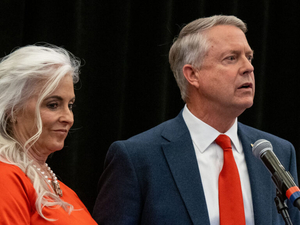
Kentucky Governor Andy Beshear, left, talks after Democrat Zach Dembo’s Sixth Congressional District win against Ralph Alvardo, at the Central Bank Center in downtown Lexington, Nov. 3, 2026. (Photo by Brian Simms for Kentucky Lantern)
This column was originally published in the Northern Kentucky Tribune.
Tuesday’s blue tsunami that gave Kentucky one more Democratic congressman, two more Democratic state senators and eight more Democratic state House members raises at least two questions: Would Gov. Andy Beshear have won the race for U.S. senator, and does the Democratic surge give that party more hope of electing a Democrat to succeed him next year?
To both questions, the initial answer seems to be “Yes, but.”
Given Beshear’s persistent popularity and President Trump’s record unpopularity, I think the Democratic governor would have beaten U.S. Rep. Andy Barr for the seat of retiring U.S. Sen. Mitch McConnell. That would have been ironic, since McConnell won the third of his seven terms by beating Beshear’s father in 1996. More importantly, it would have given the state its first Democratic senator since Wendell Ford retired in 1998.
Yes, but. Beshear said he didn’t want to be a senator, and if you take him at his word, people shouldn’t run for offices that they don’t really want, but see as a useful steppingstone to higher office – in this case, the presidency. If you were more cynical and skeptical, you might say that Beshear merely said he didn’t want to be a senator because he knew the race would be too risky.
If Beshear had run and lost, it would have killed his presidential ambitions. If he had run and won, he would have had to manage two challenging and conflicting enterprises: being a presidential candidate and a freshman senator, a job that includes compiling a voting record that could have been used against him. If he had run for senator, Republicans would have used against him his shortcomings as governor, and that wouldn’t have done his presidential ambitions any good.
That logic, of course, is all about Beshear’s self-interest, not the interests of his party, which he has done little to serve as governor. Once he was re-elected in 2023, he had an obligation to help rebuild his party at the legislative and local level, but he doesn’t seem to have done much of anything for it. Instead, he largely invested his political committee’s money in politicizing races for nonpartisan judgeships, helping get a friend elected to the state Supreme Court in 2024 but losing in Tuesday’s election a Court of Appeals Judge he appointed. A better bet would have been legislative races, in which Democrats probably could have gained even more seats with more Beshear money.
Now the parties turn to next year’s statewide elections, led by the race for governor, in which two Beshear lieutenants, Rocky Adkins and Lt. Gov. Jacqueline Coleman, want the Democratic nomination. The party’s Tuesday successes will stir more interest in its May 18, 2027, primary, and that will carry over to the general election. But likely Republican nominee James Comer will campaign on the failings of the Beshear administration, such as the abysmal juvenile-justice system.
On the other hand, the Democratic nominee will likely use against Comer his lack of action, as chairman of the House Committee on Oversight and Reform, against Trump’s blatant corruption. That wouldn’t have mattered under the status quo ante of a year ago, but Trump has fallen from favor and voters have begun to contrast their struggles with his gold-plated family and administration – and rightly assign him blame for the economic impact of tariffs and the Iran War. Comer will have to offer a platform wholly of his own; the Trump train is no longer an adequate vehicle, and may actually be one to avoid.
Trump accelerated Kentucky’s conversion to a Republican state, to the point that the GOP now has a plurality of registered voters. It lacks a majority, because an increasing number of Kentuckians are independents, registered with no major party or with minor parties. Tuesday’s election showed that Kentuckians continue to be capable of voting independently.
Some people who chose U.S. Rep.-elect Zach Dembo over Republican Ralph Alvarado in the 6th District also voted for Barr over Democrat Charles Booker, and some who voted for Barr also picked Louisville-area Democrats who defeated Republican state Sens. Lindsey Tichenor, an extremist, and Julie Raque Adams, a moderate. Adams got into trouble by starting a nonprofit “dedicated to training Republican women to seek and hold public office” that did little in the last three years except collect money from groups with interests before the legislature and pay Adams $80,500, as reported by Tom Loftus in the Kentucky Lantern.
Adams lost to Sarah Cole McIntosh and Tichenor lost to Christian Furman in suburban districts, like those where Democrats also gained eight House seats – including the one of GOP Whip Jason Nemes of Louisville. It wasn’t just a blue wave, but the lack of a red tide; Republican turnout seemed depressed in Kentucky, as it was nationally. Many Republicans are through with him.
Frankfort