Blue wave erodes margins in Pennsylvania’s GOP strongholds
Nov 04, 2026 | 2:14 am ET
Description
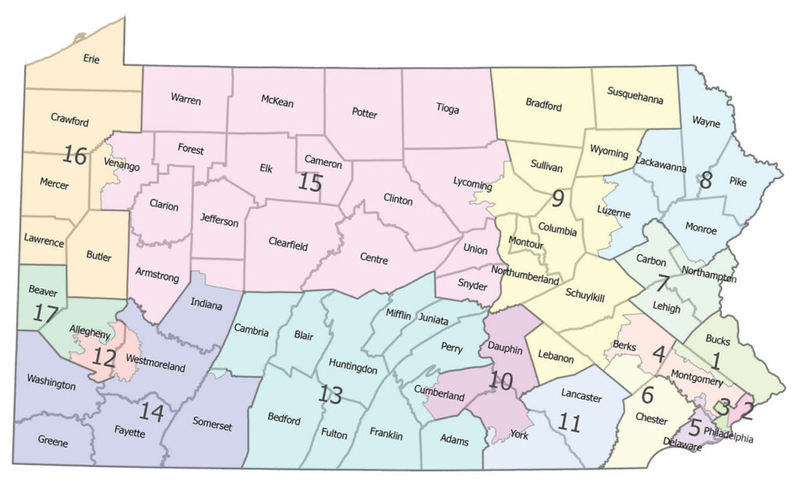
Pennsylvania's Congressional District Map. (Pennsylvania Department of State)
Incumbents have held onto their seats in a dozen of Pennsylvania’s congressional districts, leaving the state’s delegation favoring Democrats by 11-6 due to four “toss-ups” among at least 25 seats the party flipped across the country.
Thirteen seats in the commonwealth were considered safe. But races in those districts held by Republicans were closer than the last midterm election in 2022, according to an analysis of results by the Capital-Star. The analysis didn’t include two districts – the 13th and 14th – where Republican incumbents John Joyce and Guy Reschenthaler ran unopposed in 2022.
Among the most dramatic changes for GOP-held districts was the 9th, which covers nine counties and parts of three others from the state’s central agricultural region through coal country and into the northern tier.
Republican Congressman Dan Meuser won a fifth term, getting 62% of votes to the 38% cast for Rachel Wallace, the Democrat challenging him. The results are unofficial.
Meuser, who was heavily favored to win, expressed gratitude for his constituency’s “overwhelming support … and the trust they have placed in me to continue representing them.”
“Once again, voters in the 9th Congressional District have rejected the failed ideology of authoritarian socialism and reaffirmed the values Americans have spent 250 years defending: freedom, opportunity, and the promise of the American Dream,” he said in a statement.
Meuser’s 24-point margin, while dramatic, does break his pattern of increasing them with each election. He won with 70 percent of votes in 2024, up from 60 percent of votes captured in his first win in 2018.
Wallace was considered Meuser’s strongest opponent since then.
Overall, he raised twice as much money. But she out-fundraised him in some campaign finance reporting periods.
She also brought in more money than challengers in the 12 other “safe” districts: As of Tuesday, her campaign had reported nearly $1.2 million. The next highest total was $334,000 raised by Democrat Nancy Mannion in the 11th District consisting of Lancaster County and part of York County.
Mannion came within 10 points of U.S. Rep. Lloyd Smucker, who’s in his sixth term in Congress. That’s 13 points closer than in 2022 when Mannion also challenged him.
Wallace was 14 points closer to Meuser (with 91 percent of votes counted) than his opponent in 2022, according to the Capital-Star’s analysis of results.
Wallace’s campaign didn’t respond to requests for comment after the race was called.
A big issue early in the campaign was the federal government’s acquisition of two warehouses in the district for conversion to immigration detention centers – something Meuser says caught him by surprise.
After those plans were scrapped, they all but dropped out of the dialogue. Like other candidates in other races this cycle, Meuser and Wallace’s topics of focus included healthcare, data centers, affordability and the impact of Trump’s tariffs on agriculture and small businesses.
Democratic incumbents expanded their victory margins, according to the Capital-Star’s analysis.
In Philadelphia and the collar counties, it was Brendan Boyle (2nd District), Madeleine Dean (4th District), Mary Gay Scanlon (5th District) and Chrissy Houlahan (6th District) as well as the Pittsburgh region’s Summer Lee (12th District) and Chris Deluzio (17th District).
Scanlon and Houlahan – like Joyce, Meuser and Reschenthaler – each won another term Tuesday after first being elected in 2018.
That year’s blue wave coincided with an off-cycle redistricting in Pennsylvania ordered by the state Supreme Court when it found the commonwealth’s prior congressional map was an unconstitutional partisan gerrymander – though some analyses have shown the resulting paritsan split likely could have been the same with the old boundaries in place.
Philadelphia state Rep. Chris Rabb won the Democratic primary in the deep blue city in May for the 3rd district, which cuts from the Northwest through West Philly, much of Center City and into South Philly.
Rabb made it official Tuesday night with a 92-point victory over Independent Dennis Mahoney. His win holds significance apart from typical general elections in the Democratic stronghold because he’s among a slate of candidates ascending to Congress who ran as or closely aligned with the Democratic Socialists of America, which Rabb has said he joined this year.
Rabb succeeds former U.S. Rep. Dwight Evans, who before serving in Congress was a state representative for 35 years. Evans announced his retirement last year after nearly a decade in the U.S. House starting in 2016.
First elected in 2008, Republican Glenn “G.T.” Thompson remains the longest-serving of the delegation. Thompson, who heads the House Agriculture Committee, also represents the commonwealth’s largest congressional district at nearly 13,000 square miles. The rural 15th district envelops most northern tier counties and stretches deep into the heart of the state.
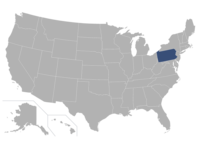
Harrisburg, PA