GOP stronghold remains in WV Senate, but Democrats flip seats to gain 4 members
Nov 04, 2026 | 12:01 am ET

Description
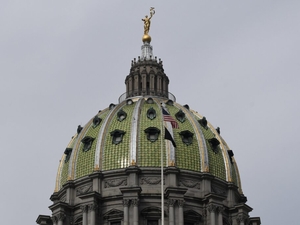
Emblem of the West Virginia Senate in the state Capitol in Charleston, West Virginia.
(Photo by Will Price/West Virginia Legislative Photography)
While the state Senate remains firmly under GOP control, Democratic candidates won three seats in the Upper Chamber. Their wins included flipping two seats to Blue in areas with West Virginia’s last Democratic strongholds.
Nineteen Senate seats were on ballots across the state, and 16 of those were won by Republicans.
The GOP will hold 30 seats in the 34 member Senate in 2027.
But, in Morgantown, John Williams added to the Democrat’s ranks after defeating long-time politician and incumbent Sen. Mike Oliverio, R-Monongalia, to claim the District 13 seat.
Williams, who is currently in the House of Delegates, won with 55% of the votes when 99% of precincts were called by the Associated Press. Oliverio received 41.4% of the votes.
“I think the totals show that we were ready for a change in Marion and Monongalian counties,” Williams said in a phone interview shortly after polls closed. He knocked more than 5,000 doors in the district, running on a campaign focused on affordability issues and pushing back on data centers development.
“The results reflect that, and I’m excited to roll my sleeves up and get to work in the Senate on the issues that I advocated for,” Wiliams said.
DuRon Jackson, a Democratic candidate in Huntington, defeated Chris Miller to keep the District 5 seat Blue.
The seat is currently held by long-serving state Sen. Mike Woelfel, a Democrat, who declined to run again.
Richie Robb defeated incumbent Sen. Anne Charnock, R-Kanawha, in District 17. Gov. Patrick Morrisey appointed Charnock to the district in early 2025 after Eric Nelson resigned.
In District 1, Sen. Laura Chapman, R-Ohio, was able to keep her seat against a significant challenge from Democratic candidate Shawn Fluharty.
Chapman won with around 53% of the vote with 98% of votes counted, according to the AP. Fluharty received 46.7% of the vote at the same time.
In a phone interview, Chapman said she “wasn’t too worried” about Fluharty’s challenge due her focus on serving her Northern Panhandle constituents.
“I’ve always been in the community and delivered for my constituents. I’ve probably given out my phone number to what feels like the entirety of the Northern Panhandle, and people do call me,” Chapman said.
“I’ve been very successful in getting great things for the Northern Panhandle … delivering on infrastructure projects, roads, sewers, bridges (and) water,” she said. “I’m just so thankful that the voters have trusted me for another four years.”
This was Chapman’s first re-election campaign. A political action group linked to Morrisey spent six figures against Fluhary; Chapman is an ally of the governor.
Sen. Tom Takubo, R-Kanawha, held onto his Kanawha County Senate seat after being targeted in the May primary. He faced a challenge on Tuesday night from Democratic candidate Wes Holden in Charleston’s strong Blue voting base.
Takubo received 52.9% of the votes with 99% of precincts reporting, according to the AP. Holden received around 47% of the votes.
“It’s been really tough over the past 12 months,” Takubo said in a phone interview. “It’s sad to see what has happened to politics in the state of West Virginia.”
With the election in the rearview, the Senate remains deeply divided after a contentious Senate president race and bitter GOP primary in May.
Senate President Randy Smith, R-Preston, defeated Takubo and Sen. Eric Tarr, R-Putnam for the top position. The race split the Senate into factions — those aligning with Takubo and others siding with Smith.
Takubo wants the Senate to focus on education, jobs, and reversing the state’s population decline. The Senate needs to get away from “divisive social issues,” he said.
“We only got 34 people to make a lot of really important decisions,” Takubo said. “Each Senate member represents about 105,000 West Virginians, and every one of those voices should be heard. Now, will they be heard? You know, time will tell.”
Charleston, WV