Oregon on track to keep its congressional incumbents
Nov 03, 2026 | 11:30 pm ET
Description
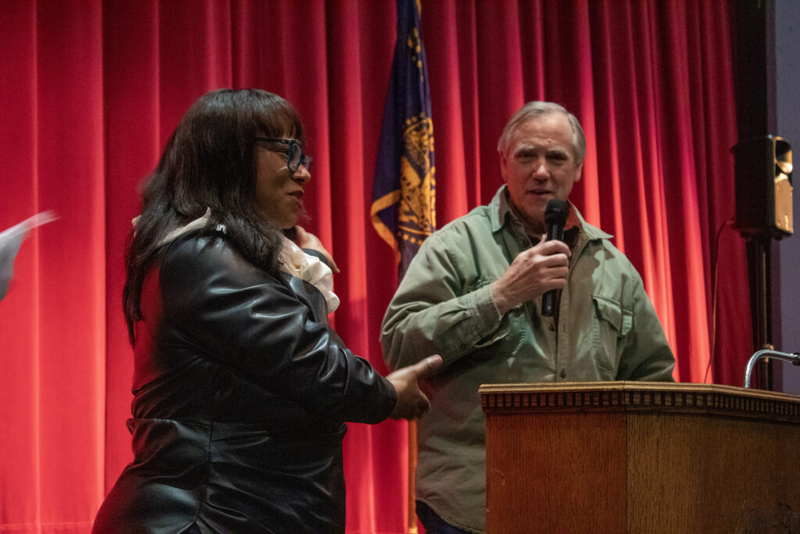
U.S. Rep. Janelle Bynum and U.S. Sen. Jeff Merkley, both Oregon Democrats, speak to a crowd at a town hall in Albany on Sunday, Jan. 18, 2026. (Photo by Mia Maldonado/Oregon Capital Chronicle)
All seven of Oregon’s incumbent members of Congress appear on track to keep their seats, early results show.
The state’s five Democratic and one Republican U.S. representatives and Democratic U.S. Sen. Jeff Merkley were leading their races with more than 1 million votes counted as of 8 p.m. The Associated Press has called elections for Merkley and Democratic Reps. Suzanne Bonamici and Maxine Dexter.
The closest race is in the 5th Congressional District, where Democratic U.S. Rep. Janelle Bynum is leading Deschutes County Commissioner Patti Adair by nearly 10 points.
The district stretches across Linn County, most of Clackamas and Deschutes counties and parts of Multnomah and Marion counties. More than a third of registered voters in the district are nonaffiliated, followed by 31% Democrats and 27% Republicans.
Bynum flipped the district in 2024 when she beat Republican U.S. Rep. Lori Chavez-DeRemer.
Speaking to reporters Tuesday evening, Bynum said she doesn’t take her odds for reelection for granted in the swing district and that she is riding on the hope that Democrats gain the majority in the U.S. House and Senate.
“My job was to defend this seat and make sure that Democrats could regain control of the House,” she said. “This was a hard-fought seat to begin with. It was $37.5 million the first time. We wanted to make it a non-contest this time.”
Bynum’s campaign brought in more than $4.7 million since she filed to run for a second term in early 2025 — nearly seven times as much as Adair’s campaign which brought in $680,000, federal campaign finance records show.
The next closest race is in the 4th Congressional District, where Democratic U.S. Rep. Val Hoyle and Republican challenger Monique DeSpain played a rematch of their race in 2024 to represent Oregonians living along the state’s central and southern coast and the university towns of Eugene and Corvallis and surrounding communities.
Two years ago, Hoyle beat DeSpain by nearly 8 percentage points. She was nearly 12 percentage points ahead of DeSpain as of 8 p.m.
Merkley easily defeated three challengers: Republican state senator David Brock Smith of Port Orford, Libertarian candidate Gary Lyndon Dye and Progressive and Pacific Green candidate Chris Henry.
Oregon’s less competitive districts
Half of Oregon’s U.S. House districts have strong partisan voter registration advantages, making them less competitive.
That includes Oregon’s 1st Congressional District between the North Coast and Portland, which has the second highest proportion of registered Democratic voters. Bonamici had captured 70% of the vote.
And in the 2nd Congressional District bordering Idaho, which has the highest percentage of registered Republican voters, Republican U.S. Rep. Cliff Bentz appears to be headed to a fourth term. Bentz had nearly 61% of the vote, leading Democratic challenger and former state lawmaker Chris Beck by 21 percentage points.
In the Portland-based 3rd Congressional District, which has the highest proportion of registered Democrats out of all six of Oregon’s U.S. House districts, voters reelected Democratic U.S. Rep. Maxine Dexter to a second term. She beat Republican challenger Loran Ayles with more than 75% of the vote.
Although Oregon’s Willamette Valley-based 6th Congressional District was once considered competitive, this year’s election didn’t bring out a high profile challenger, political analysts previously told the Capital Chronicle. Voters are on track to reelect Democratic U.S. Rep. Andrea Salinas to a third term. She is leading against Republican challenger and former Dundee mayor David Russ by nearly 16 percentage points.
All the candidates running to represent Oregonians in Congress raised at least $19.6 million and spent $13.5 million on their campaigns this election, according to data from the Federal Election Commission.
Salem, OR