Pappas defeats Sununu in pivotal U.S. Senate race
Nov 03, 2026 | 8:48 pm ET
Description
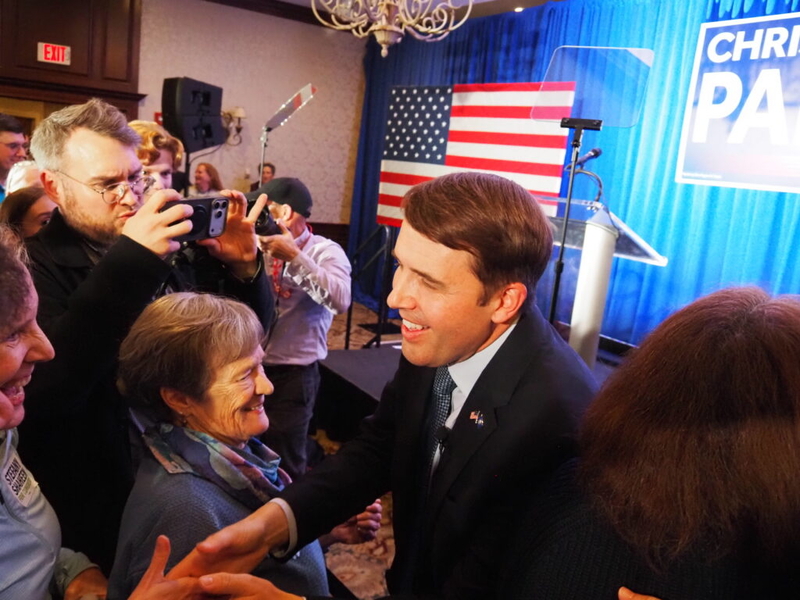
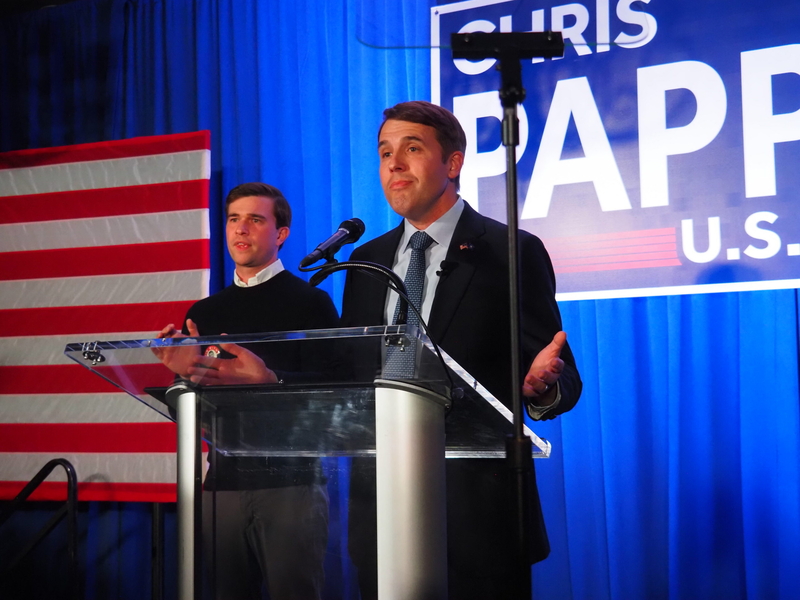
Senator-elect Chris Pappas shakes the hands of supporters after his election victory speech Nov. 3. Pappas defeated John Sununu in the race for New Hampshire's U.S. Senate seat. (Photo by William Skipworth/New Hampshire Bulletin)
This story was updated at 12:30 p.m. Wednesday to include more up-to-date results as additional votes were counted.
In an election that attracted attention across the country, Democrat Chris Pappas defeated Republican John Sununu to become New Hampshire’s next U.S. senator.
He’s the first openly gay man elected to the Senate, and his win helped Democrats take control of the upper chamber.
The four-term U.S. representative from Manchester won 56% of the vote as of midday Wednesday, while Sununu won 42%, according to The Associated Press. AP called the race at 8:20 p.m. on Tuesday.
“This has been a long campaign against the backdrop of the chaos, corruption and costs coming out of Washington,” Pappas said Tuesday night from a stage at the Puritan restaurant in Manchester owned by his family. “And New Hampshire showed up today.”
Pappas characterized his win as a rebuke to President Donald Trump and Republicans’ national agenda.
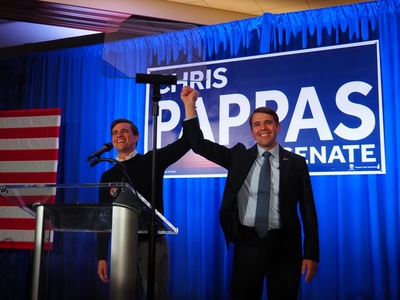
“You said in a resounding voice that America needs a course correction,” Pappas told supporters. “That Washington needs a new generation at the table to fix things.”
Key Senate races in Maine, Michigan and other states hadn’t yet been called by the time Pappas took the stage, but Democrats nationwide received early signs of their hoped-for “blue wave.” Throughout the night, the wave turned into a tsunami and Democrats picked up big wins in Texas, Kansas and South Carolina, states that analysts had previously thought were unwinnable for Democrats.
Both Pappas and Sununu tried to define the race by affordability issues, which have been a driving force across the country this election cycle. Pappas put the blame on President Donald Trump for rising inflation amid a war in Iran that has spiked fuel prices and a tariff campaign that hit New Hampshire companies doing business with Canadian partners particularly hard. Sununu, on the other hand, pitched a series of old-school Republican free-market solutions to economic challenges, such as energy infrastructure deregulation and reining in federal spending.
Pappas also made campaign finance reform a key part of his campaign with proposals aimed at stemming dark money in politics. During the campaign, he brought a parade of national Democratic figures to the state — particularly those rumored to be considering a run for president in New Hampshire’s influential primary election — including Kamala Harris, Pete Buttigieg and Gavin Newsom.
Pappas worked hard to tie Sununu to Trump, who has lost New Hampshire in three consecutive presidential elections and is suffering from low approval ratings. While Trump endorsed Sununu in the GOP primary, the Republican tried to distance himself from the president, going so far as to say in one campaign ad, “I’ve never even met the man.”

Sununu sought to frame this race as about the future, specifically the post-Trump future. The candidate, who once penned an op-ed in the New Hampshire Union Leader under the headline “Donald Trump is a loser,” said during a WMUR debate last month: “In two years, the president will leave office, and my question is, where do we go next?”
On Tuesday night, he conceded from a election results watch party at McIntyre Ski Area in Manchester.
“This has been an incredible campaign,” Sununu told supporters. “But this is not our night.”
Sununu’s defeat is also a blow for one of New Hampshire’s most politically connected families. John E. Sununu is the brother of former Gov. Chris Sununu and the son of former governor and White House Chief of Staff John H. Sununu. John E. Sununu was himself a U.S. representative and held this same Senate seat from 2003 to 2009.
In an interview outside a New London polling location earlier Tuesday, Pappas told the Bulletin he met a lot of Republicans voting for him.
“I think it shows that the usual political dividing lines aren’t going to necessarily hold in an era where people distrust the president’s leadership and don’t think Congress is getting the job done,” he said.
Democratic Senate candidates and Republicans gubernatorial candidates in New Hampshire have long relied on split-ticket voters in this purple state. It’s a dynamic that played out Tuesday when Republican Gov. Kelly Ayotte held onto her seat despite big Democratic wins for Congress and down ballot races.
Pappas has been a reliably centrist vote in the House since 2018. His most notable votes were ones in which he crossed the aisle. That includes his vote for the Laken Riley Act in early 2025, an immigration and law enforcement bill pushed by Republicans in the wake of a Georgia woman’s death at the hands of an immigrant. The legislation was criticized by progressives and immigration advocates who argued it disregarded immigrants’ due process rights, gave too much power to state attorneys general and empowered ICE ahead of a series of aggressive enforcement surges; they also note crimes by immigrants are rare and describe Riley’s tragic death as an outlier. He was also one of six Democrats opposing the Marijuana Opportunity Reinvestment and Expungement Act — which unsuccessfully attempted to legalize marijuana federally — in 2020 over concerns about a provision to expunge federal convictions. In 2023, the Lugar Center ranked him the most bipartisan Democrat in Congress.
Pappas enters a Senate that’s in many ways defined by the Trump presidency. In the two years before Trump is term-limited out of office, Democrats will likely bicker over how to rebuke the president. Asked about the prospects of more impeachment proceedings or a potential removal — something some Democrats have suggested if they take control of Congress — during a WMUR debate last month, Pappas said “oversight and focused hearings” rather than impeachment would bring “the accountability that the American people deserve.”
Pappas has now won five straight congressional races.
Concord, NH