Voter interviews reflect struggle for South Dakota Democrats as party hopes for gains nationally
Nov 03, 2026 | 6:35 pm ET

Description
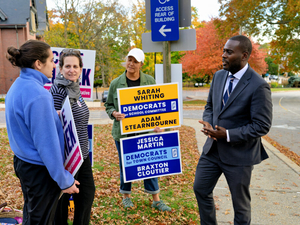
Campaign signs advertise various candidates during the general election on Nov. 3, 2026, at T&C's Other Place convenience store in Dell Rapids, South Dakota. (Photo by John Hult/South Dakota Searchlight)
Democrats were expected to make gains nationally in Tuesday’s election, but interviews with voters reflected the challenges still facing Democrats in South Dakota, where the party was trying to prevent a losing streak in statewide races from extending to 18 years.
Allison and Cade Wood, voters in their mid-20s from Sioux Falls, said they voted only for Republicans.
“I like voting for the party that is pro-life, with conservative values,” Allison Wood said.
In the capital city of Pierre, 84-year-old Bill Strickland said he also voted for all the Republicans on his ballot.
“I know most of them, so I just voted for them,” Strickland said. “They’ve always done everything well, everything I’ve wanted them to do.”
South Dakotans set to decide races for governor, Congress, Legislature and 4 ballot questions
In Dell Rapids, home of Democratic nominee for governor Dan Ahlers, voter Adam Schmitz said he sometimes encounters Ahlers at community events, including a recent downtown trick-or-treat night. That familiarity wasn’t enough to convince Schmitz, a 37-year-old Republican, to vote for Ahlers.
“He seems like a nice guy, but our views don’t always line up,” Schmitz said.
South Dakota Searchlight encountered few Democratic voters during visits to polling places Tuesday, which is reflective of a downward trend for the party that started after a high point in 2008.
Democratic voter registrations in the state climbed to a peak above 200,000 that year as Democratic President Barack Obama won his first term and the two Democratic members of South Dakota’s three-member congressional delegation, U.S. Sen. Tim Johnson and U.S. Rep. Stephanie Herseth Sandlin, won reelection.
No Democrat has won a statewide race in South Dakota since then. Herseth Sandlin lost her next reelection bid in 2010 to Republican Kristi Noem, and Johnson chose not to seek reelection in 2014.
The number of registered South Dakota Democrats has plummeted in the meantime. Democrats, now with about 135,000 registered voters, are outnumbered not only by the state’s roughly 330,000 Republicans, but also by the other 160,000 voters registered as independent, a member of a minor party or with no affiliation.
Johnson’s departure from the Senate after 2014 opened the door to Republican Mike Rounds, who won the seat that year and again in 2020, and was running for reelection Tuesday. Polling indicated Rounds had one of the strongest challengers in statewide races this year — not a Democrat, but rather an independent, Brian Bengs. The Democratic nominee dropped out of the race in August.
Nationally, Bengs was one of four independent candidates for Senate in Tuesday’s election who were the main opponents of Republican senators. The others were in Nebraska, Montana and Idaho — states like South Dakota where President Donald Trump has won and Democrats have struggled.
Michael Heusinkveld, a 62-year-old Mitchell Republican, said he didn’t think any national momentum by independents would help Bengs in South Dakota.
“He wasn’t going to beat a Republican,” Heusinkveld said. “I mean, it’s just somebody to throw out there.”
Other voters said the Rounds-Bengs contest was the only statewide race that might be competitive. An independent, Greg Dyer, 59, of Sioux Falls, said he voted for Bengs to bring a “different voice” to the U.S. Senate.
“Just the stranglehold that the Republican Party has on the state — I’d like a bit more diversity in the conversations that take place,” Dyer said.
Another Sioux Falls voter, 46-year-old Democrat Heather Reed of Sioux Falls, declined to say whether she voted for Rounds or Bengs.
“It was complicated,” Reed said of the Senate race. “I didn’t feel like there was a good choice for somebody that I believe has full integrity and maturity and will stand up for people who are marginalized. I’m not sure that either of the candidates will do that.”

Pierre, SD