Gulf Coast states could get more flexibility to manage red snapper limits
Nov 02, 2026 | 6:02 pm ET
Description
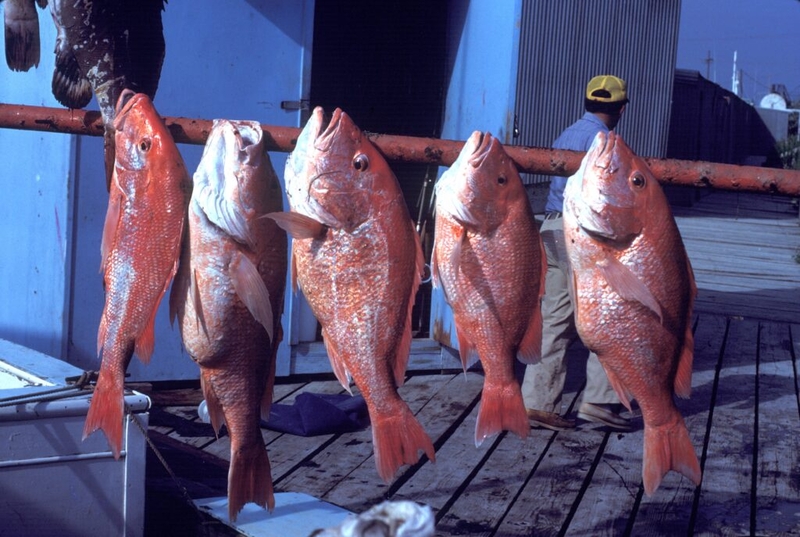
Red snapper displayed on a dock in 1978. (NOAA NMFS SEFSC Panama City Beach Laboratory)
The way Gulf Coast states manage their catch limits for red snapper, a popular catch among recreational anglers, is poised to change next year as fisheries management officials recommend adding more flexibility for states into federal rules.
The Gulf Fishery Management Council took action last week to alter how red snapper catch limit “paybacks” are done at their meeting in Galveston, Texas. The council advises the federal government on managing species in its Gulf of Mexico waters. Its members include sportfishers, commercial harvesters and scientists.
Gulf states are each allotted a specific amount of fish per species that recreational anglers may pull from the water every season. It’s done to ensure anglers don’t take too many, which can destabilize the population or even lead to a species’ extinction.
Previously, if a state went over its seasonal catch limit for red snapper, it had the overage amount taken away from its limit the following season, known as a payback.
The Gulf Council will change the regulations to require payback in only some instances. It will apply when a state exceeds its catch limit by more than 10%, surpasses its limit twice within three years or goes beyond its individual state limit in a year where the total catch limit for all Gulf States is surpassed.
Kesley Banks, a fisheries scientist and chair of the Gulf Council, said the change is being made to avoid punishing states that go over their catch limits by insignificant amounts.
“It’s an estimate. There’s a margin of error on either side,” Banks said about the statistical modeling used to set catch limits. The added flexibility allows states that consistently obey catch limits to fall back on their good track records to avoid being “punished” when they fall within the margin of error, she added.
“This is one way we can address that without opening that long, convoluted process” of reworking the standards from scratch, Banks said.
The new rules go next to the U.S. Department of Commerce, where its secretary will decide whether to approve the council’s recommendation. The council fashioned the rule changes after a public comment period, and the public will get another chance to provide feedback when Commerce Secretary Howard Lutnick officially opens the comment period, lasting 16 to 30 days.
In all, the process is expected to take seven to 10 months, Banks said, with the rules becoming official around mid-year 2027.
The Gulf Council is one of eight regional fishery management groups that Congress established in 1976. They all set and revise regulations for federal waters to keep fish populations from being overexploited and maintain healthy ecosystems.
Baton Rouge, LA