A letter to the Sage of Emporia about poetry, bright red alarms and warning signs in western Kansas
Nov 02, 2026 | 4:33 am ET
Description
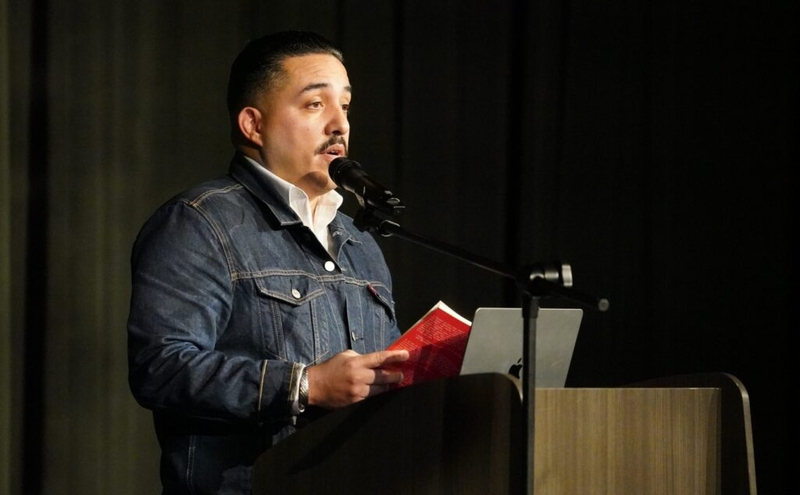
Kansas author Huascar Medina reads from his latest book, "Protest as Love Poem." He started his recent book tour in western Kansas. (Photo by Phillip Lee)
Dear William Allen White,
It’s been some time since I last wrote you. The air is swirling across Kansas. Maddening gusts of uncertainty from east to west, and the entire nation is watching. I often call wind the prophet of change, and its message remains to be determined.
You once said of our great state, “Kansas is the Mother Shipton, the Madame Thebes, the Witch of Endor, and the low barometer of the nation. When anything is going to happen in this country, it happens first in Kansas.”
I often hark back to this quote when elucidating on the importance of Kansas. We shall see.
I‘m on a western Kansas book tour. My first stop was your hometown, where my publisher, Meadowlark Press, is based. You should know I was well received in Emporia. I left that reading fulfilled, a few books lighter and ready for what lay ahead, or so I thought.
Around midnight, at mile marker 149 on U.S. Highway 50, the blinking lights of wind turbines lay strewn across the horizon of an outstretched, overextended prairie like briar berries. They grow quickly as you enter Ford County. The blinking is synchronized, flashing like hotel alarm clocks needing a reset after a power outage.
I wonder if this is the first sign I shouldn’t be out here. Giant stoplights are an ominous sign to consider when you’re weary on the road and far from home. Out here, at this hour, I think of Marvin Bell’s “Incarnate: The Collected Dead Man Poems” and his line “On the dead man’s stopped watch, the time is always right.”
So, in my mind, I am not late. There’s no bad time to head west with all these unset alarms. I might be early.
I thought more about the first stop on my tour, just hours before, at Middle Ground Books. I sat drinking Nicaraguan coffee and breaking bread with the staff, with a large statue of a rabbit standing watch over me at the right corner of the cafe counter.
“I was born and bred in the briar patch … born and bred,” I say to myself now as I drive up Wyatt Earp Boulevard in search of a hotel parking lot.
Why would I start a book tour in western Kansas? My reply: “Why not?
Does it seem foolish or unsafe? After all, I do consider myself a prairie fool.
There are many reasons to head west, especially right now. The recent U.S. Immigration and Customs Enforcement raids in the area caught my attention and infuriated me. I needed to sublimate.
Sublimation is a defense mechanism in which socially unacceptable, aggressive impulses are transformed into productive, socially acceptable, constructive behaviors. Creating art is a form of sublimation. There’s a poem in my collection titled “ICE sublimation.” You should check it out.
Those ICE attacks were timely, coming right before election season. Officials called them “Operation Safe Community – Kansas” to gaslight the public, because masked men dressed in military tactical gear harassing hardworking Kansans is the exact opposite of safety. The optics have always been bad for the administration and, by default, the GOP.
Those communities felt safer before the ICE raids. I know this because I was there after the fact, and people in the community told me so repeatedly. It didn’t make sense to do this now except for one reason: to intimidate the Latino and immigrant communities right before elections.
The Roger Marshall-Adam Hamilton race for U.S. Senate is extremely close. The race is a toss-up. Post-election headlines will either read: “Florida man loses bid for reelection to Kansas Senate seat” or “Local pastor too religious for Kansas conservatives.”
Trump administration officials claimed they were after “the worst of the worst” and highlighted five individuals they were targeting. A Wichita Eagle investigation later found the individuals had already been deported or were in custody. For three days, western Kansans fell under tyranny, and I didn’t hear a peep from Don’t Tread on Me enthusiasts.
I will think about that the rest of my life when I see those license plates.
What occurred in western Kansas was an attack on the working class, the “trabajadores” who are the lifeblood of cities they live and labor in. There will probably be vitriol in response to this op-ed online, but it’s the same old tired song and dance from the alt-right, those who are fed hate daily by fake news stations drumming up nightly viewership. Soulless algorithms spread propaganda to get us to buy into the next big grift.
We don’t have much time to cover this right now, William. Just know that outside forces that don’t care about Kansans are influencing our politics like never before. I miss the days of trusted local voices who lived in the places they wrote about. Voices like you. We had a responsibility to our communities. To lie in a single line betrayed the trust to every neighborhood street and sidewalk.
We have to walk the streets we write about. I won’t go on a tirade. The list of grievances is long. There’s already enough blame being thrown on the TV, radio and the internet. It runs back-to-back as slanderous political ads across Kansas. The fearmongering is relentless. The texts are infinite. I’ve never felt so wanted or targeted.
Independents have it the worst. We are bombarded by both sides.
So much money is being spent on this election in Kansas. The latest figure I’ve read was $84.5 million dollars. I don’t want to hear any politician on any side say: “We don’t have money.”
What is worrying me today is what will happen next. Cults are most dangerous when they face collapse and exposure. The Branch Davidians, Jonestown, and Aum Shinrikyo all show what a cult of personality can do when the end is near.
I think about them as I finish my audiobook on my drive into Dodge City: “End Times Fascism,” by Naomi Klein and Astra Taylor. I check into my hotel via a kiosk, speaking with a virtual front-desk person from a third-party customer service provider.
Someone from another part of the world, unconcerned with what is happening here, smiles and says: “Welcome.” I walk into my hotel room. First, I check whether the alarm clock is blinking, then unplug the hotel room phone. Finally I check the weather to see what tomorrow might bring.
P.S.:
I continued my drive deeper into western Kansas. Yellow diamond-shaped road signs lined the highway. They say “Wind gusts” or “Severe side wind ahead.” All I can do is hold the steering wheel tighter. I keep trying to stay in my lane and in-between the lines, but this wind — I’ve never felt anything like it.
Here’s a poem about collective choices from my book, “Protest as Love Poem.” I hope you like it.
Take care, my friend,
HM
Found Transcript: Typewritten by the Wind on the Heads of Triticum Aestivum¹
We are bountiful, said the horizon to the skyline. We are rising,
emerging ahead, growing upright like rows of grain-filled wheat.
Every act of breaking bread begins here, in these fields—where
you and I meet. Right here, in Kansas, where souls are weighed
in bundles, not grams.
¹bread wheat
Huascar Medina is a poet, writer, and performer who lives in Lawrence. His latest book is Protest as Love Poem. Through its opinion section, the Kansas Reflector works to amplify the voices of people who are affected by public policies or excluded from public debate. Find information, including how to submit your own commentary, here.
Topeka, KS