Judge orders Kenis Lopez Gonzalez to be freed, returned to U.S. from Central African Republic
Oct 30, 2026 | 6:58 pm ET

Description
Kenis Lopez Gonzalez. Courtesy photo.
A federal judge has ordered the federal government to immediately return Kenis Lopez Gonzalez to the U.S. from the Central African Republic, where he has been detained since August despite having no ties to the country.
Lopez, who has no criminal record, arrived in the U.S. in 2022 from Nicaragua and turned himself in to immigration authorities at the border. In 2024, an immigration judge ruled that he could not be deported to his home country because he was at risk of torture.
After he was arrested outside his Shakopee home in January, Immigration and Customs Enforcement held him in various detention centers before deporting him to the Central African Republic in August. Lopez is among more than 25,000 people deported to countries that aren’t their home country since President Donald Trump took office in 2025.
Following a Friday afternoon hearing, U.S. District Judge Jeffrey M. Bryan ordered that ICE return Lopez to Minnesota expeditiously, where he will — at least for now — return to the same immigration status he held before he was arrested in January.
During Friday’s hearing, Justice Department attorneys indicated they would file a motion requesting that Bryan extend the timeline for Lopez’s return, so that they have time to appeal the order.
Bryan, in a strongly-worded opinion, found that Lopez risked irreparable harm if allowed to remain in the Central African Republic; that his case against the government was likely to succeed; and that it was in the public’s best interest that ICE follow its own policies and return Lopez.
“ICE violated Mr. Lopez’s constitutional rights, and hardly even denied it,” said Simon Sandoval-Moshenberg, one of Lopez’s attorneys.
ICE has not always followed court orders. During the two-and-a-half months of Operation Metro Surge, the agency violated 210 court orders. In some cases like Lopez’s, the federal government has dragged its feet returning people. On Oct. 7, for instance, a judge ordered the Department of Homeland Security to bring Ahmed Soliman back from Equatorial Guinea. He still has not arrived in the U.S.
Seemingly aware of such cases, Bryan mandated a nine-step process, with deadlines, for immigration officials to facilitate Lopez’s return.
Much of Bryan’s questioning in the hearing centered on Lopez’s expression of fear of removal to the Central African Republic. Immigrants who fear persecution in their home countries are entitled to hearings to determine whether those fears are justified and warrant a cancellation of deportation — exactly what happened in Lopez’s prior immigration case, when a judge found that his fear of return to Nicaragua was justified and blocked his deportation.
When Lopez learned he was about to board a plane to Central African Republic, he expressed fear to the staff. But he was not permitted a hearing on the subject. Instead, agents used projectiles — either rubber bullets or pepper balls — to force him and others off of the bus. They wrapped him in a full body restraint and carried him onto the plane.
“The threat of irreparable harm to Lopez of remaining in the Central African Republic while his claims are pending is self-evident and was known to Defendants well before they ever forced Lopez (with quickly developing bruises and welts) onto a flight to the Central African Republic,” Bryan wrote.
The government’s argument that Lopez does not face the risk of harm in the Central African Republic, Bryan wrote, is “plainly disingenuous.”
‘Diplomatic assurances’
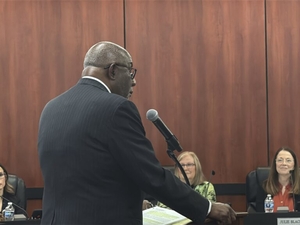
David Fuller, assistant U.S. attorney for the District of Minnesota, argued that Lopez was not entitled to a hearing on his fear of removal to Central African Republic because it was not the country — Nicaragua — named in his immigration case for the threat of torture.
Fuller and Bryan have met before: In early March, Bryan summoned Fuller and his boss, U.S. Attorney Daniel Rosen, to his courtroom to explain why they should not be held in contempt for failure to comply with court orders.
Fuller’s argument also relied on “diplomatic assurances” from the government of the Central African Republic that detainees would be treated humanely in accordance with international law.
The Central African Republic has been mired in political violence for years, especially since rebels took power in 2013. The State Department website, updated in January, warns Americans not to travel to the country due to risks of unrest, crime, kidnapping, health, terrorism and more. Corruption is a “significant concern,” the State Department warns, and armed groups control large areas of the country.
“It’s a little difficult to juxtapose what the Department of State tells people about living in the Central African Republic — even the existence of a government there — and a statement that some government officials have provided ‘diplomatic assurances’ of something,” Bryan told Fuller.
And, later during the preliminary injunction hearing: “I’m sure you’ve seen the Department of State reports about the Central African Republic,” Bryan said.
“I must admit I have not, and I don’t know what it says, but that would fall into the purview and the province of the Department of State,” Fuller replied.
Secretary of State Marco Rubio is a defendant in the lawsuit.
In his order, Bryan extensively cited the State Department’s report on the Central African Republic to demonstrate the risks Lopez faces there.
Little is known about the terms of the deal between the U.S. government and the Central African Republic. The federal government began sending deportees to the country after paying $85 million to the United Nations’ International Organization for Migration in the Central African Republic. That organization is overseeing the detention center in the capital city of Bangui, where Lopez is held.
Christopher Landau, the deputy secretary of state, sent a letter to interim ICE director Todd Lyons in May stating that the government of the Central African Republic assured the U.S. that “it would treat any third-country nationals transferred from the United States to CAR in a manner that is in accordance with its international legal obligations and that the third-country nationals removed to CAR would not be subjected to persecution.”
“It is the Department of State’s view that the assurances received from the CAR government are credible and reliable,” Landau wrote.
He ended the letter by asking the Department of Homeland Security to “refrain from publicly discussing our cooperation with CAR on this matter.”
The letter was submitted by U.S. attorneys as evidence in Lopez’s case.
“The Court is left to presume the reason for asking DHS to refrain from making the arrangement public; perhaps it is because they do not want the general public to know that they have agreed to forcibly relocate prisoners to a country in which foreign nationals will be subject to the known and serious danger,” Bryan wrote in his order.
The U.S. Supreme Court is scheduled to hold oral arguments on the legality of third country deportations in December.
As an exclamation point, Bryan’s final point in the order prohibits the government from shooting Lopez with rubber bullets or any other projectiles, at close range or otherwise.

Saint Paul, MN