Amendment 8 would keep ‘foreign adversaries’ from seizing Louisiana property
Oct 30, 2026 | 2:10 pm ET
Description
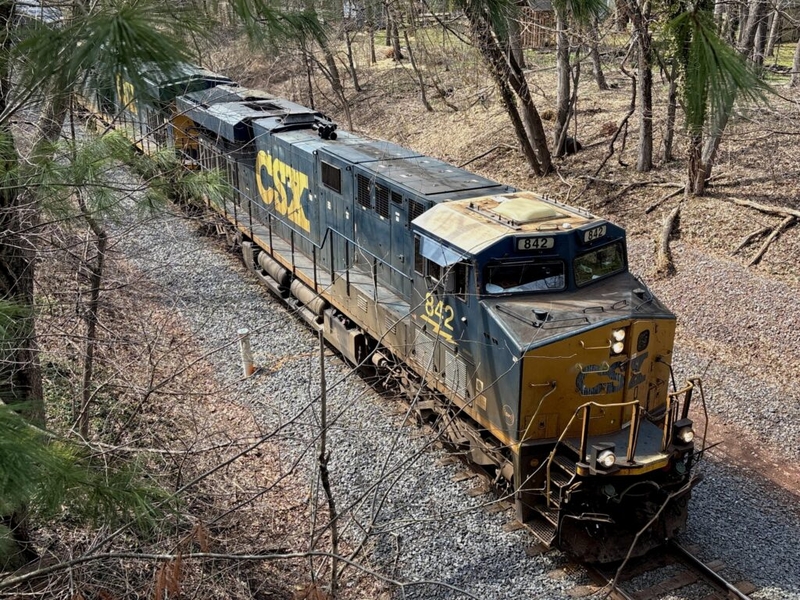
Railroad companies have expropriation authority in Louisiana, the state lawmaker who authored proposed Amendment 8 on the Nov. 3 ballot says it will prevent any foreign adversary that acquires a rail line from taking over private property in the state. (Photo by Dana DiFilippo/ New Jersey Monitor)
Louisiana would join a trend among states that have banned certain foreign nations from gaining control of private property if its voters approve a change to the state constitution on Tuesday’s ballot.
Amendment 8 specifically prohibits a “foreign adversary” or their representative from expropriating property. The list of countries considered adversarial is based on the U.S. Treasury’s official designation, which currently includes China, Cuba, Iran, North Korea, Russia and the regime of Venezuela’s former leader Nicolás Maduro.
Expropriation is typically a power local or state governments wield when they want to justify the forced acquisition of private property for a greater common benefit, such as building out roads, drainage, water lines and other public infrastructure. The private owner has to receive fair compensation for the property being taken to comply with eminent domain laws that give governments expropriation power.
“This is simply a wall of separation to make sure that they never get into the expropriation business, either them directly or indirectly through an intermediary or an agent,” said state Rep. Chuck Owen, R-Rosepine, who authored the amendment. “This is simply a wall of protection for the citizens of Louisiana.”
When he brought his bill before lawmakers this spring, Owen laid out a hypothetical example in which a foreign adversary buys a controlling stake in a Canadian railroad. Two such rail lines exist in Louisiana, and the state gives railroads expropriation power. The proposed amendment would provide “guardrails” to protect private property in such a situation, Owen said.
Existing state law already prohibits foreign adversaries from expropriating property within 50 miles of a military base and from acquiring or leasing all immovable property in Louisiana. Owen’s proposal would bake this ban into the state constitution, making it harder for the legislature to change it moving forward. If Amendment 8 is approved, it would take another statewide vote to alter the constitutional provision.
Since 2023, there has been a push among state legislatures to prohibit foreign adversaries from securing U.S. property for national security and economic reasons. There is no federal law banning such acquisitions, though the Agricultural Foreign Investment Disclosure Act of 1978 requires the deals to be reported to the U.S. Department of Agriculture.
Several government agencies track other types of commercial real estate transactions involving foreign buyers, but federal law protects the confidentiality of that data. The Bureau of Economic Analysis conducts foreign investment surveys every five years, but its publicly available summaries offer very limited insight into ownership.
Laws similar to the proposal Louisiana voters will consider Tuesday are already in place or proposed in at least 35 states, with some differences among them regarding the type of property to which the prohibition applies.
For example, it’s illegal in North Dakota for China, Cuba, Iran, North Korea and Russia to acquire farmland. Indiana prohibits adversaries from buying property or leasing it for non-residential uses.
The bans also have compelled foreign-owned businesses to sell some of their U.S. holdings.
After Arkansas put its law in place in 2023, Gov. Sarah Huckabee Sanders ordered Sygenta, a Chinese-owned company, to sell 160 acres it owned there, and it was fined for failing to report to the state when it originally bought the land under a separate Arkansas law.
Sygenta still owns property in five other states, though Chinese ownership of U.S. farmland totals less than 1%, according to the USDA. China’s biggest holdings are through pork and beef producer Smithfield Foods, which Shuanghui Group (now WH Group) acquired in 2013. Smithfield currently owns roughly 85,000 acres (0.004%) of U.S. land.
Foreign interests are not taking these laws sitting down. A group of Chinese citizens and a real estate business have sued in federal court to block Florida’s ban. Their case is currently before an appellate court. A similar lawsuit in Texas involving plaintiffs from China, North Korea and Russia landed before the U.S. 5th Circuit Court of Appeals, which ruled this month to uphold the state law.
USDA figures show international buyers — whether from a friend or foe nation — make up about 3.5% of U.S. agricultural landowners. Canadian interests hold the biggest share at 2.3%, and close to 100 other countries account for the remainder.
The National Agricultural Law Center, a nonpartisan research center, tracks state laws that deal with foreign ownership. Its director, attorney Harrison Pittman, said a potential pitfall in such measures is that they leave discretion over what countries are considered adversaries up to the president.
“What if you have a state that has a lot of Saudi Arabian investment … like in the equine industry, and a future president labels Saudi Arabia as a foreign adversary? What does that do, like after the fact? That’s not what necessarily people had on their mind” when they approved the law, Pittman said.
There have also been questions about whether Amendment 8 is actually needed.
In its analysis of the proposal, the progressive policy think tank Invest in Louisiana notes there is no evidence any foreign adversary has ever tried to seize property from anyone in the state. The group does not take a position on any of the amendments.
Another progressive group, the Power Coalition for Equity and Justice, opposes the measure.
“We don’t need to change the constitution for something that can be handled through regular state law,” the group wrote for its review of the amendment.
The Louisiana Association of Business and Industry, the state’s largest business lobby group, has not taken a position on the amendment.
Owen’s bill was approved without opposition or debate when it advanced through the legislature. Organizations whose representatives voiced support for it in committee included the Louisiana Citizens Advocacy Group, Louisiana Family Forum and the Louisiana Landowners Association. Those opposed were from the oil, gas and chemical industries as well as the regional economic development group Greater New Orleans Inc.
All you need to know about Louisiana’s property tax constitutional amendments
Amendment 7 would let New Orleans use federal money for private lead-pipe removal
Louisiana considers banning bail for those convicted of crimes against minors
Louisiana Democratic Party comes out against amendment to limit governors’ time in office
Baton Rouge, LA