In contested majority-Black legislative districts, candidates focus on affordability
Oct 30, 2026 | 5:59 am ET
Description
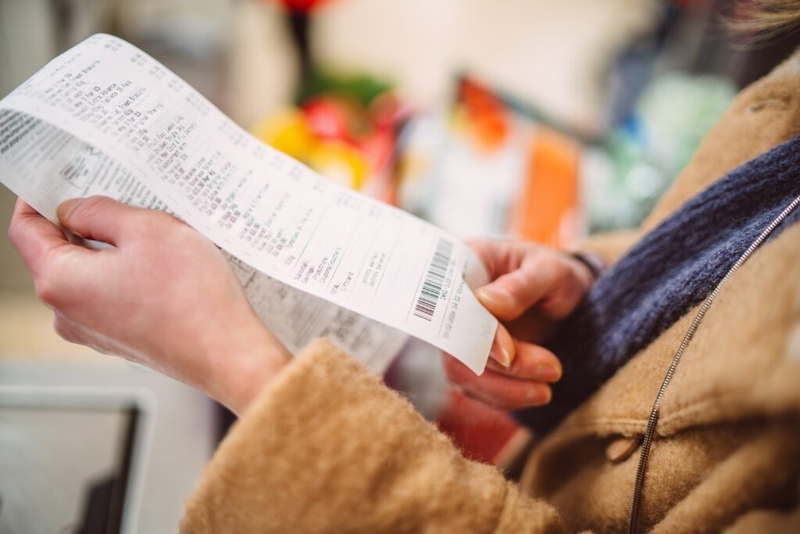
A person reviewing a grocery receipt. Legislative candidates in potentially close races around the Black Belt and central Alabama all said that they favor repealing the state portion of the grocery tax to help address the high price of food. (Photo by Ming Tang Tung/Getty Images)
Four majority-Black legislative districts where Republicans did notably well in 2022 will be contested again this fall.
The contests include three districts in the Black Belt region as well as an open seat in Anniston left by Rep. Barbara Boyd, D-Anniston, who is retiring from the Legislature.
“These are districts where there is a little bit more competitiveness between the two parties, whereas most districts in Alabama politics are more heavily favored by one party or the other,” said David Hughes, an associate professor at the University of Louisiana at Lafayette who analyzed the races. “These at least have voters who have a demonstrated record of a bit more bipartisanship compared to elsewhere.”
One is House District 69 that includes Autauga, Lowndes, Montgomery and Wilcox counties. In that race, Rep. Kelvin Lawrence, D-Hayneville, is facing Republican nominee Josh Pendergrass, who ran in 2022 for District 88 but dropped his campaign after he realized he lived outside of the district.
Rep. Thomas Jackson, D-Thomasville, is also seeking another term for House District 68 in Clarke, Conecuh, Marengo, Monroe, Perry and Wilcox counties, against second-time challenger Fred Kelley. Sen. Robert Stewart, D-Selma, is trying to keep his seat against Thayer Spencer in Senate District 23, which includes Butler, Clarke, Conecuh, Dallas, Lowndes, Monroe, Perry, and Wilcox counties.
Multiple messages were left with Spencer seeking comment.
In House District 32, located in Calhoun and Talladega counties, Democratic nominee Debra Foster is going against Republican Joey Callahan.
The races were relatively close in 2022 thanks in part to a weak Democratic statewide ticket, a generally favorable environment for Republicans and low turnout in blue areas. Jackson defeated Kelley that year by just under 600 votes, a margin of 3%. Lawrence beat Republican Karla Knight Maddox by about 10%, 55% to 45%.
Another factor is ongoing population loss in the Black Belt, a Democratic stronghold, and more equal distribution of white and Black voters. In Alabama’s racially polarized electorate, white voters tend to support Republicans, and Black voters tend to support Democrats.
House District 32, Hughes said “is competitive in the sense that there are a pretty good number of Black voters in Talladega County, around the city of Talladega, but not the same concentrated population that we see in parts of western Birmingham or Montgomery.”
House District 69, represented by Lawrence, includes parts of Autauga County with a significant number of Republican voters. Stewart’s district incorporates significant parts of southern Alabama with fewer Black residents, according to Hughes.
However, the national environment this year is much more favorable to Democrats, with Donald Trump facing sagging popularity and voter concerns about the cost of living.
Affordability concerns
Both Democrats and Republicans said they wanted to prioritize affordability and prioritized grocery tax elimination and reduction of the gas tax.
“People are having to determine whether to pay for rent or they buy groceries, or their rent or their medicine,” Lawrence said. “That should not happen in 2026 here in Alabama or in the United States.”
Pendergrass said he wants to review the grocery tax imposed by local municipalities.
“We need to work on the state level with local counties and municipalities and figure out a way on how we can get them to also remove the tax on groceries so that it is zero percent,” he said.
Kelley said he wants to go further and ease the gas tax.
“Did you know there is a 30-cent per gallon state gas tax?” Kelley said. “If we repeal 10-cents per gallon on every gallon sold in Alabama just today, how much money would that be?”
The tax was part of a law in 2019 that was passed by the Legislature for road and bridge maintenance. Kelley later said in an interview Thursday that “is not a good idea” after he researched the issue after the interview.
Democrats for their part have also proposed legislation to eliminate the state tax on groceries. It was a focal point of a news conference the party hosted on Monday concerning affordability. Former Rep. John Knight, D-Montgomery, said he introduced legislation more than 30 years ago to repeal the sales tax on food, but it did not pass.
Some Democrats said they want to increase people’s earnings. Stewart in January filed a bill that would have established a $10 minimum wage in the state for businesses with 51 employees or more.
“Our state does not have a minimum wage, so I sponsored legislation to create a minimum wage,” Stewart said.
Several candidates also said rural healthcare is a priority.
“People are without health insurance,” said Foster, running in House District 32. “People are sick and can’t go to the doctor. Hospitals are closing. They don’t have hospitals that are close to them. When you are sick, it is a matter of life and death if you don’t get care expeditiously.”
Foster said she wants to expand Medicaid, which Alabama has not done.
“Medicaid will not only give people access to healthcare, but it is also going to allow us to draw doctors and nurses to the community,” she said. “Not only that, it is also an economic engine because it is going to bring jobs to the state.”
Callahan said he wants to provide funding through community block grants.
“You bring that money back and you find out the communities that need it,” he said.
Other candidates said that economic and workforce development is a priority. Several said they want to develop programs through the community college system.
“That takes state money, but I think it could be done with private partnerships along with tax money,” Callahan said. “The more people make, and the more opportunities people have to create wealth for themselves, then the more they can afford.”
Pendergrass said he wants to invest in two-year colleges and provide students with a path to obtain a credential while in high school.
“What can we do spending priority wise to make sure as many of our students as possible finish high school with at least part of their associates degree done if not the whole thing,” he said.
One possibility would be to allow school districts to partner with local two-year colleges to educate students.
Jackson said he wants to help farmers in his district. He filed HB 523 in the 2026 session that would have allowed the Commissioner of Agriculture and Industries to create the Agricultural Enhancement Program funded by the Legislature to provide money to farmers to help pay for investments in their farms.
He also wants to continue his efforts to fight voter disenfranchisement.
“Voting rights was passed in 1965,” Jackson said. “Now they are trying to make it hard for people to register to vote.”
Jackson filed HB 59 in 2025 that would have required each county to provide at least one precinct to allow people to vote the week before the election. The bill never made it out of the House Constitution, Campaigns and Elections committee.
Montgomery