Montana Democratic lawmakers highlight affordability as first legislative priority in ‘27
Oct 28, 2026 | 7:07 pm ET
Description
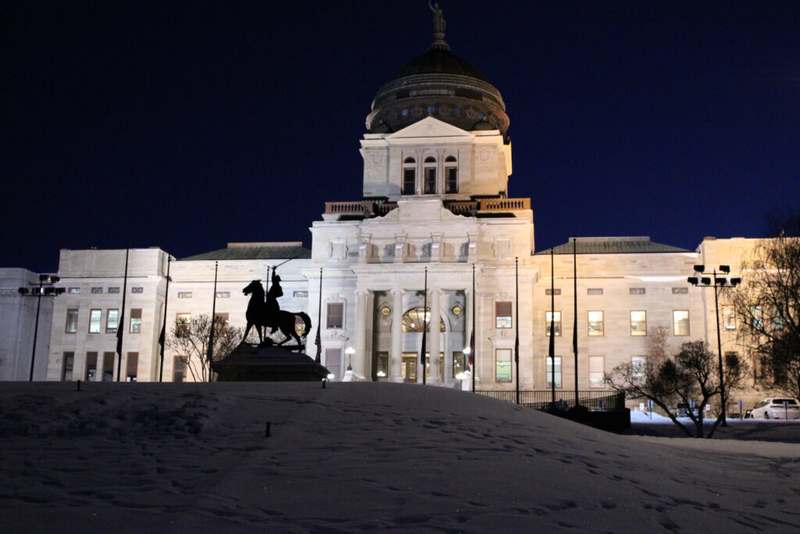
The Montana state capitol pictured after a late-night Senate vote on Jan. 9, 2025. (Micah Drew/Daily Montanan)
Many facets of everyday life, from flipping on the lights as days grow darker to running weekly errands, are getting more expensive for Montanans, and Democratic lawmakers hope to address those issues in the 2027 legislative session.
During a Tuesday press conference at the state Capitol, Democratic legislative leaders shared three proposed bills they hope will help ease the climbing prices of groceries, housing and energy.
“Costs have continued to grow out of reach for anyone of the average income,” state Rep. Kelly Kortum, who is running for state Senate representing part of Bozeman. “Families need to afford the basics without worrying where they will have to trade off in their budget, or if they will have the money to afford it at all.”
Kortum acknowledged that many costs are tied to national and international policies, supply chains and corporations, “aspects of these are all far out of reach for the Montana legislature,” but said his colleagues planned to take whatever steps possible to fight “for a Montana we can all afford.”
Sen. Laura Smith, who is likely to be a part of Senate minority leadership next session, introduced a proposal aimed at stopping grocery stores from using personal data and AI algorithms to fix prices differently for different people.
Large grocery chains have begun replacing in-store paper price tags with digital shelf tags, which make it easier for employees to change prices on individual items.
But in many cases, the move has driven concerns that prices could be altered based on who is purchasing an item. For shoppers who purchase groceries online, there are concerns that personal data could be used to cater prices to individuals — similar to how airlines use “dynamic pricing” based on someone’s search history or ride-share apps will surge prices when services are in high demand.
“Montanans deserve to be protected from algorithms controlled by large businesses with no accountability to the average shopper,” said Smith, D-Helena. “Montanans should not be charged different prices depending on the time of day, their purchasing history, and even their projected income.”
Similar pieces of legislation have been pushed in states around the country.
Two states — Connecticut and Maryland — have enacted laws prohibiting the use of personaldata in grocery pricing, while a similar bill advanced through the New York legislature this year. Colorado Gov. Jared Polis vetoed his state’s proposed legislation, saying it was overly broad and could prevent lowering prices in some instances.
Local legislation has also been passed, with Seattle adopting a ban on so-called “surveillance pricing” earlier this month.
“It’s a phrase I never thought that I would have to say in regular life or as a legislator: I do not want robots choosing the price of your groceries,” Smith said.
Localizing housing ownership
In a state where housing prices have outstripped wage growth — especially in popular areas such as the Flathead Valley and Bozeman — affordability of renting or owning a home is top of mind.
Sen. Jacinda Morigeau, D-Arlee, shared proposed legislation that would focus on just one facet of the affordable housing situation, the “scourge” of private equity firms and corporations buying homes, apartments and mobile home parks in the state.
“Nationally, it’s estimated that private equity firms own 13% of all apartment units,” Morigeau said, citing reporting by Lee Enterprises that 30 mobile home parks in the state are owned by private equity — about 3,900 homes.
“To these faceless corporations, Montanans are just numbers on a spreadsheet, and their homes are assets to extract money from to the detriment of the people who live in them,” she said.
A proposed bill Democrats plan to bring next session would ban private equity firms and institutional investors from owning residential real estate property, including mobile home parks.
Federally, Congress passed legislation this year aimed at slowing corporate ownership of single-family homes by prohibiting large private equity firms from buying additional single-family homes with some exceptions.
Montana’s proposed legislation would pair with additional Democrats’ efforts in 2027 to bolster new construction and focus on keeping homes in the hands of Montanans, Morigeau said.
“It reinforces the thought that Montana money should stay in Montana, keeping our local economy strong instead of being funneled to the coffers of out-of-state investors,” Morigeau said.
Lights on, bills low
The lawmakers also outlined a proposed bill that would focus on addressing rising energy costs across the state.
Rep. Peter Strand of Bozeman said that energy bills for Montanans have jumped around 44% in the last four years for customers of Northwestern Energy, the state’s monopoly utility company.
Strand said a new Efficiency First Act would be a public-private partnership that would require utilities to prioritize investments in Montana’s energy grid, incentivize modernization of substations, and expand weatherization programs. It would also provide for investments in technologies for homes and businesses such as smart thermostats and heat pumps to address energy demand within buildings.
“Each of these investments improves the resiliency and function of the grid, which, bottom line, means lower costs for everyone along the line,” Strand said. “As a teacher, I saw what it meant for my students to be able to return each night to a healthy and warm home, not one where parents have to choose between paying rent, getting groceries, or paying for utilities.”
Montana’s next legislative session will begin on Jan. 4 and Republicans are projected be hold majorities in both chambers.
“We’re very interested to hear Democrats’ ideas and to engage in honest and good-faith discussions about what’s possible this session on affordability policy and many more topics,” a spokesperson for Senate Republicans told the Daily Montanan by text message.
Helena, MT