Clerks must temporarily retain electronic pollbook after Nov. 3 election, Court of Claims rules
Oct 28, 2026 | 1:24 pm ET

Description
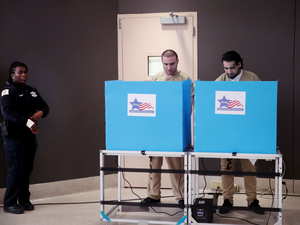
A Voter Assist Terminal in the Lansing Elections Office is tested prior to the August primary. July 20, 2026. | Photo by Katherine Dailey/Michigan Advance.
A Court of Claims ruling Tuesday granted a temporary restraining order instructing local clerks across Michigan to maintain the electronic pollbooks created in the Nov. 3 General Election until an underlying lawsuit brought by Bridgewater Township Clerk Michelle McQueer and the Michigan Republican Party can be resolved.
The electronic pollbook, or EPB, is “used for processing voters, generating precinct reports, and recording voter history at in-person polling places,” according to a manual for election officials published in 2024 by the Michigan Department of State.
Under current Michigan election rules, “electronic pollbook software and associated files must be deleted from all devices by the seventh day following the final canvass and certification of the election,” unless there is a pending recount or audit.
McQueer’s lawsuit centers on that rule and what she sees as its potential conflict with federal law, which states that election officers for any federal election must retain “all records and papers which come into his possession relating to any application, registration, payment of poll tax, or other act requisite to voting in such election” for 22 months after any general, special or primary election.
In late August, the Court of Claims issued a temporary restraining order directing McQueer to retain her electronic pollbook from Michigan’s August primary election and prevented the Michigan Department of State — the defendant in the lawsuit — from imposing penalties against her from doing so.
On Oct. 5, a motion from the Michigan Republican Party and Republican National Convention to intervene in the suit was granted but a request for another temporary restraining order, this time requiring local election officials to retain their electronic pollbooks, was denied.
Tuesday’s order, however, granted that statewide restraining order, citing that “The Court does not anticipate the full resolution of this matter before the General Election.”
“Defendants are directed to instruct all local election officials to retain the EPBs from the November 3 General Election,” the court order states. “The instructions must direct those officials to transfer the EPB from the precinct laptops onto the encrypted flash drives and then to securely store those flash drives until further order of this Court.”
Deputy Secretary of State Aghogho Edevbie explained at an August town hall in Ann Arbor how Michigan’s current policies align with federal law — through the use of a physical poll book that is retained for 22 months.
“Those flash drives and the information on those flash drives are backed up by paper, by the poll book,” he said. “For 22 months, every step is memorized in some paper form. There is no step in the process that you cannot recreate in 22 months under federal law.”
Republicans called the court order a victory over Secretary of State Jocelyn Benson, who is also the Democratic nominee for governor. However, the actual decision out of the Court of Claims on the legality of Michigan’s standing policy is still forthcoming, and that decision could be appealed.
“The Court of Claims did not rule on the merits or determine that the Bureau of Elections’ guidance conflicts with state or federal law. We are reviewing the ruling to determine our next steps,” Michigan Department of State Press Secretary Samantha May said in an emailed statement.
Macomb County Clerk Anthony Forlini, the Republican nominee for Secretary of State in the 2026 election, said in a news release following the ruling that Benson “has been consistent in her lack of transparency and avoidance of proper election law.”
“This one ruling will help restore confidence or expose what the Michigan Secretary of State office has been trying to hide,” Forlini wrote. “This order is temporary, and the underlying case remains unresolved. My position is straightforward: follow the court’s order, preserve the required records, protect sensitive information, and give our clerks the guidance they need to do their jobs properly.”

Lansing, MI