Fleming, Brown Reynolds compete to be Georgia’s next top elections officer
Oct 28, 2026 | 4:30 am ET
Description
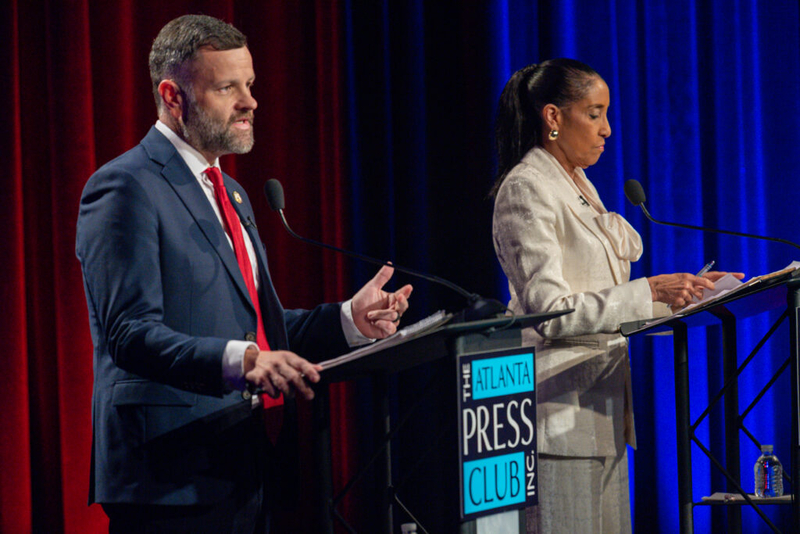
The two candidates for secretary of state, Republican Tim Fleming (left) and Democrat Penny Brown Reynolds (right) face off at a debate hosted by the Atlanta Press Club. Photo by J Glenn Photography
The race to become Georgia’s next top elections official is heating up as Election Day nears, and the two candidates on the ballot are offering starkly different visions for the future of voting in the Peach State.
On the Republican ticket is Covington state Rep. Tim Fleming, a two-term lawmaker and the former deputy secretary of state under then-Secretary of State Brian Kemp. He also currently serves on a special committee dedicated to helping select Georgia’s next voting system.
Democrat Penny Brown Reynolds is a former Fulton County judge, reality TV show star and member of the Biden administration. She helped lead the Office of the Assistant Secretary for Civil Rights in the U.S. Department of Agriculture.
The role soared to national prominence in the aftermath of the 2020 election when Republican Secretary of State Brad Raffensperger resisted President Donald Trump’s request to overturn his loss in Georgia. Georgia’s status as a battleground state means the next secretary will likely continue to administer elections with national consequences, including the 2028 presidential race.
Lawmakers weigh seismic changes to Georgia’s voting equipment
The next secretary of state will also be responsible for overseeing the implementation of Georgia’s new election system. The state’s decade-long contract with its current ballot-marking devices is coming to an end, and lawmakers are expected to select a new system during the 2027 legislative session.
Both nominees have pledged on the campaign trail to improve the state’s election system, but the two candidates are offering contrasting visions of what voting should look like in the future.
Fleming has been a staunch opponent of Georgia’s current ballot-marking devices, introducing a key amendment during the state’s June special session that requires the special election committee to focus exclusively on hand-marked ballot systems. He has also sought to restrict no-excuse absentee voting and “defend” the state’s voter ID laws.
Brown Reynolds has focused more on expanding voting access, pledging to defend absentee voting and coming out against the federal SAVE America Act, arguing that Georgia’s current laws already require voters to present their ID at the polls and prevent non-citizens from voting. She has also highlighted her mother’s experience as a poll worker, promising to expand voting rights and support local election officials.
With the potential for mid-cycle redistricting on the horizon in Georgia, Cathy Cox, a Democrat who served as Georgia’s secretary of state from 1999 until 2007, said that whoever leads the office will likely play a key role in carrying out the Legislature’s redistricting plans and defending them in court.
“There’s probably going to be some effort toward reapportioning legislative districts outside of the normal 10-year reapportionment cycle,” she said. “Those reapportionment efforts always go back to the Secretary of State’s office because the Secretary of State is the one who ultimately has to administer elections.”
Cox also said the secretary of state plays an important role in certifying election results for statewide races and turning federal results like for the presidential race over to the governor’s office for certification.
Efforts from the GOP-run State Election Board to delay certification of election results became a flashpoint of the 2024 election cycle, and the Trump administration has already sought to block certification of election results in states like Alaska if Republican candidates lose.
And in Georgia’s secretary of state race, perhaps more than any other contest on Georgia’s ballot this year, the memory of Trump’s efforts to overturn the 2020 election by urging Raffensperger to “find 11,780 votes” for him looms large.
Raffensperger’s refusal to overturn Georgia’s election results likely helped him gain support from Democrats and independent voters and defeat a Trump-backed GOP challenger in 2022.
Trump urges supporters to ‘pretend’ he’s on the ballot as he campaigns with Georgia Republicans
But Fleming has taken a different route, downplaying Trump’s claims of a stolen election in 2020 and appearing alongside the president during a recent rally in Dalton.
“I’m not here to relitigate 2020,” he said during an Atlanta Press Club debate earlier this month. “I’m here to focus on the future and focus on Georgians to make sure their right to vote is secure, fair, transparent and trusted moving forward.”
Brown Reynolds has sought to capitalize on Fleming’s close association with Trump, arguing that she wouldn’t hesitate to stand up to pressure from federal officials.
In a recent campaign ad, she highlighted Trump’s call with Raffensperger and pledged to “do what’s right for Georgia, no matter who’s calling.”
And during the Atlanta Press Club debate, she questioned Fleming for failing to oppose a March executive order from Trump that sought to restrict mail voting.
“He’s doing everything in his power not to be able to say ‘what Donald Trump did was wrong,’” Brown Reynolds said during the debate. “You need an independent Secretary of State, not somebody that’s running to Washington trying to get an endorsement.”
Fleming has doled out criticisms of his own, attacking Brown Reynold’s decision to resign from the bench before the end of her term as a Fulton County judge and film her reality TV show, “Family Court with Judge Penny,” which ran from 2008 to 2009.
“She chose Hollywood instead of Georgia,” Fleming said at Trump’s October rally in Dalton.
Atlanta, GA