Data center bans, a high-profile DA race and other things to watch for on Nov. 3
Oct 28, 2026 | 4:07 am ET
Description
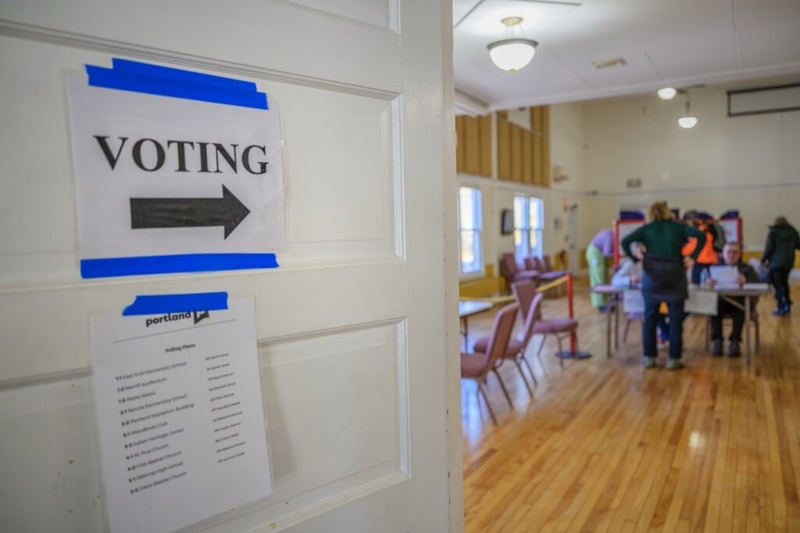
The polls at the Woodfords Club in Portland on Election Day, Nov. 4, 2025. (Photo by Jim Neuger/ Maine Morning Star)
Some feature candidates who do not fall neatly within party lines, or recently switched or disaffiliated from a party. That’s part of larger trends of Republicans trying to defy political headwinds during a midterm and attempts to reach beyond the two-party system as Americans increasingly ditch labels.
Depending on where voters live, they may be able to weigh in on several municipal or county-wide ballot questions, including on lot rent stabilization, restrictions on syringe service programs and bans on data centers and Flock cameras.
While at the polls, voters may also come across petitions to repeal recreational cannabis, publicly fund universal healthcare and restrict transgender rights in schools, which groups are seeking to get on ballots next year.
Here are some notable contests and questions:
Cumberland County district attorney
Current Cumberland County District Attorney Jackie Sartoris, a Democrat, is seeking reelection against independent Stephanie Anderson, who previously held the role as a registered Republican.
Anderson served as district attorney for 28 years, first elected in 1990. She is now a town councilor in Cape Elizabeth. Sartoris was first elected in 2022.
Coming out of retirement to run, Anderson has argued Sartoris has destroyed her legacy and endangered public safety. Meanwhile, Sartoris has claimed a return to Anderson’s leadership would set the district back after she’s made major progressive changes.
Sartoris has broadened the use of restorative justice programs, worked through a backlog of untested rape kits, and publicly shared her willingness to prosecute illegal use of force by federal immigration agents.
Some of that work has been opposed by police unions, who are backing Anderson, along with several attorneys. Meanwhile, Sartoris is endorsed by several city councilors and Democratic state legislators, including Speaker of the Maine House of Representatives Ryan Fecteau, as well as former Democratic candidates for national and statewide office.
While Anderson was district attorney, she was known for her toughness. She established Maine’s first drug court, juvenile unit and domestic violence unit.
Anderson has out-raised Sartoris, with $89,707 to $49,969 total contributions, respectively. Regarding independent expenditures, Sartoris has received more than $12,000 from the Working Families Party political action committee, and Anderson has received $6,400 from Bright Future Maine PAC.
Hancock County sheriff’s race
A local contest where party lines are blurred can be found in Hancock County.
On face value, a Republican is running against a Democrat for sheriff. However, cross party endorsements in the race paint a more complicated picture.
Three Democratic state legislators endorsed Republican Corey Bagley, a detective with the Ellsworth Police Department and former sheriff’s chief deputy, over Democrat Dakota Dupuis, who is currently a lieutenant at the Hancock County Sheriff’s Office.
In their endorsement letter, Reps. Nina Milliken of Blue Hill and Gary Friedmann of Bar Harbor and Sen. Nicole Grohoski of Hancock County pointed out that Dupuis only recently switched party affiliations and that the current sheriff, Scott Kane, a Republican, is supporting Dupuis. Whoever wins will replace Kane, who is not seeking a fourth term.
“As Democrats, we definitely expect to disagree with Bagley on policy positions down the road,” they wrote. “But we would not be serving our communities honestly if we failed to say this plainly: we believe Corey Bagley is the better choice for Hancock County Sheriff. Clear independence from the current sheriff, experience, good judgment, and leadership matter more than party branding in a race like this.”
Data center bans
After Gov. Janet Mills vetoed a temporary statewide data center moratorium, some could be coming on the local level.
Voters in Peru, a town in Oxford County, will decide whether to adopt a 180-day moratorium on data center development and permitting.
Wiscasset voters will get to decide whether to temporarily stop the town from accepting, processing, reviewing, or approving applications for new or expanded data centers. Unless lifted earlier or extended, it would expire six months after enactment.
Amid housing crisis, Maine mobile home residents make strides to protect themselves
In York County, voters in Wells will be asked if they want a 180-day moratorium on development of data centers 100,000 square feet or larger, and in North Berwick they will consider an outright ban on data centers larger than 25,000 square feet.
Lot rent stabilization
Several municipalities are considering ordinances to stabilize the cost of rent for mobile home lots.
Affordability is a concern for people in various types of housing across Maine, as a massive shortage in supply confronts stagnant wages, high building costs, and an influx of residents in part due to an increase in remote workers.
While mobile home residents often own their physical homes, they have to rent the underlying land, leaving them vulnerable to skyrocketing monthly lot rents, especially when corporate or out-of-state investors buy parks.
Augusta, Farmington, Jay, Wells and Wiscasset each have ordinances on their ballots.
In Augusta, the ordinance would cap annual lot rent increases at either 3% or the rate of inflation, whichever is lower. In Farmington, the measure would cap annual rent increases at 3% for occupied lots and 5% for vacant lots. In Jay, the ordinance would limit most mobile home park lot rent increases to the Northeast Consumer Price Index. In Wells, it would cap annual lot rent increases to the rate of inflation plus 1%. In Wiscasset, voters will decide whether to temporarily prohibit lot rent increases exceeding 3%.
State’s first peer-led harm reduction community center opens in Lewiston
Syringes
Lewiston voters will decide whether to implement restrictions on syringe service programs.
Lewiston has one of several syringe service programs in the state. They are aimed at harm reduction, offering sterile needles and other supplies and connecting people to services such as substance use treatment.
Currently in Lewiston, people can receive up to 100 clean needles per visit. The ballot question asks if Lewiston residents want to amend the program to mandate a 1 to 1 needle exchange with a 20-syringe daily limit per person, require each provider to operate from one fixed location and ban mobile units.
Portland rejected a similar proposal two years ago.
Flock cameras
As municipalities in Maine and across the country are increasingly relying on Artificial Intelligence for policing, some localities are considering bans.
Voters in York will decide whether to ban automated license plate readers, such as Flock cameras.
Auburn voters will eventually get to decide on their own petition to ban such cameras, but not until early next year in a special election. Over the summer, a group of bipartisan legislators collected enough signatures for the petition, which the city council decided in September to send to the voters (not enough time to put the question on the Nov. 3 ballot).
South Portland disabled and removed its Flock cameras in June following concern about data sharing and surveillance.
Circulating petitions
Voters may also come across people gathering signatures for several petitions at the polls because three statewide petitions are currently in circulation.
One seeks to roll back cannabis legalization (which signature gatherers have been accused of misrepresenting in the past).
Another would direct the Maine Legislature to develop a healthcare system that would ensure that all Mainers have “comprehensive, publicly funded healthcare coverage.”
And another would limit what sports and school facilities transgender students can access. It is a renewal of a failed attempt to get the initiative on the Nov. 3 ballot, after Maine’s highest court ruled the group did not clear the signature threshold.
Augusta, ME