Here’s what to know about potential election related litigation, here and beyond
Oct 26, 2026 | 9:00 am ET
Description
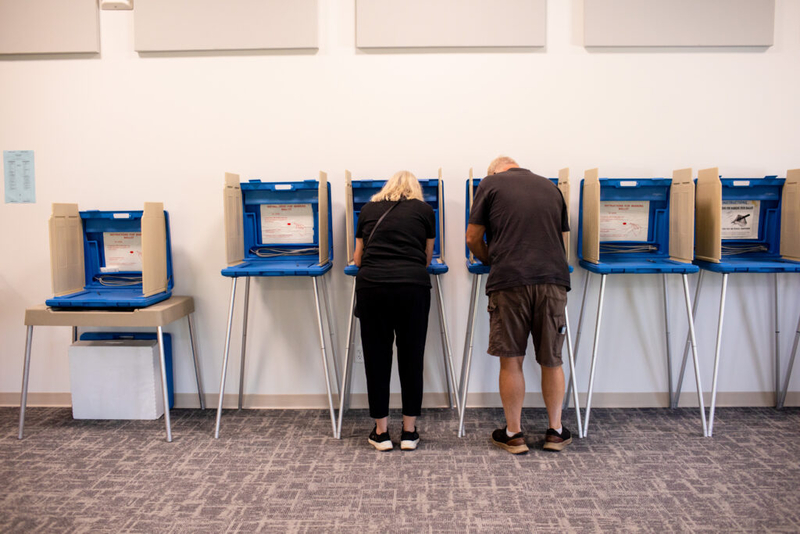
Voters cast their ballots at Webster Town Hall in Webster, Minnesota during the primary election Tuesday, Aug. 11, 2026. (Photo by Nicole Neri/Minnesota Reformer)
The U.S. Department of Justice sued the state of Alaska in federal court last week over its U.S. Senate election. In California, the DOJ appealed a lawsuit judgment against suspected noncitizen voters. These actions are part of a broader push by the administration to block and tackle their way to GOP electoral success in the midterms and beyond.
Last week, I listened to a briefing with the Democratic National Committee’s litigation team. During the first Trump term, the DNC began building out an in-house attorney’s office for the sole purpose of taking the GOP and Trump to court. This is a new role for in-house staff attorneys specialized in high-stakes civil litigation, many with government experience in voting rights protection. This also added capacity on top of the existing voter protection and general counsel teams. This effort could become highly significant this year; more on that in a minute.
Democrats in Minnesota and across the country are fighting legal brushfires in state and federal courts to stop illegal anti-voter actions and preemptively do their own blocking on potential future actions, like the DOJ litigation against Alaska, filed the day after our briefing.
In 2020, the days between the general election and Jan. 20 were highly litigated. We all remember the insurrection on Jan. 6, but there were also court fights trying to block Joe Biden’s earned victory. In all, the Trump campaign and allies filed 62 lawsuits in nine states, including Wisconsin and, infamously, Georgia.
In 2020, then-U.S. Attorney General Bill Barr sowed doubt in the election with false statements about voter fraud and authorized DOJ investigators to look into supposed “vote tabulation irregularities.” When DOJ investigators found nothing, Barr leveled with Trump, and which is how he became persona non grata.
Current U.S. Attorney General Todd Blanche — formerly Trump’s personal attorney — has been highly active in the voting sphere. When the DOJ acquired state voter registration rolls, it shared that data with the Department of Homeland Security for cross-referencing citizenship and immigration data in an unconstitutional and sloppy dragnet, sifting through the voting records of millions of Americans who exhibited no evidence of wrongdoing.
In Minnesota, Attorney General Keith Ellison has blocked the DOJ from acquiring the Minnesota voter registration roll, which would include private information not shared with candidates and political parties. A federal judge in the Minnesota district tossed out the DOJ lawsuit in August. The DOJ has not won a single case to acquire voter data when a litigant has opposed them.
The DNC is in a unique position as a national political party. The DNC is in association with thousands of candidates across the country in every state, from DFL candidates for school board to Jon Ossoff running for re-election to the U.S. Senate in Georgia. In 2025, the Supreme Court issued a judgment in Trump v. CASA Inc. that limits the ability of federal courts to block federal statutes and actions. In order to have a nationwide or universal relief (like a temporary injunction), a party must have nationwide or universal “equity.” In other words, they must be a stakeholder in the case everywhere. Because the DNC is the keystone committee of a national party with direct association with every Democratic candidate, the DNC litigation team can win a nationwide injunction.
If only Ossoff filed suit in his Northern District of Georgia in Atlanta, he could not individually have an injunction outside of the equity of his own campaign’s focused relief, whereas the DNC could win a national decision.
Looking to next Tuesday, Nov. 3, and beyond, we know that the DOJ will deploy 1,000 election monitors to polling places across the country, including in Minnesota. Likely there will be more DOJ monitors in Minnesota next Tuesday than there were for the August primary. By law, these election monitors are unarmed and they must stay at least 100 feet from the building of the polling place. They abided by the law in August. They may not enter the polling place and they may not interfere or harass voters in any way.
Ellison is deploying Minnesota’s own state monitors, who are also required to stay outside 100 feet. Essentially they are attorneys and staff with notepads and cameras, not falling under any special statute for this unprecedented situation.
Inside the polling place, under Minnesota Statute 204C.07, each major political party (the DFL and GOP this year) are allowed one challenger to represent their party at a specific polling place. Both the DFL and GOP have trained poll challengers, and they are assigned to polling sites in their communities or ones of special interest. Poll challengers must be residents of Minnesota, and they may not influence voters, as happened in the Tammany Hall days of bosses pointing where to mark. For the DFL, these poll challengers are the eyes and ears of the DNC litigation team, able to quickly send text-only messages to the switchboards in St. Paul and Washington.
As the name implies, poll challengers can contest the eligibility of a voter, but only on specific knowledge, not a drafted list of unwelcome voters. The voter has the ability to clear a challenge, and election judges of the precinct make that judgment. That is one of the reasons why Minnesota poll workers are called election judges, because in the most local sense, they are issuing rulings.
When you vote, you are going to court, the most local, democratic court. Your right to vote that day is being protected by your neighbors who are paid a few days a year and may have a potluck for lunch. They raise their right hands and take an oath at the opening of the polls that morning:
“I solemnly swear that I will perform the duties of election judge according to law and the best of my ability and will diligently endeavor to prevent fraud, deceit and abuse in conducting this election. I will perform my duties in a fair and impartial manner and not attempt to create an advantage for my party or for any candidate. I will not share information about voting that I know to be materially false and will not intentionally hinder, interfere with, or prevent a person from voting, registering to vote, or aiding another person in casting a ballot or registering to vote, except as specifically required by law.”
Some may add, “So help me God.”

Saint Paul, MN