Ayoub: Nebraskans can lead to close the fissure
Oct 26, 2026 | 6:45 am ET
Description
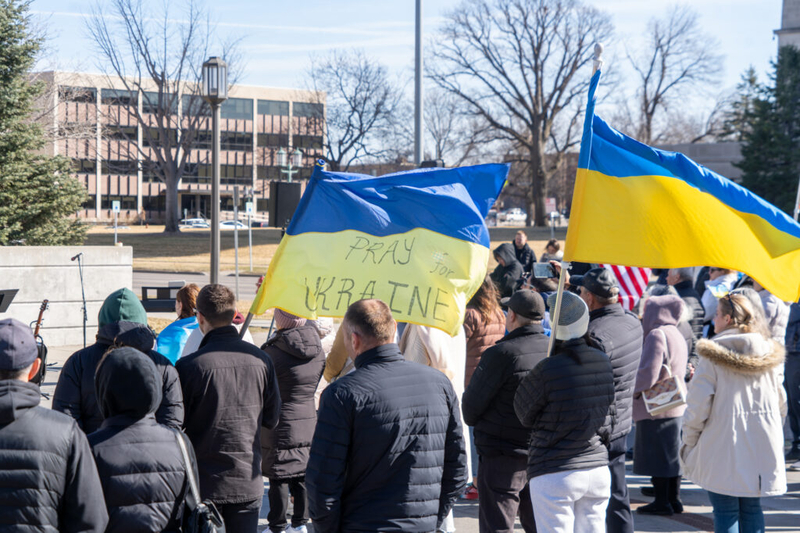
Supporters of Ukraine and the Ukrainian people gather outside the Nebraska State Capitol every Saturday to honor the homeland in its continued resistance to Russian invasion, including this weekend on Saturday, Feb. 28, 2026, marking the four-year mark of the war. (Zach Wendling/Nebraska Examiner)
We interrupt this election season to bring you a seismic, geopolitical event: We have met the enemy … and bought him a gift card. Written in Cyrillic.
What’s up with the president’s latest appeasement of Russia’s Vladimir Putin? The capitulation includes a diesel deal that will help fund its war with Ukraine and its support for Iran but do little to stanch the rising cost of fuel here, and an executive order bypassing a new wave of sanctions against Russia. The result was a windfall for Putin, money to aid a war with our ally and support Iran in its war with the U.S. — where American troops have been killed and injured.
Seriously? We are now carrying water for Russia? For those of us in a certain demographic — one which includes the real missiles of October — the idea addles the mind. This has less to do with “I never thought I would see the day” and more to do with “For the love of Mike, what are we doing?”
There’s more: The Wall Street Journal has reported that presidential pal Elon Musk purposely sabotaged Starshield, Ukraine’s first line of defense against Russian drones and critical to its own prosecution of the war. Musk has threatened members of Congress who are calling for an investigation. To roil the waters further, Reuters has reported that the decision to slow Starshield came from within the White House. Musk and the president deny any involvement, but late last week the WSJ said Trump had asked Musk to remove restrictions to Starshield. Bad business, indeed.
Finally, in an unctuous fit of senseless subservience, Special Envoy Steve Witcoff, during a meeting with Putin, praised him as a humanitarian, a farcical idea that has been widely ridiculed here. Perhaps Witcoff didn’t get the 2023 memo the rest of the world did, the one where the International Criminal Court issued an arrest warrant for Putin for kidnapping and transferring Ukrainian children to Russia, a war crime. That’s not to mention the ongoing killing of civilians in Ukraine, most recently a 14-month-old in a stroller in a public park.
Congress — you remember Congress — hasn’t been in session since Oct. 3 and won’t be back until after the midterms, when it will be populated with enough lame ducks that actual lawmaking may have to wait until a new Congress is sworn in in 2027. That may be too late for Ukraine … or for the rest of us.
Sixty percent of Nebraska’s congressional quintet is campaigning, but to the quintet’s credit, none of them sided with the president on waiving sanctions, diesel or undercutting an ally locked in a battle for its survival. Their political courage in this instance is noted and applauded.
Putin has suggested that he, the president and Chinese leader Xi Jinping meet in a summit to decide Ukraine’s fate. Wait, what? Thirty-two years ago, in signing the Budapest Memorandum, Ukraine gave up its nuclear arsenal, third largest in the world at the time, in exchange for security assurances from the U.S. Now we would consider its fate without a seat at the table?
Perhaps it’s the latent trauma of being sent home early from junior high during the Cuban missile crisis, so I might be incinerated among family and friends. This was after Russian Prime Minister Nikita Khrushchev had pounded his shoe on a desk at the Polish embassy in Moscow and declared, “We will bury you!” While history and alternative translations have tried to mitigate his threat, no one is disputing that six years later he sent nuclear-tipped missiles to Cuba. The result brought the world to the brink of an atomic war, terrifying seventh graders like me who knew cowering under desks while inside a 50-megaton blast radius was pure folly.
We then lived through glasnost, perestroika and the eventual fall of the Soviet Union in 1991. Eight years later Putin arrived, bringing with him a nostalgic view of the once mighty empire. His 2014 incursion into Crimea and the war in Ukraine underscore his view that Russia should return to its former bellicose self.
Sure, alliances change as do the political fortunes of countries. Consider Japan and Germany, our sworn enemies during World War II but now considered — or at least as many of us would like to believe — strong allies.
Nothing in its recent behavior indicates we should be playing geopolitical footsie with Russia, however. Its war with Ukraine and ongoing economic hardships have diminished the country in many regards, its nuclear arsenal notwithstanding. Still, its aim seems clear.
Meanwhile, when Congress does reconvene, perhaps Nebraska’s delegation can lead in putting party, partisanship or patronage aside and go about the business of closing a major fissure in the geopolitical world, lest it widen beyond repair.
Lincoln, NE