Ohio policymakers wrestle with prediction markets as wagers on sports and politics explode
Oct 23, 2026 | 3:50 am ET
Description
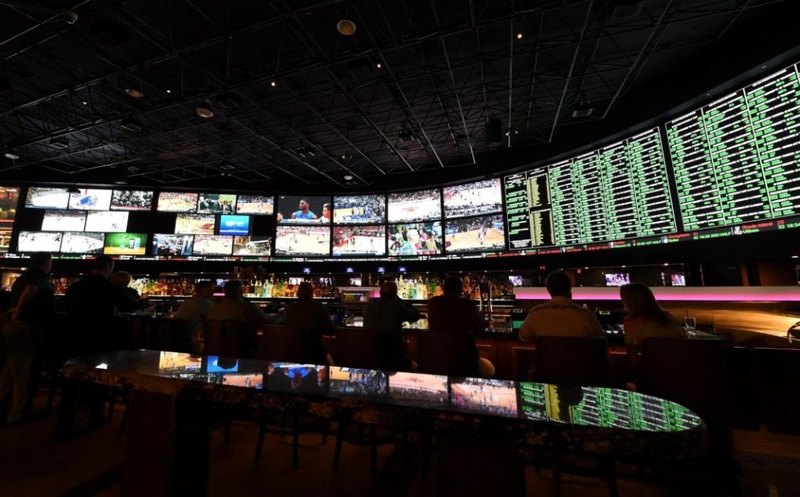
A casino sports book. Photo by Ethan Miller/Getty Images.
People wanting to know who will win a contest before it’s over isn’t new, but as Ohioans head to the polls this year, there’s a bit more prognostication than in recent elections. Political polling has been around for nearly a century, but in the past several years prediction markets have muscled in as another way to tap the wisdom of crowds.
Instead of surveying opinion, prediction markets let users put their money where their mouth is — placing bets on not just political contests, but sporting events, commodity prices, even the weather.
And bet they have.
On Polymarket as of Oct. 21, users had staked $1.4 million on the outcome Ohio’s U.S. Senate race and another $603,000 on the governor’s race. On Kalshi, users had bet $8.1 million on the Senate race and $3.6 million for governor.
Game six of Major League Baseball’s American League Championship Series between the Cleveland Guardians and the Tampa Bay Rays produced $22.1 million in bets on Kalshi. The National Football League matchup between the Cleveland Browns and the Pittsburg Steelers earlier this month? $119.5 million.
Those dollar figures are fueling anxiety among policymakers in Ohio and around the country. Ohio state Sen. Bill DeMora, D-Columbus, has filed legislation to treat sports transactions on prediction markets like gambling at any other sports book, and to ban bets on politics outright.
Kalshi and Polymarket are also the subject of dozens of federal lawsuits around the country, primarily for their role in sports betting. States typically regulate sports gambling and they stand to lose out on significant tax revenue if prediction markets can avoid oversight.
Cases have made their way up to eight different appeals courts, including the Sixth Circuit which covers Ohio. Opinions among those appellate courts don’t quite line up, though. So, earlier this month, Ohio Republican Interim Attorney General Andy Wilson led a coalition of 38 states urging the Supreme Court to settle the matter.
The litigation
The Sixth Circuit case dealt with a disagreement between district courts in Ohio and Tennessee. Prediction markets like Kalshi contend their customers aren’t so much betting as buying “swaps” — a financial derivative where two parties agree to exchange payments based on a real-world outcome. They’re typically used as way to hedge against financial risk, and they’re overseen by The Commodity Futures Trading Commission.
Kalshi argued the federal law granting the CFTC authority over event contracts like swaps means states can’t regulate its sports offerings. A federal court in Tennessee agreed, but another in Ohio rejected that argument.
Late last month, a unanimous Sixth Circuit panel sided with Ohio. The judges didn’t buy that Kalshi’s argument that their contracts meet the statutory definition of swaps, and even if they did, the CFTC’s jurisdiction doesn’t preempt state gaming laws.
“The States’ gaming laws do not directly target the licensing and operation of (prediction markets),” the court wrote. “They are thus not the sorts of laws that Congress sought to preempt, and their application to Kalshi does not subvert Congress’s goals.”
The Third Circuit, however, came to the exact opposite conclusion.
Wilson’s amicus brief in that case insists the courts are “hopelessly confused and divided,” and urges the Supreme Court to settle the matter. He cited conflicting appellate decisions in three circuits as well as an “incomplete sample” of more than two dozen lower court cases involving prediction markets.
“Like the circuits, these courts disagree not only about whether state law is preempted, but why — and how,” Wilson wrote.
The courts have previously determined regulating gambling is a core element of a state’s police powers. And while federal authorities regulate derivatives like swaps, Wilson contends, that doesn’t mean prediction markets should be able to sidestep state oversight.
“They cannot strip the states of their core sovereign power through relabeling and window-dressing,” Wilson wrote.
Wilson added that state restrictions like licensing, minimum age requirements and spending limits have been put in place to protect citizens. The prediction markets’ reading of federal law, he wrote, “threatens to wipe out all those critical protections.”
Ohio Capital Journal reached out to Kalshi and Polymarket for this story. Kalshi did not respond. In a written statement, a Polymarket spokesperson said simply, “Prediction markets are regulated by the Commodity Futures Trading Commission under a federal framework, not a patchwork of state rules.”
Ohio proposals
Following the Sixth Circuit decision, Ohio’s Casino Control Commission issued cease and desist orders to prediction markets operating in the state. The companies largely ignored them.
While market operators continue to insist on a distinction between their services and gambling, Ohio state Sen. Bill DeMora, D-Columbus, has introduced legislation to explicitly define their sports contracts as gaming.
“(The Sixth Circuit) decision solidifies that prediction markets are not exempt from Ohio law,” DeMora said in a statement, “and that they need to be regulated the same way other sports betting companies are.”
“Ohio is losing out on tens of millions of dollars every month by not regulating these sites,” he added.
In addition to Ohio Senate Bill 430, which brings prediction markets within the scope of sports gaming, DeMora has introduced Ohio Senate Bill 479 which prohibits betting on elections.
In the Ohio House, state Rep. Sean Brennan, D-Parma, has filed Ohio House Bill 887 which bars public officials and employees from participating in prediction markets, or disclosing privileged information relevant to a prediction market contract.
“With the rise of prediction markets in Ohio and across the country,” DeMora said, “this is not a partisan issue; it is one that needs to be addressed immediately.”
Follow Ohio Capital Journal Reporter Nick Evans on X or on Bluesky.
Columbus, OH