5 takeaways from Phil Scott and Amanda Janoo’s first debate of the campaign
Oct 22, 2026 | 10:10 am ET
Description
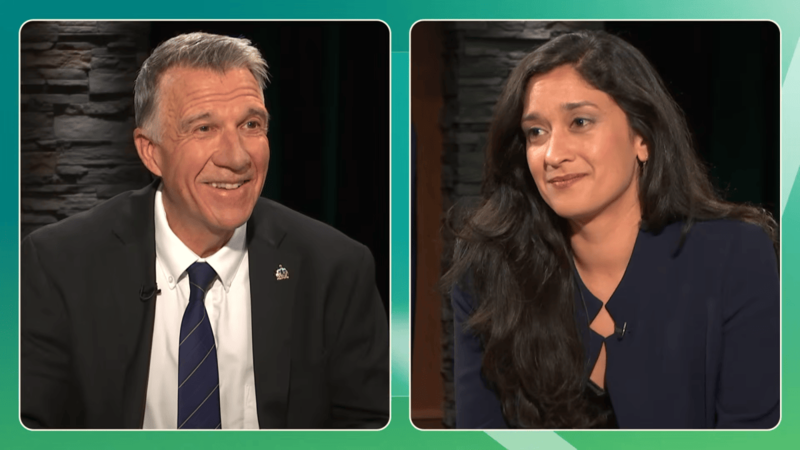
Vermont’s Republican Gov. Phil Scott and Democratic/Progressive challenger Amanda Janoo talk during their first debate of the 2026 campaign on Wednesday. Screenshot via Vermont Public/YouTube
Vermont’s leading candidates for governor agreed at their first debate of the campaign Wednesday that the state is facing a slew of challenges that make life unaffordable. But Republican Gov. Phil Scott and his Democratic and Progressive challenger, Amanda Janoo, presented at times polar opposite ideas for what to do about it.
The debate, hosted by Vermont Public, was friendly and did not appear to feature even one tense exchange between the candidates. But with less than two weeks until Election Day, the stakes are high: Recent polls and fundraising data suggest that this year’s race for governor could be the state’s most competitive in a decade.
Here are five takeaways from the hourlong forum.
The same playbook vs. a new one
Gov. Scott knows his greatest hits — and he’s hoping voters remember them, too. At the top of the debate, Scott invoked the major crises Vermont has weathered during his decade-long tenure, including the Covid-19 pandemic and the devastating floods in 2023 and 2024. The governor is banking that goodwill he’s enjoyed from voters across party lines for his leadership during those times will buoy him again this year.
“We’ve been through a lot together over the last 10 years. And while it hasn’t been easy, we’ve got some tough things done,” he said.
Scott said he has made affordability a campaign issue for years and so voters should trust that it will be top of mind for him again. What needs to change isn’t the state’s governor, he said, but the Legislature’s willingness to work with him more than it has in the past. For Scott’s part, “I’m not changing my style,” he said.
Janoo, an economist and government consultant who is running her first campaign, is pitching voters on a very different style. “We can’t solve our problems with the same thinking that created them,” she said Wednesday. She said she’s been asking voters across the state, “What do you think the government’s goals are right now? And people have no idea.”
Janoo wants to restructure the state’s economic system with a focus on redistributing the wealth it already has and improving people’s living conditions “from the bottom up.”
READ MORE
“The standard economic playbook that we’ve been using of just cutting taxes, deregulating industries, gutting and privatizing government services and trying to attract or appease the largest multinationals or big corporations, it’s not leading to the trickle down prosperity, I think, that we have been promised over the last decades,” Janoo said.
Taxes and healthcare dominated
When moderator Mikaela Lefrak asked Scott a question about how Vermont can make itself more attractive to new residents, the governor replied that “we need to do everything we can to reduce the tax burden.” He reiterated that he’ll propose a slate of tax cuts or credits to the Legislature if he gets reelected and said he doesn’t think the state’s tax system needs to be any more progressive than it already is.
Janoo, on the other hand, said that “we need more government strategic intervention to actually reduce” the cost of basic needs. She pointed to one of her signature proposals: raising taxes on the state’s wealthiest residents to generate revenue for new public services, top among them free primary healthcare for everyone. That would “fundamentally improve affordability,” she said, because healthcare expenses are a major reason it’s so hard for many people and businesses to make ends meet.
“We are at a moment where we can see that our healthcare system is collapsing. And it’s pretty clear at this point, like, a profit-oriented healthcare system is just a bad idea,” she said. “It’s a perverse incentive.”
Scott agreed that healthcare costs are a major issue but was skeptical of the viability of a universal primary care system, instead arguing the state should make less sweeping reforms like building on the executive order he signed earlier this year allowing Vermont insurers to price premiums partially based on age. He questioned why the state would pursue publicly-funded healthcare again after it tried and failed to do so in the 2010s.
“When you promote free healthcare, it’s hard to say no. But, there’s nothing free in this world,” he said.
Some details were left unsaid
To pay for her primary care plan, Janoo has cited modeling from Fair Share for Vermont, a lobbying campaign in Montpelier, which shows that surcharges on personal income over $250,000 could generate between $114 million and $344 million in annual revenue. Pressed by Lefrak about what she would do if that money wasn’t enough to create the system she wants, though, Janoo did not directly answer. She then said the state could start by piloting a program of publicly-funded doctors in just some towns.
At another point, in response to criticism from Scott that the math behind her plan to fund primary care with income taxes “doesn’t seem to work for me,” Janoo said that “the point here is less about, you know, this is the specific pot that we have to use.”
Scott later asked Janoo what salary she would propose paying doctors under a publicly-funded system; Janoo did not give a specific figure and said only in response that, anecdotally, she had heard from existing primary care doctors who would be OK making “the average salary” if they did not also have to deal with the private insurance industry.
Scott, for his part, did not directly answer a question from Lefrak about what his tax package would include. He said it would be geared toward people with lower and middle incomes and that, personally, he does not think social security payments should be taxed.
Trump wasn’t an issue (in this debate)
At the national level, President Donald Trump’s unpopularity, and the extent to which it will impact the outcome of races across the country, has been a major focus. But the president’s name was uttered just once in Wednesday’s debate, and in an unexpected way.
Asked by Lefrak to name someone from another political party whom she respects, Janoo picked Scott, saying the governor is “just super nice” and that she appreciates how he has not “followed along with a Republican, sort of like Trump, MAGA, fascist regime.” Scott, whom Lefrak directed the question to first, named the former U.S. Sen. Patrick Leahy and the late Vermont state Sen. Dick Mazza.
They disagreed on some other topics, too
Janoo did take aim at Scott in another instance, though. Asked by Lefrak what issue the Legislature spends too much time on, Janoo replied: “school consolidation.” The governor has hinged the last two legislative sessions on his efforts to reform the state’s school funding and governance structure, saying the state needs to centralize decision-making and that some schools will need to consolidate in order to save money.
READ MORE
Janoo said earlier in the debate that she thinks the state should improve the viability of small schools by locating more community resources at them, including health clinics, services for older adults and food banks. Scott said that his education plan will lower property taxes, which will address the broader affordability crisis, too.
In response to a question from Lefrak, Scott said he thinks a new “small-scale” nuclear power facility would help reduce energy bills in the state, while Janoo said she does not support any nuclear infrastructure. And, in another set of answers, while Scott reiterated his support for state employees coming into their offices three days a week, Janoo said she would allow them to work remotely as much as they wanted.
Vermont Public’s debate was the first of three televised governor forums in the leadup to the election on Nov. 3. NBC-5 will host a debate Thursday at 8 p.m., while WCAX will host one next Wednesday, Oct. 28 at 7 p.m.
Read the story on VTDigger here: 5 takeaways from Phil Scott and Amanda Janoo’s first debate of the campaign.
Montpelier, VT